Museums · 2026
Multimedia installations for the Museum of Memory
Museums / Multimedia installations for the Museum of Memory
About the project
Twenty-one multimedia installations for the Museum of Memory in Moscow: an introductory projection, interactive maps, touch tables, a screen on rails, a transparent screen and a content management system.
On 22 June 2026 the Museum of Memory opened in Moscow, on 1st Samotyochny Lane — a museum about the victims of the genocide of the Soviet people during the Great Patriotic War. Its exhibition of 18 thematic sections draws on materials from the “No Statute of Limitations” project, archive holdings and private collections; academic supervision was provided by the National Centre for Historical Memory under the President of the Russian Federation.
We worked as a subcontractor to the exhibition’s general contractor and produced its multimedia component: the introductory projection, 18 interactive applications, two sound installations and a system through which museum staff manage the content. Sets, dioramas and films with actors were not part of our scope.
Year
2026
Industry
Museums
Scope of work
21 multimedia installations and a content management system
Venue
Museum of Memory, 1st Samotyochny Lane, Moscow
- 21
- multimedia installations
- 18
- thematic sections of the exhibition
- 22.06.2026
- museum opening
The task
Each section of the exhibition needed its own way of presenting documents and figures: a map, a table, a screen in the wall, sound. Some of the applications had to pull materials from the memory portal and accept visitors’ stories about their families. All of it in two months: work under the contract ran from 15 April to 15 June 2026, with commissioning and staff training continuing until 19 June.
What we did
Introductory projection
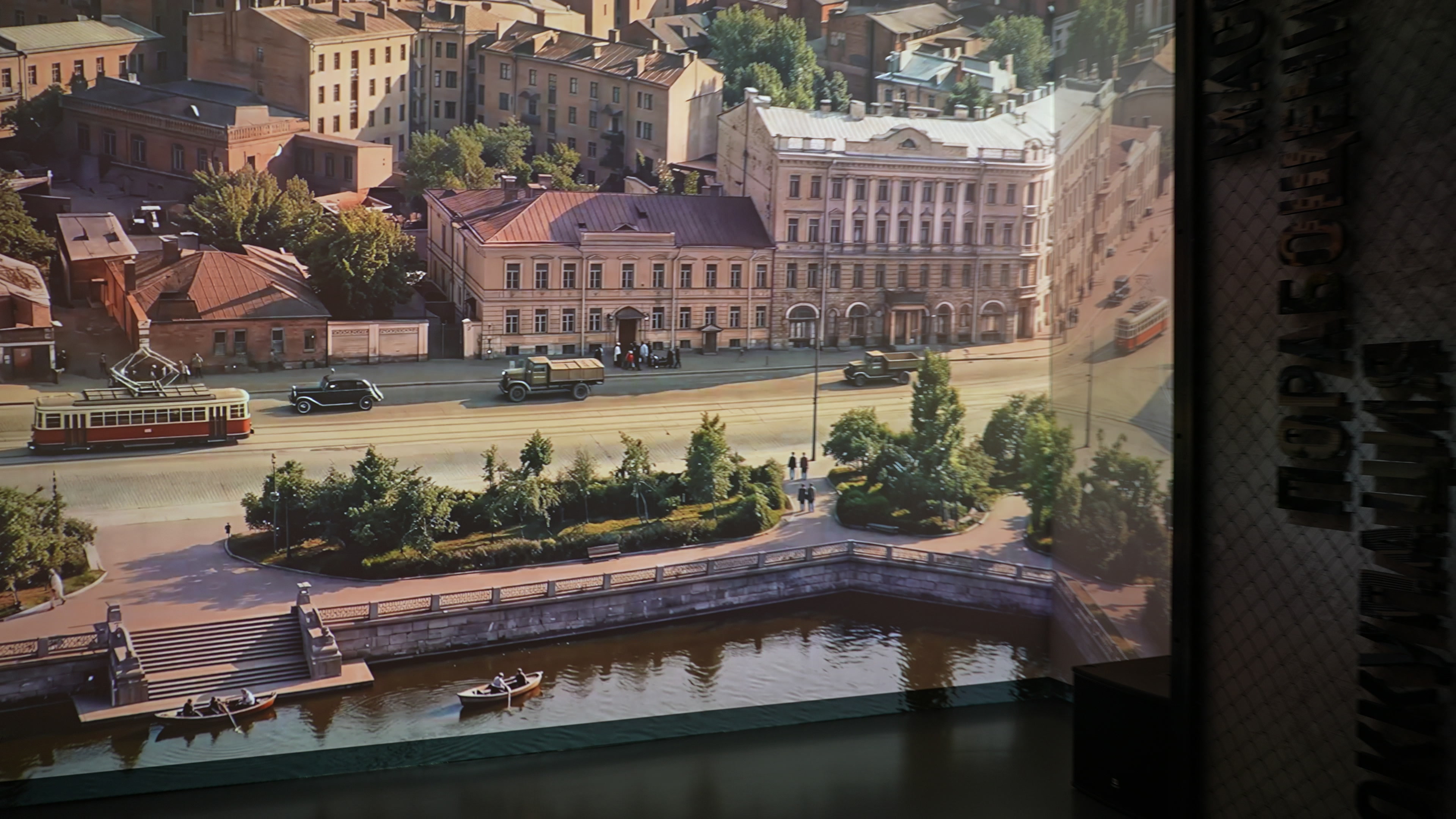
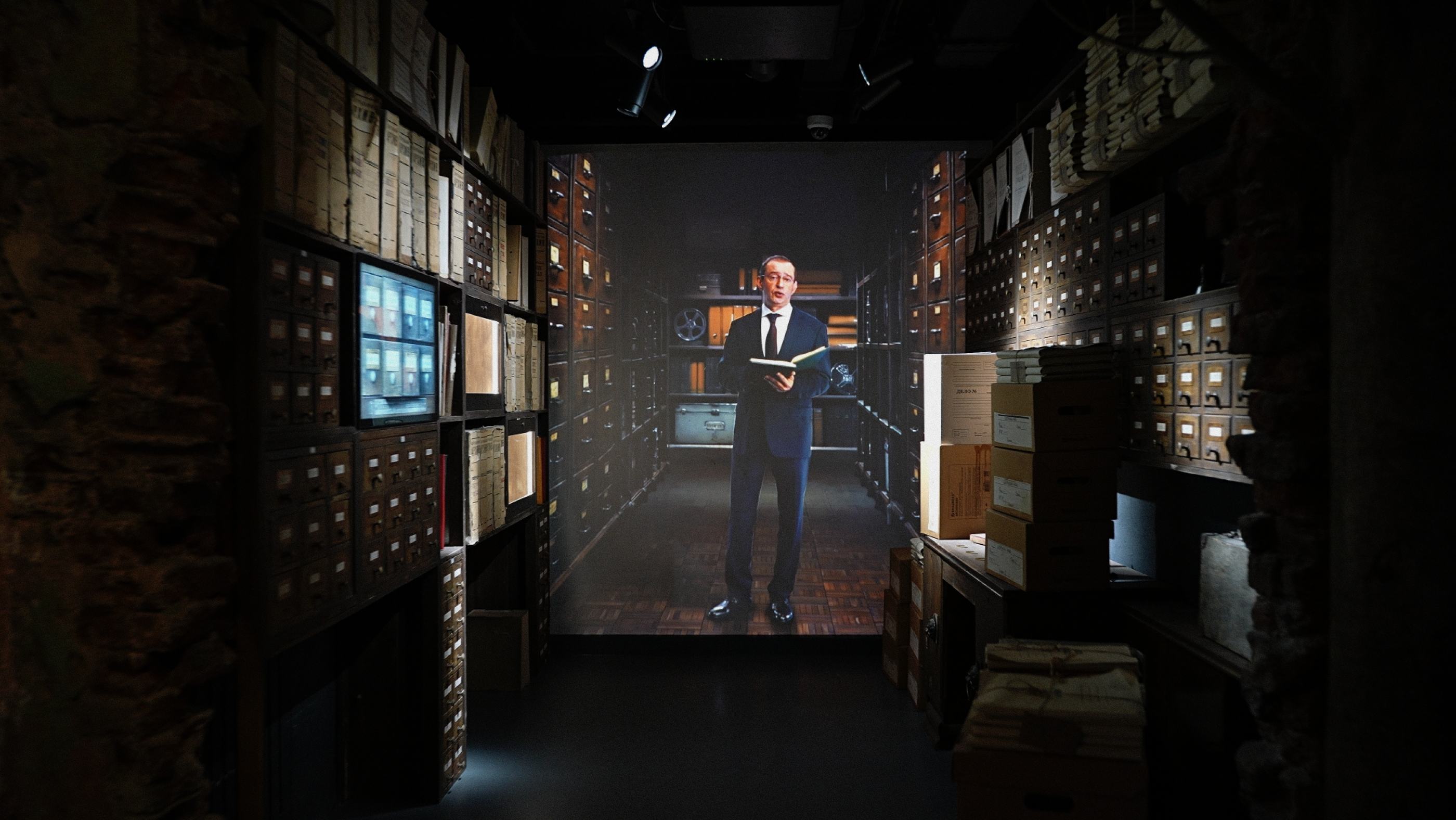
“Immersion in the museum’s theme” is a video projected onto a wall with two bas-relief windows: a peaceful Soviet city in the summer of 1941 gives way to war, and quotations from Nazi documents, the definition of genocide and the first figures appear on the wall. A guide starts the film; between screenings a holding loop plays. We did the direction, storyboards, 3D graphics and animation, sound and the playback software.
Generalplan Ost
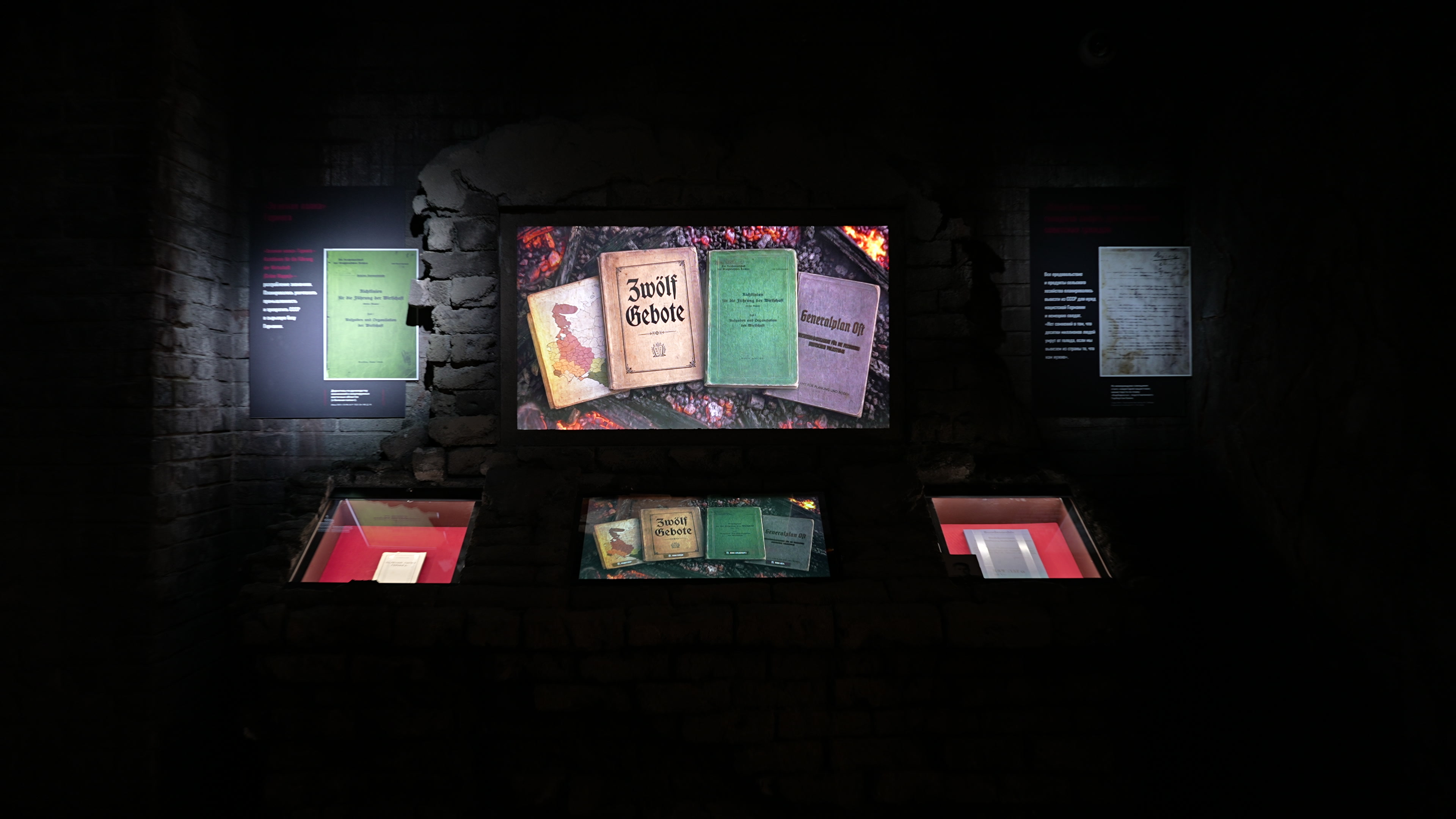
Two screens in a brick niche: on a touch screen built into a table, the visitor chooses a document — Generalplan Ost, the “Green Folder”, the “Hunger Plan” — or a map of the USSR divided into Reichskommissariats, then pages through it and zooms in; the selection is shown on a large screen above the display cases.
Sites of mass extermination
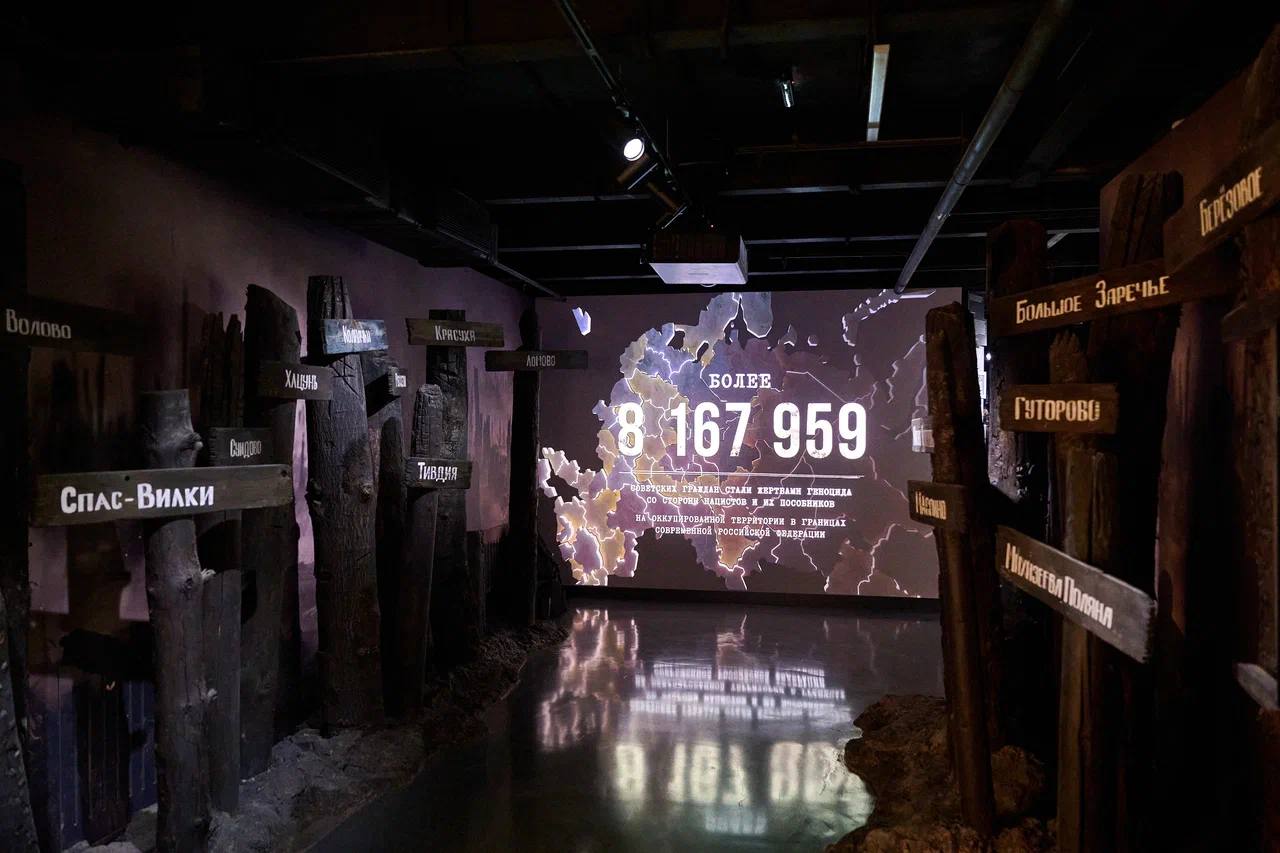
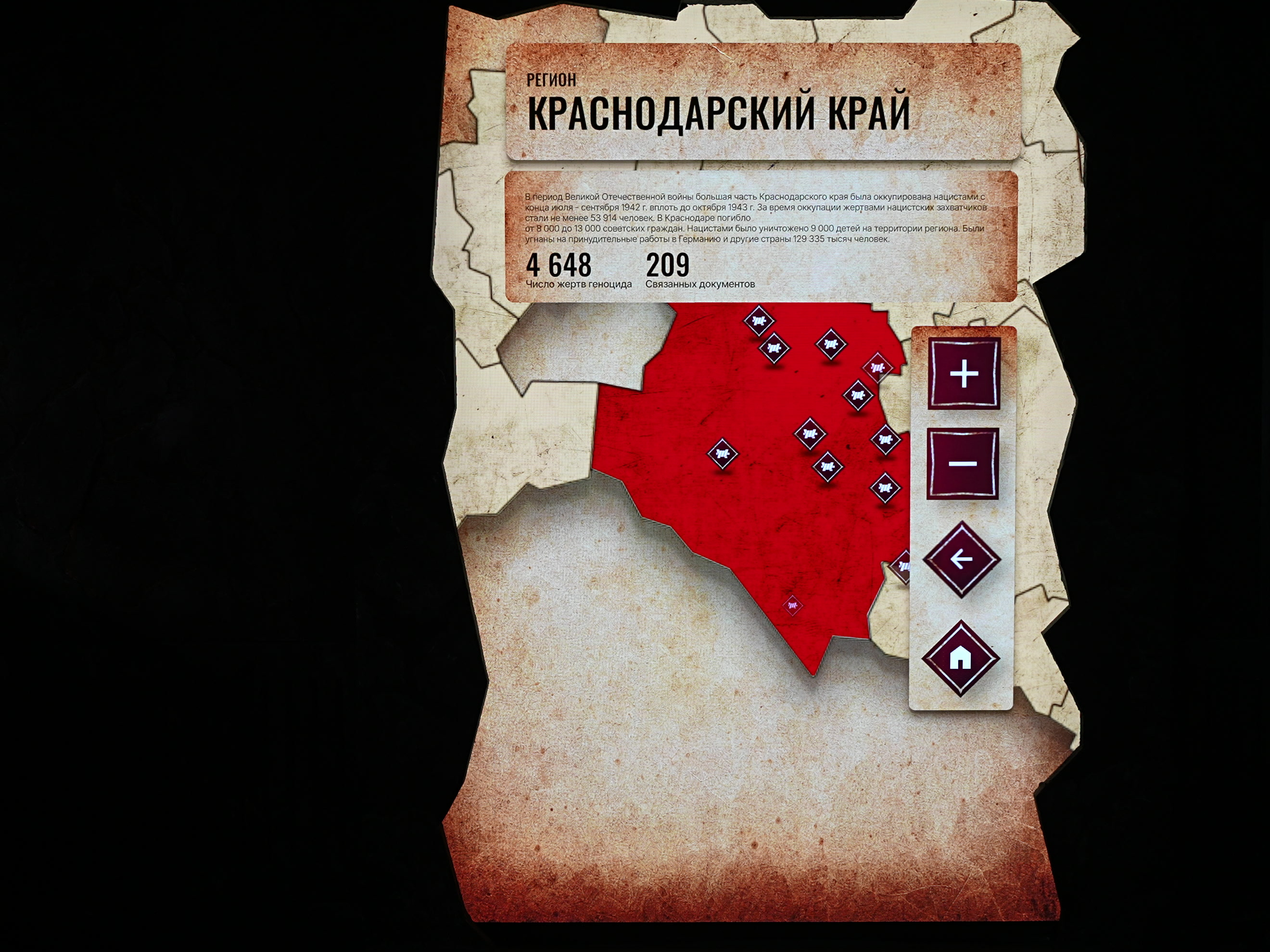
An interactive map shaped like a torn sheet: the visitor touches a region and the map shows the crime sites, the number of genocide victims and related documents. The region’s data is shown on an LED screen at the end of a corridor of charred posts bearing the names of burnt villages; in the overview it shows “more than 8 167 959” victims of genocide within the borders of present-day Russia. Next to it is the “Documents and materials” screen with digitised documents.
Personal stories
A screen with the sections “Personal stories” and “Mass killings”: a searchable catalogue of stories and a profile of each person with documents. Visitors submit their own family stories via a QR code; they appear on the screen after moderation.
Camps on the territory of the RSFSR
A touch map of places where civilians and prisoners of war were held, with search by surname; the selected camp is shown on a projection — location, type, period, number of prisoners, number of deaths. When a card with an RFID tag is inserted into a slot in the stand, a video with newsreel footage and infographics starts on the projection.
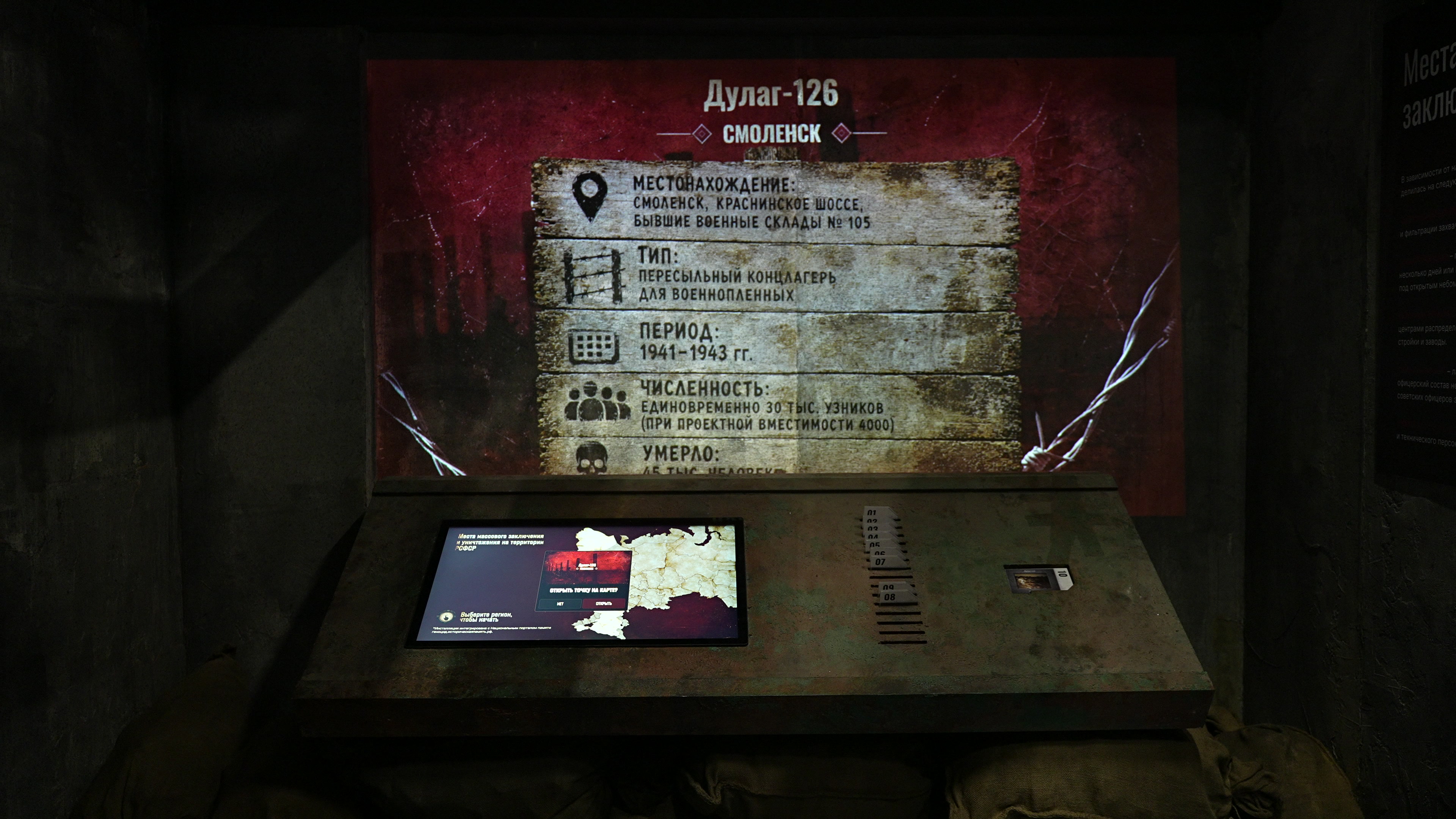
“Protections removed”
A table with a touch screen on which provisions of the Hague and Geneva Conventions open side by side with Third Reich orders on the treatment of Soviet prisoners of war — originals, translations, explanations.
Crimes against children
A vertical screen with the sections “Extermination of children in the occupied territories”, “Children as blood donors”, “Children in concentration camps” and a “Send your story” button. A soundscape of the medical room where blood was taken from children.
Deportation into slavery
“Deportation map” is a vertical touch screen on rails set into the wall of a railway wagon: the visitor moves it by a handle along a map on the wall, chooses a region and sees how many people were deported from there and where to. “Slave trade: the Königsberg exchange” is a 4K touch screen in the form of a board with the cards “Slave trade in Königsberg”, “Hard labour in captivity” and “Traces of deported Soviet citizens”. “Ostarbeiter letters” is a screen in a shelving unit with the sections “Archival documents”, “Censorship and regulations” and “People’s stories”: letters shown front and back, with transcriptions and censors’ marks.
The Siege of Leningrad
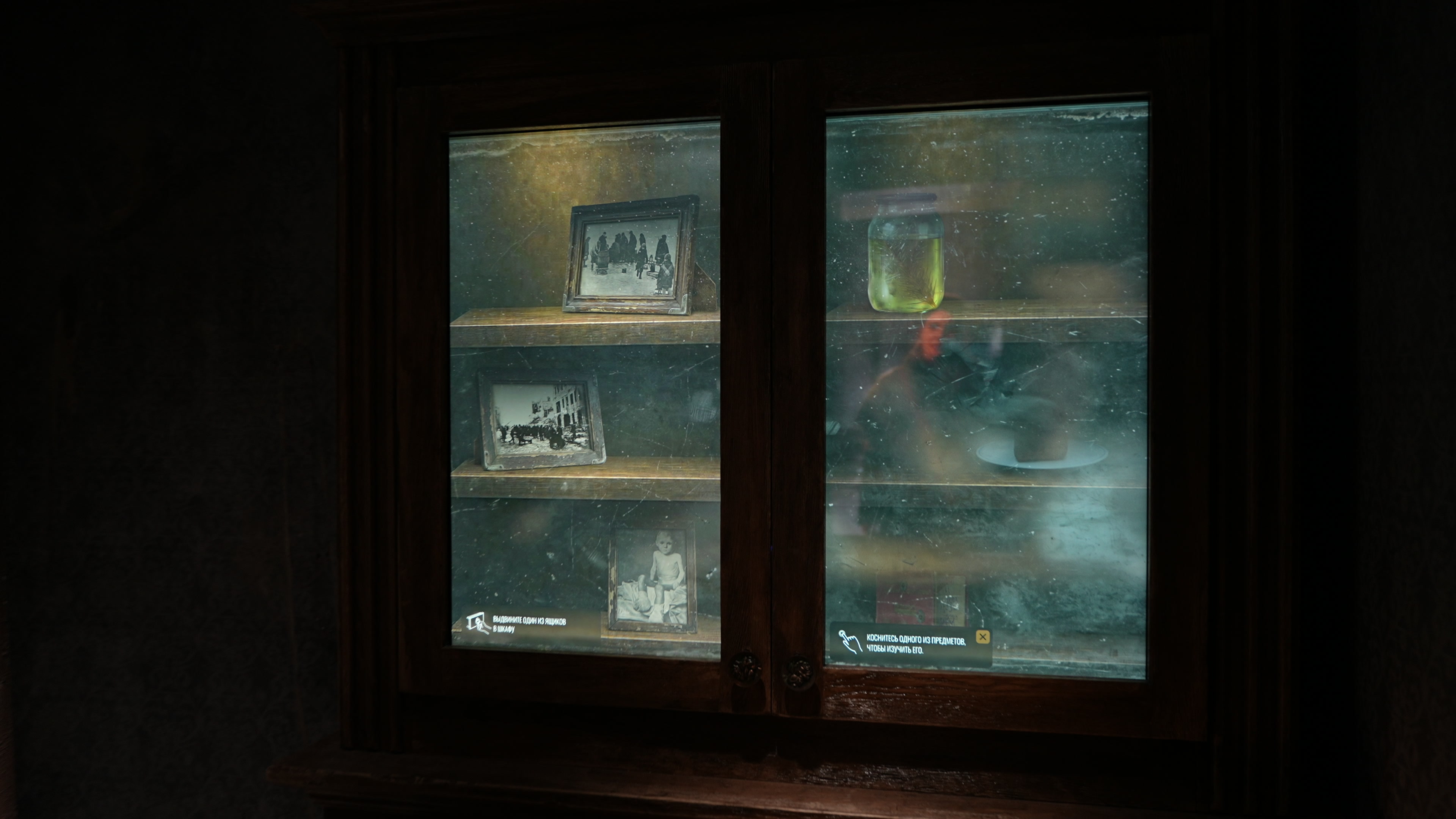
A sideboard in a flat during the siege, with two screens in its glass doors: the visitor pulls out a drawer or touches an object on a shelf, and its story opens. Software for a mirror: on a signal from a sensor, a video account of life in the besieged city begins in it. Doorbells: pressing one plays one of five audio stories — we also recorded and mixed them.
Losses of museums, libraries and archives
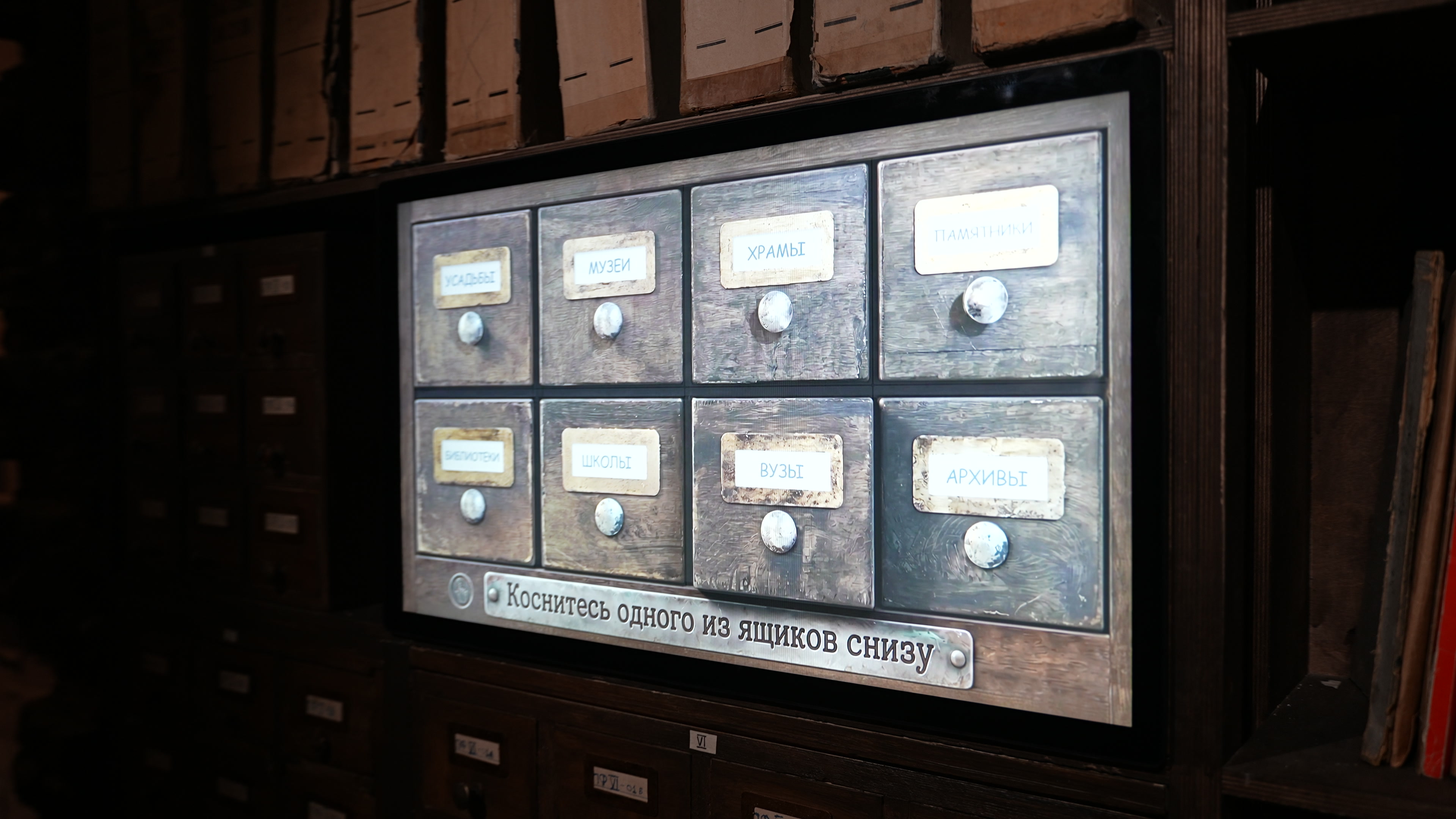
A card-index screen in archive shelving: eight “drawers” — country estates, museums, churches, monuments, libraries, schools, universities, archives; a section opens when the visitor touches a real drawer under the screen.
Europe
“Nazi plans for Europe” is a touch table with a relief map and a timeline in two sections: “The Wehrmacht’s step-by-step conquest of Europe” and “The Red Army’s step-by-step liberation of Europe”; the projected map on the wall changes along with the table. In “Scales”, the visitor places one of three objects on the scales and the screen tells them what it is made of.
Japan
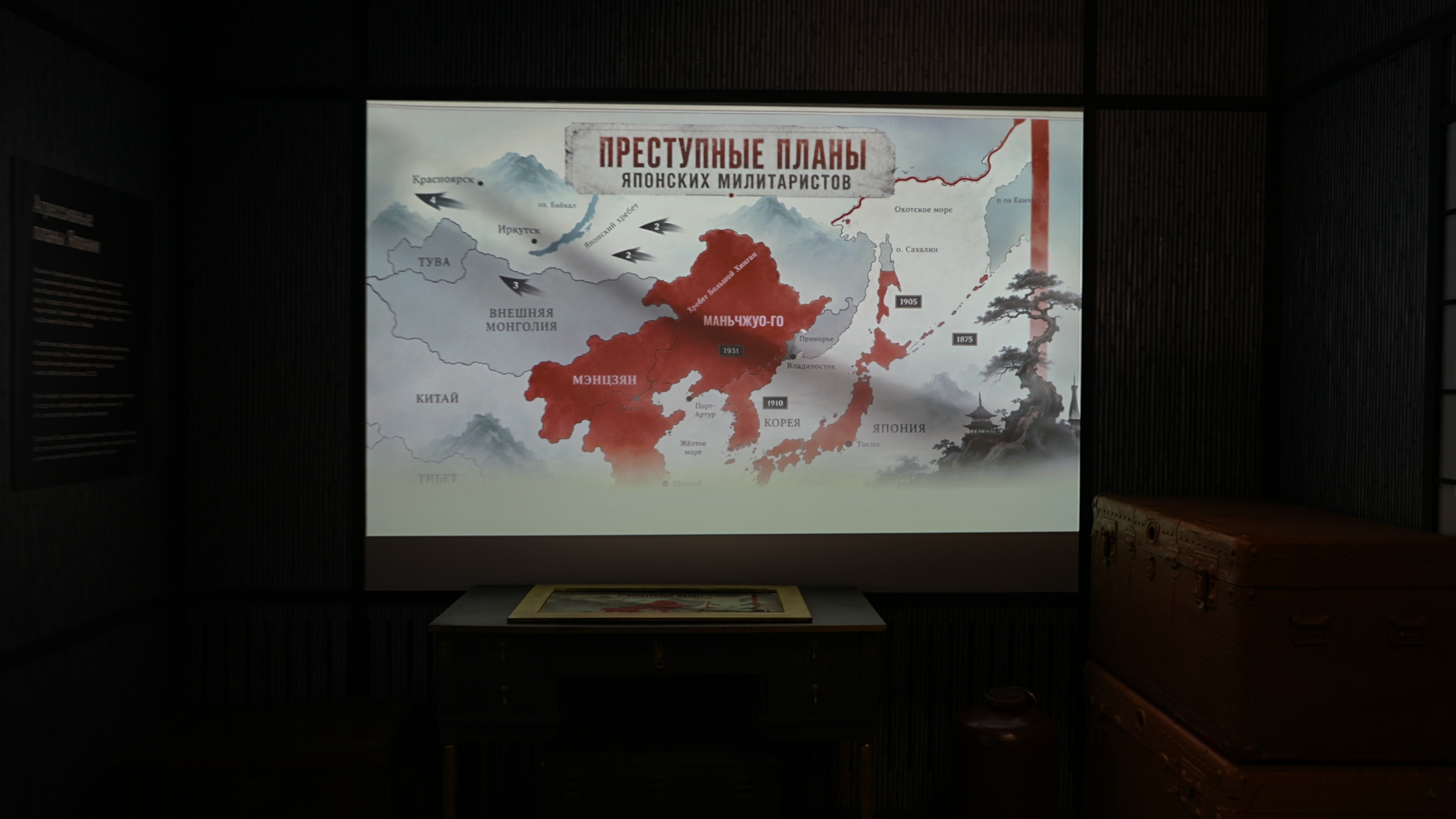
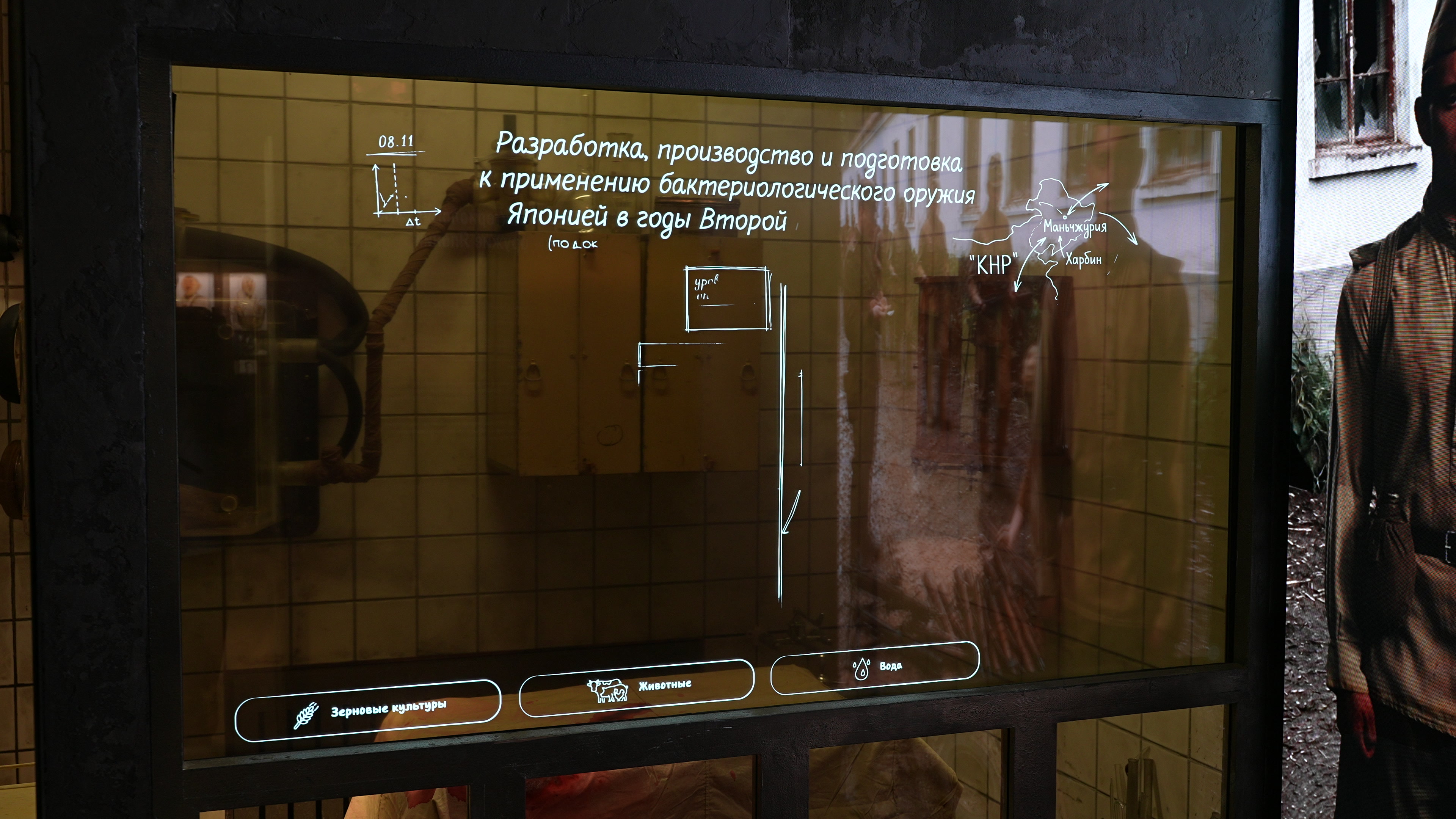
“Criminal plans of the Japanese militarists” is a touch table and a projected map of East Asia with the sections “The Greater East Asia Co-Prosperity Sphere”, “Soviet policy in the Far East”, “The ‘Kantokuen’ plan” and “Crimes against the population”. A transparent touch screen in front of a reconstructed laboratory tells of Japan’s development of bacteriological weapons: three topics — grain crops, animals, water — with a video for each.
Russia — successor to the USSR
An application, installed in two copies, about what has been done to preserve memory since 1945: the folders “Legislative framework” and “National memory portal”, with laws ranging from the 1995 law on days of military glory to the 2025 law on perpetuating the memory of the victims of genocide.
Content management system
Museum staff change the texts, photos and videos in all the applications themselves and can see whether the screens are working. Materials come from the memory portal and are stored on site, so the screens keep working without a network connection.
How it is built
The introductory projection consists of three projection areas blended into a single image, with geometry correction for the bas-reliefs and multichannel sound; playback runs from a media server.
Touches on the map of extermination sites are detected by an IR frame; the region’s data is shown on the LED screen in sync.
RFID tags are in the camp cards and in the three objects for “Scales”; sensors are in the drawers of the sideboard and the card index and by the mirror; buttons are in the doorbells.
The “Deportation map” is a screen on a rail system; the interface works in any position of the screen.
“Nazi plans for Europe” and “Criminal plans of the Japanese militarists” each consist of two linked applications: the touch table controls the projection on the wall.
The transparent touch screen is 3840×2160: the reconstructed laboratory is visible through the interface.
All applications take materials from the shared management system, keep a copy on site, start up on their own and return to standby mode.
Result
The museum opened on 22 June 2026, the Day of Remembrance and Sorrow; it has received visitors since 23 June, with guided tours every hour from 12:00 to 20:00. The exhibition covers 1,700 m².
Similar projects
-
 Software and videos for the Amur Dinopark
/2026 — Museums
Software and videos for the Amur Dinopark
/2026 — Museums
-
 Undory Palaeontological Museum
/2026 — Museums
Undory Palaeontological Museum
/2026 — Museums
-
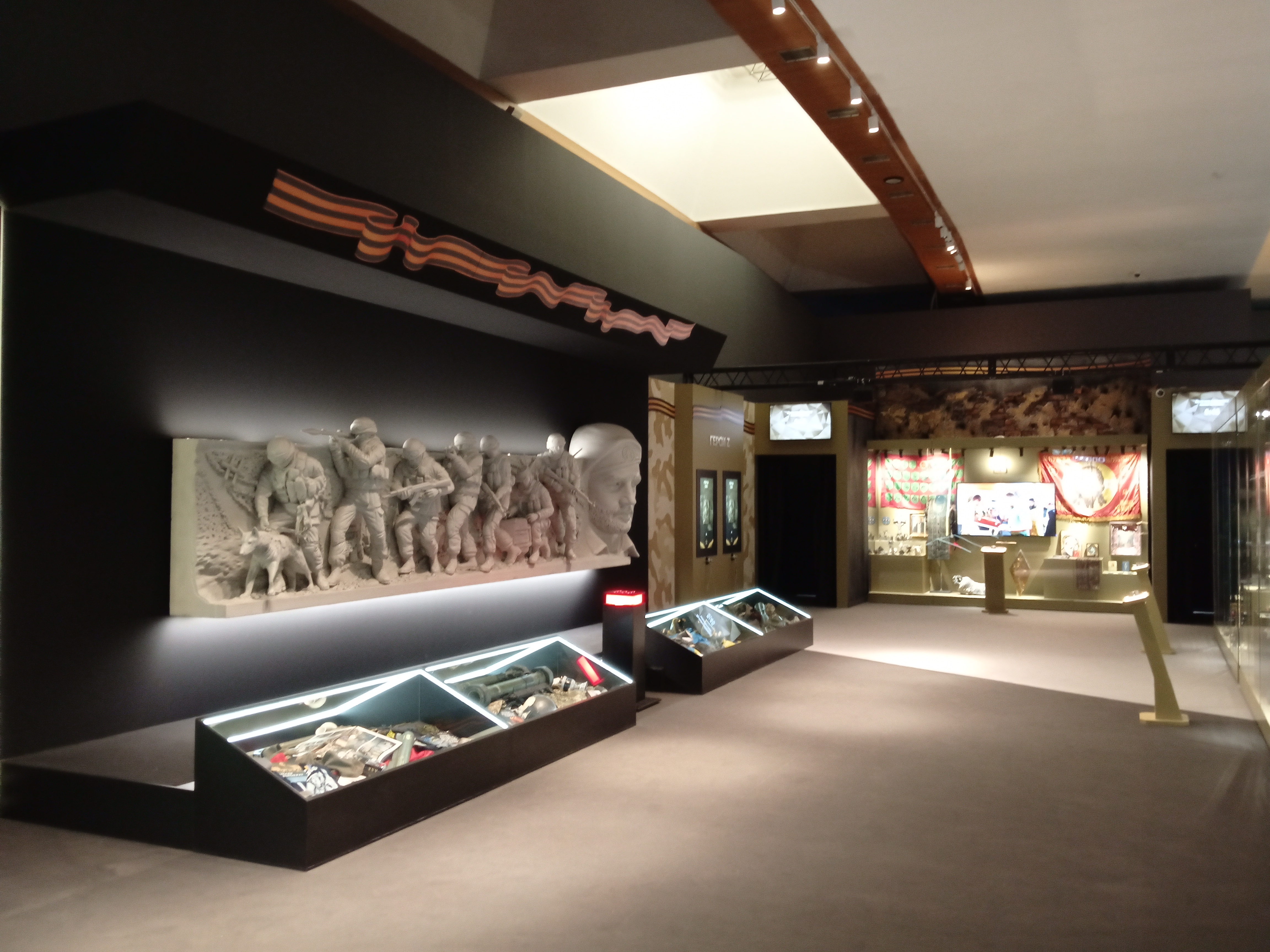 Updating the applications of the “Special military operation. Defenders of the Fatherland” exhibition at the Victory Museum
/2026 — Museums
Updating the applications of the “Special military operation. Defenders of the Fatherland” exhibition at the Victory Museum
/2026 — Museums
-
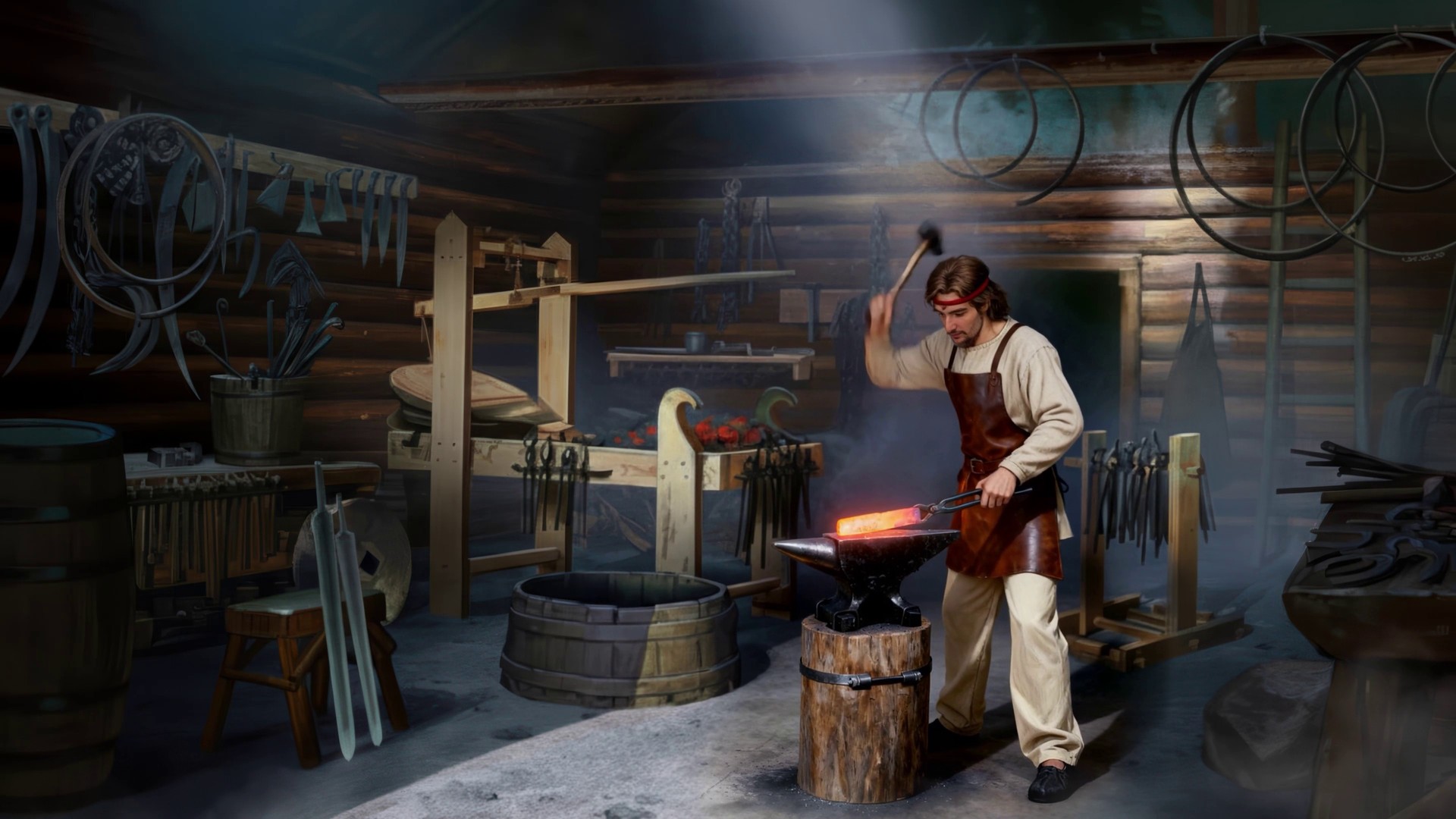 Ryazan History Museum. “Two capitals”, “The book in the Age of Enlightenment”, “Folk costume”
/2026 — Museums
Ryazan History Museum. “Two capitals”, “The book in the Age of Enlightenment”, “Folk costume”
/2026 — Museums