Museums · 2026
Ryazan History Museum. “Ryazan Governorate”
Museums / Ryazan History Museum. “Ryazan Governorate”
About the project
Software, videos and interactives for the “Ryazan Governorate” section of the new history exhibition at the Ryazan History Museum, opened in March 2026.
On 13 March 2026, a new permanent history exhibition opened at the Ryazan History Museum — the Museum Centre of the Ryazan Historical and Architectural Museum-Reserve on Sobornaya Street: more than 4,500 objects from the museum's collection across over 1,000 m², in four sections. The section “The Russian provinces in the imperial era. Ryazan Governorate” tells two hundred years of the history of the Russian Empire through Ryazan material.
For this section and the museum's entrance area we made software for 27 installations — projections, touch screens, interactive objects — together with the videos and animations for them and a system through which the museum updates the materials itself.
This is the first stage of our work at the museum. The multimedia for the sections “Two capitals of the Principality of Ryazan”, “The book in the Age of Enlightenment” and “Ryazan folk costume” was our second stage — a separate project.
Year
2026
Industry
Museums
Scope of work
27 interactive and video installations, a content management system
Venue
Ryazan History Museum, Ryazan
- 27
- installations running our software
- 20
- crafts on the interactive map of the governorate
- 13.03.2026
- exhibition opens to visitors
The task
The installation scenarios came from the general contractor. Working from them, we had to produce the software and content for the whole section — from the entrance area to a townsman's “flat” — and get everything running on site. Almost every installation has its own way of control: a button, a rotary knob, a potter's wheel, a book page, a touch screen, a camera. The museum had to be able to change and add materials on its own, without developers.
What we did
Entrance area. “Famous natives”
Two groups of three seamless screens, each group with a lidar above it: the lidar switches between modes — the museum's posters and announcements, the logo, stories about famous people from Ryazan. The third installation in the entrance area is an interactive wall about famous natives with an event announcement mode.
Rotunda. “The coronation book”
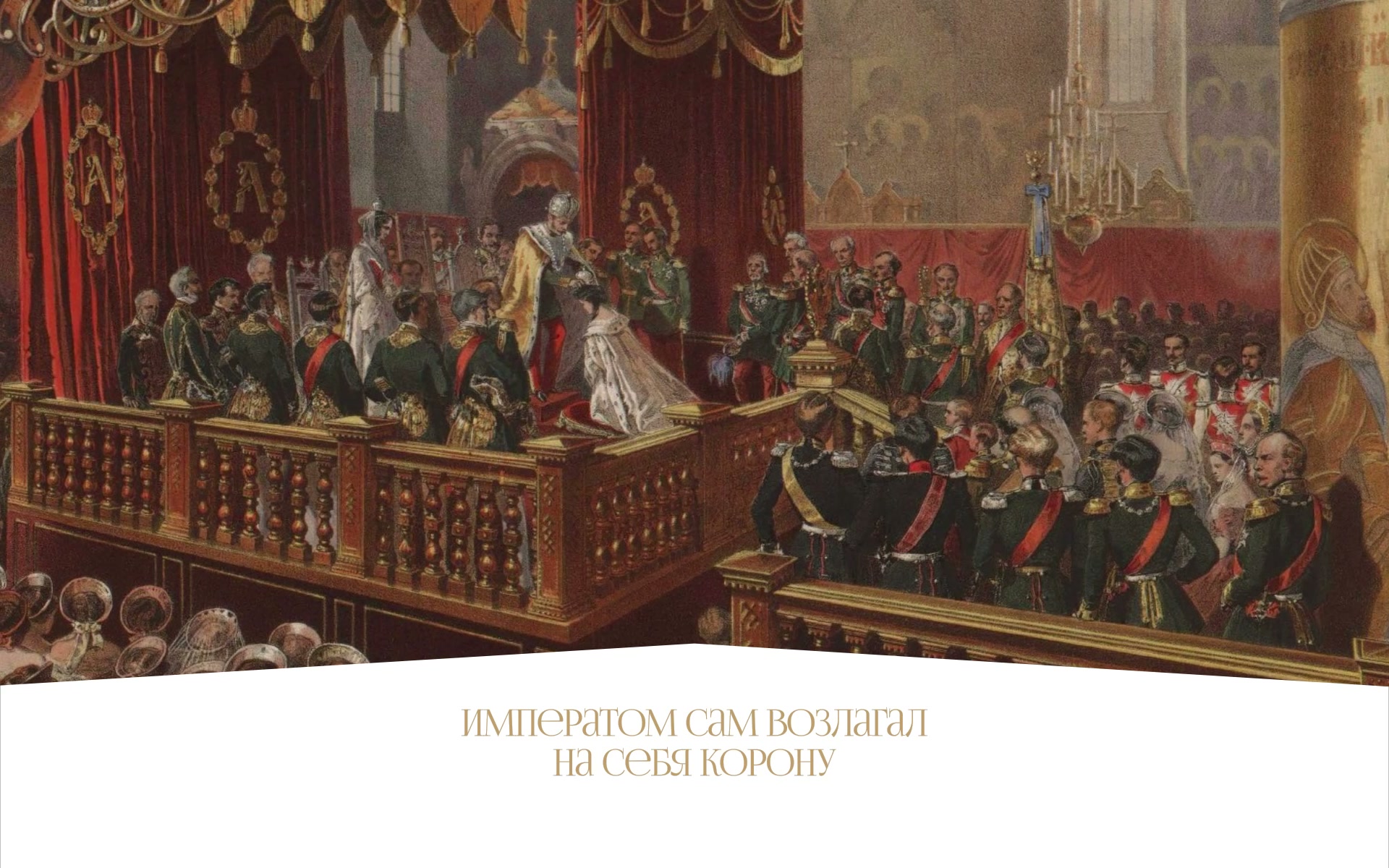
A book with projection based on the 1856 coronation album of Alexander II: the visitor turns the pages, and an illustration from the album comes to life on the spread — the order of the ceremony, the arrival in Moscow, the crowning, the anointing, the public festivities, the fireworks.
“Peter I. Reforms”
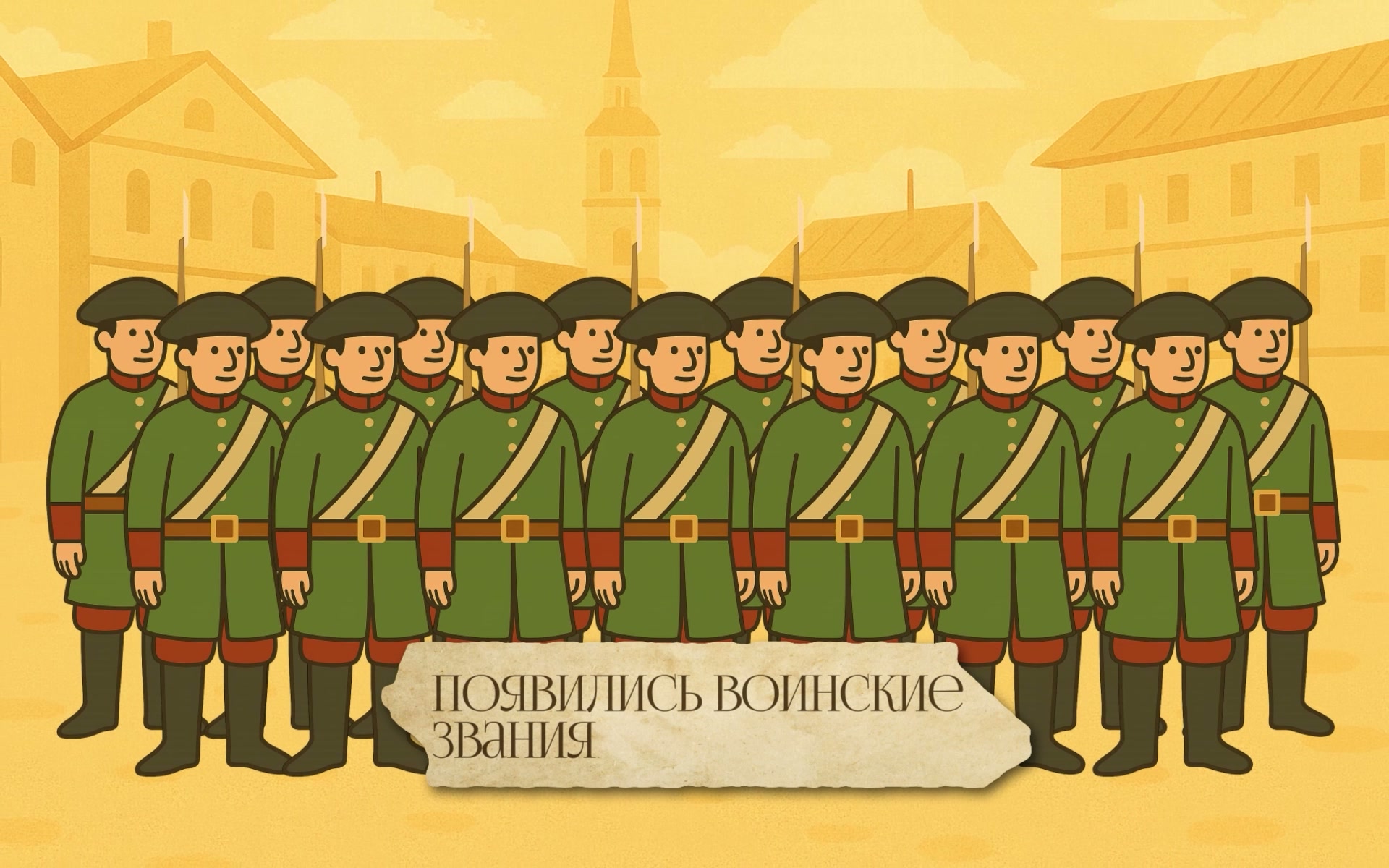
Projection onto frames on the wall and a table with objects: the visitor touches an object, and an animated video about one of the reforms — military, economic, educational or church — starts in its frame.
“Wars of the Russian Empire”
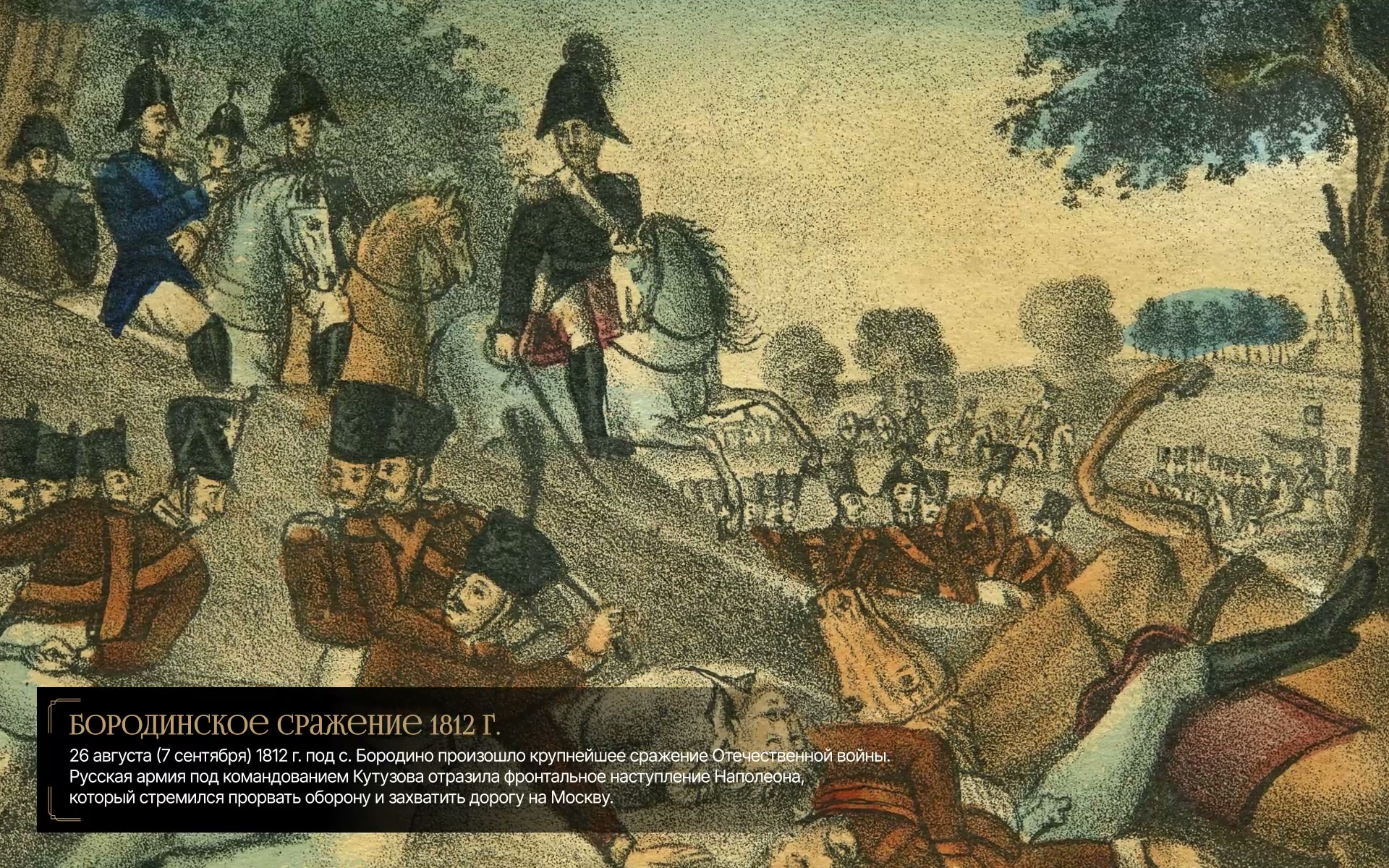
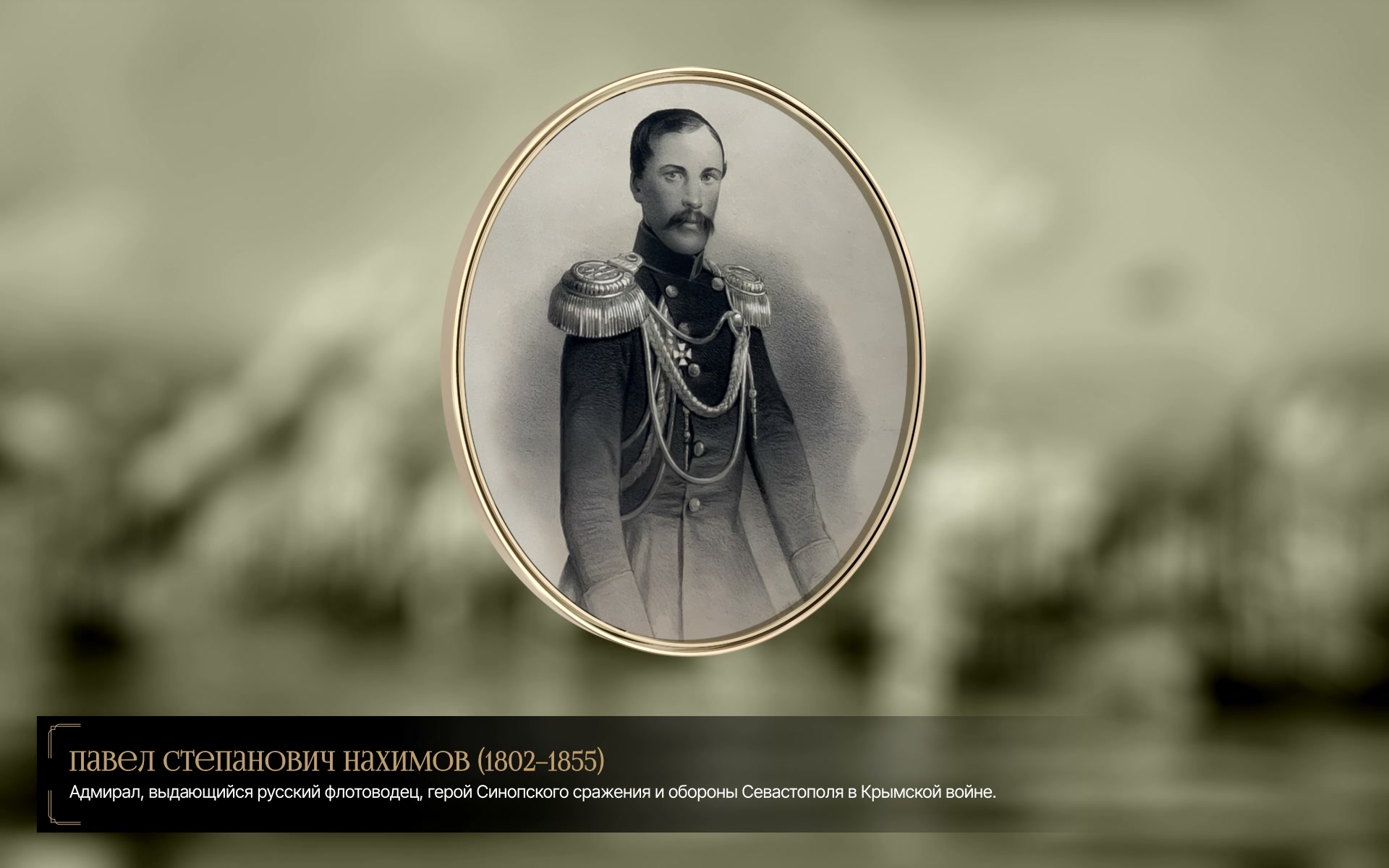
Two projections with buttons: the battles of the Patriotic War of 1812 — from Smolensk and Borodino to Napoleon's flight — and the wars of the mid and late 19th century — Sinop, the defence of Sevastopol, the crossing of the Danube, Plevna and Shipka — with portraits of the commanders. Next to them is a touch-screen game, “Changes in military uniform”: the visitor chooses a soldier, studies the details of his uniform, answers questions and at the end has a photo taken “in uniform”, collecting it via a QR code.
“Catherine II. The nobility”
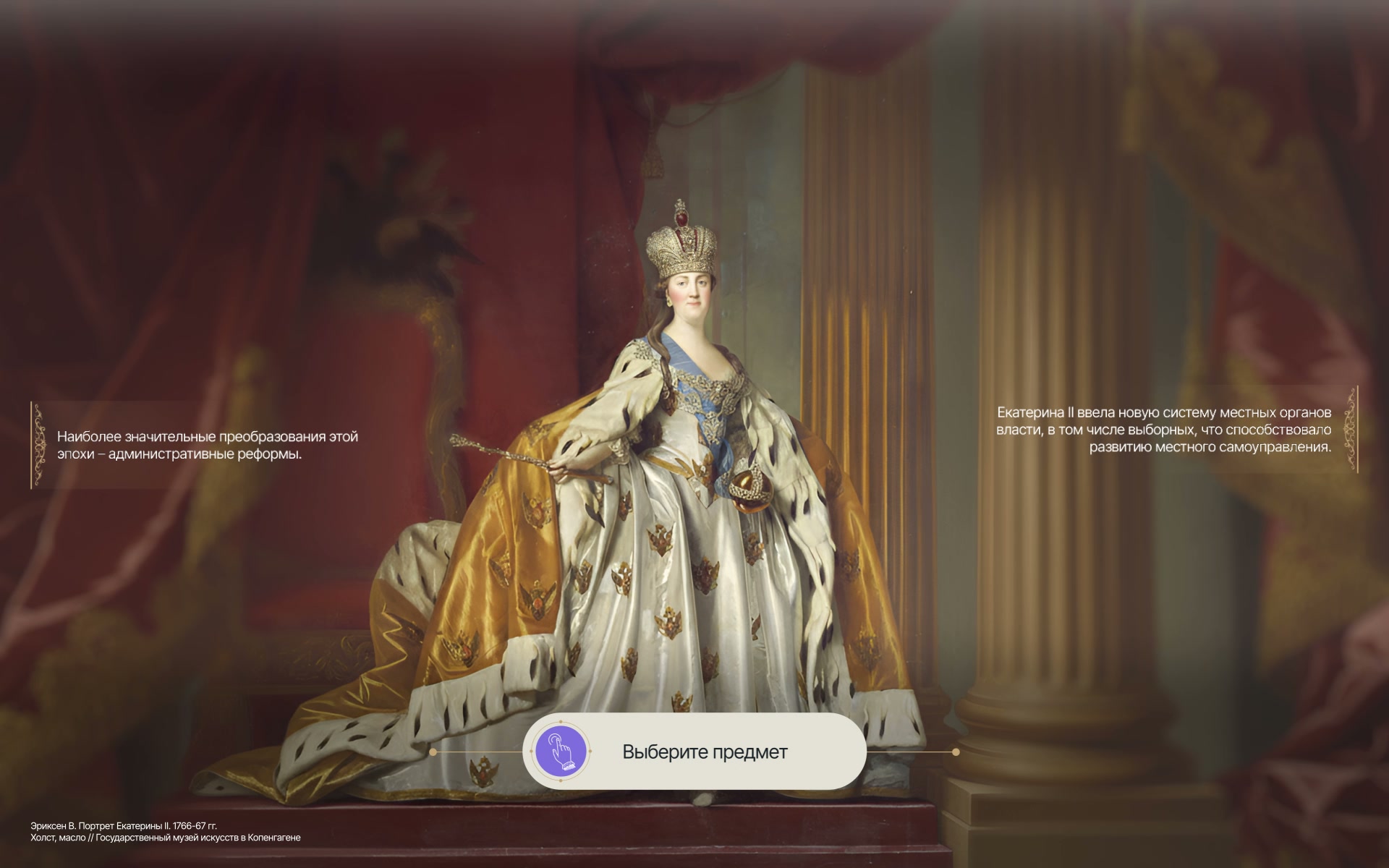
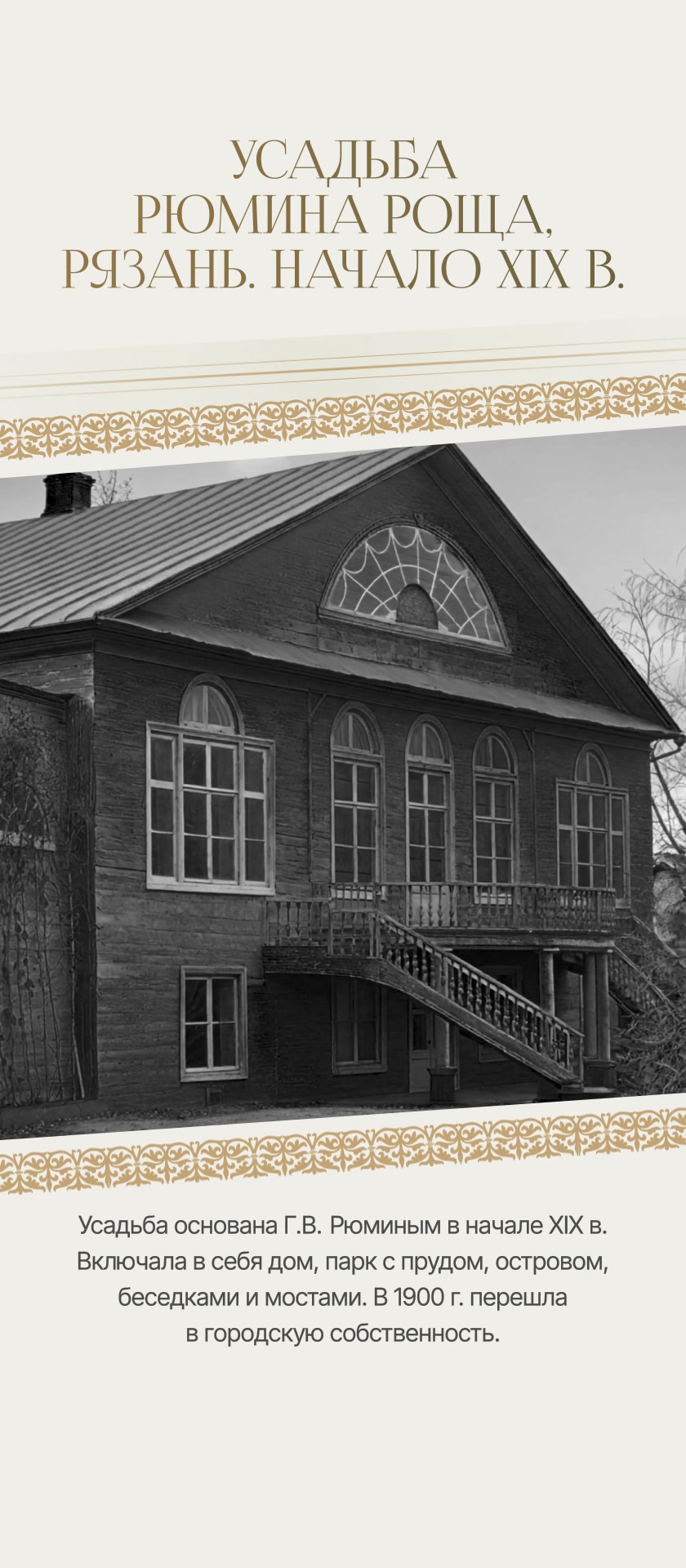
“The founding of Ryazan Governorate” is a projection of extended labels for seven objects in a showcase; the object is chosen with a button. “Boudoir” is a mirror-style touch screen with a camera: the visitor chooses a century, gender and look and tries on an outfit from the 18th to the early 19th century; the outfit follows their movements, and the photo is collected via a QR code. “The governorate interactive” is a vertical projection with views of Ryazan manors and estates: Ryumina Roshcha, Kiritsy, Aleshnya and others.
Dining room and drawing room
Floor projection: polonaise and waltz step diagrams set to music.
Ballroom
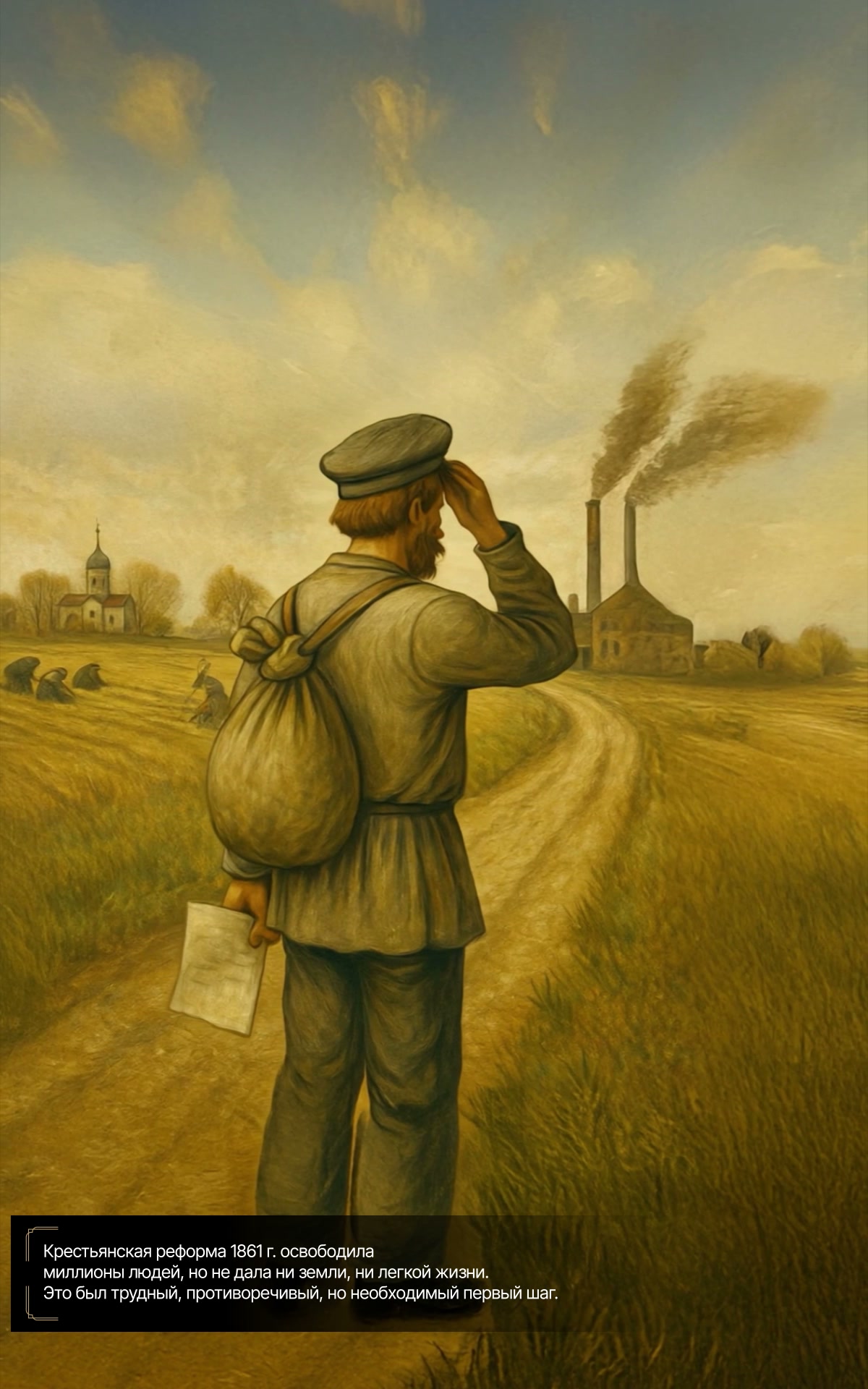
The touch screen “The Great Reforms of the 1860s–1870s” and a vertical projection on the peasant reform of 1861.
“The peasantry”
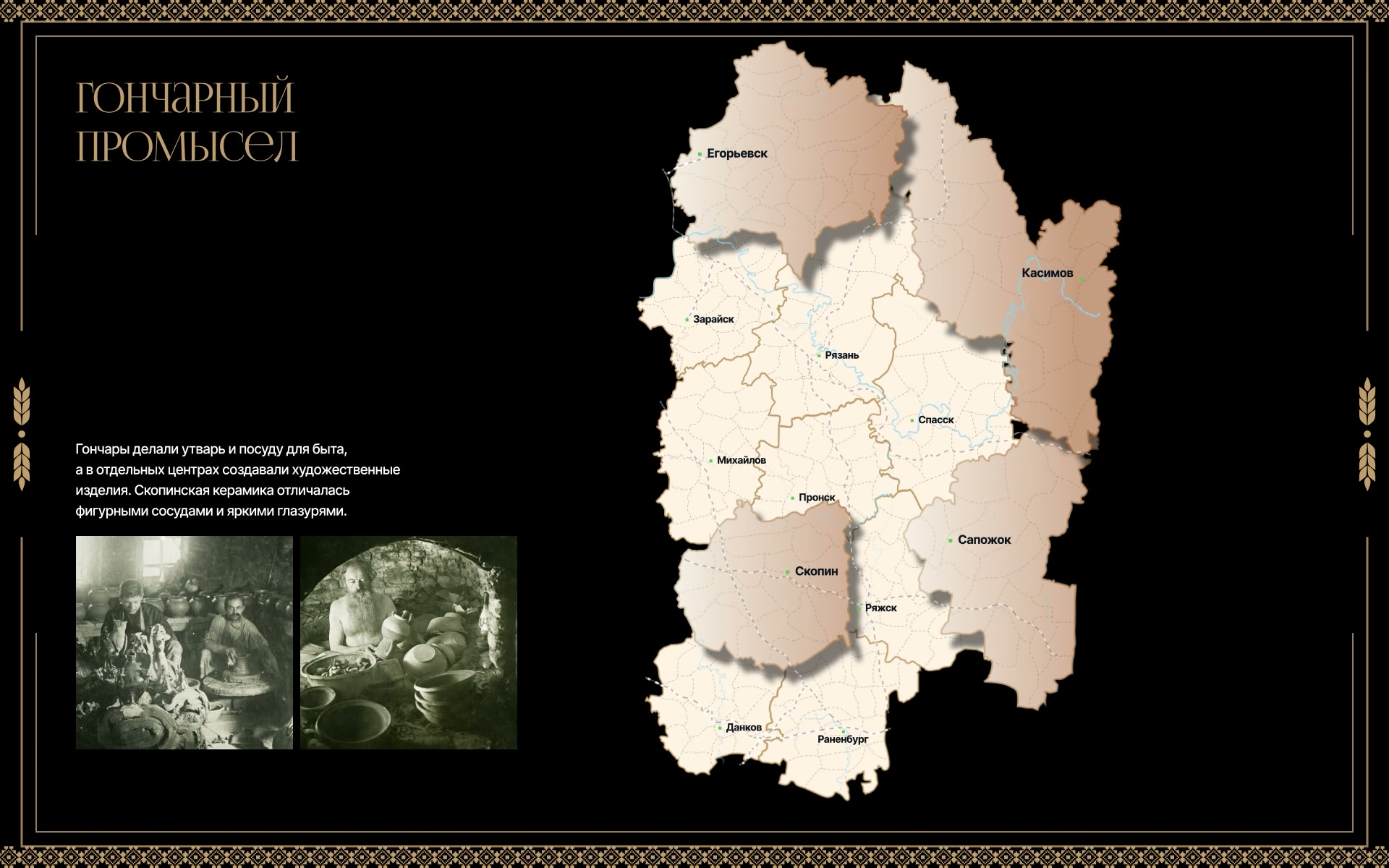
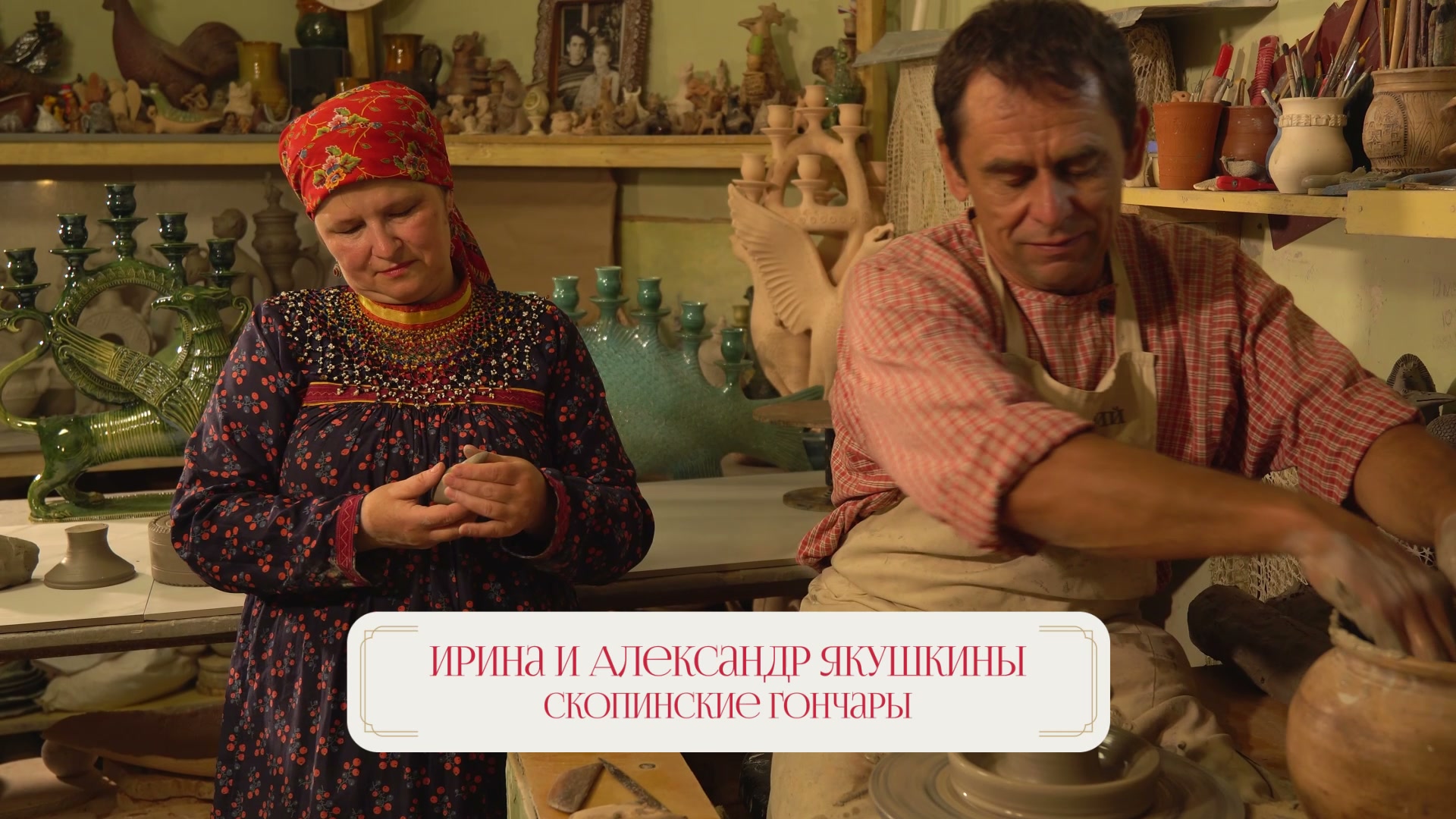
A projection in a peasant hut — archive photographs of huts and villages of Ryazan Governorate with captions — and a touch-screen label. “The pottery workshop”: we shot and edited a film about the Skopin potters Irina and Aleksandr Yakushkin; it plays while the visitor turns the potter's wheel and stops when the wheel does. “Map of traditional crafts” is a projection of a map of the governorate: by turning a knob, the visitor chooses one of twenty crafts, from pottery and lace-making to carriage building, and sees on the map where it was practised. A touch-screen label about the crafts.
“Seasonal rites and festivals”
Projection onto showcases with animated scenes of the seasons and festivals, with voice-over narration.
“The governorate town”
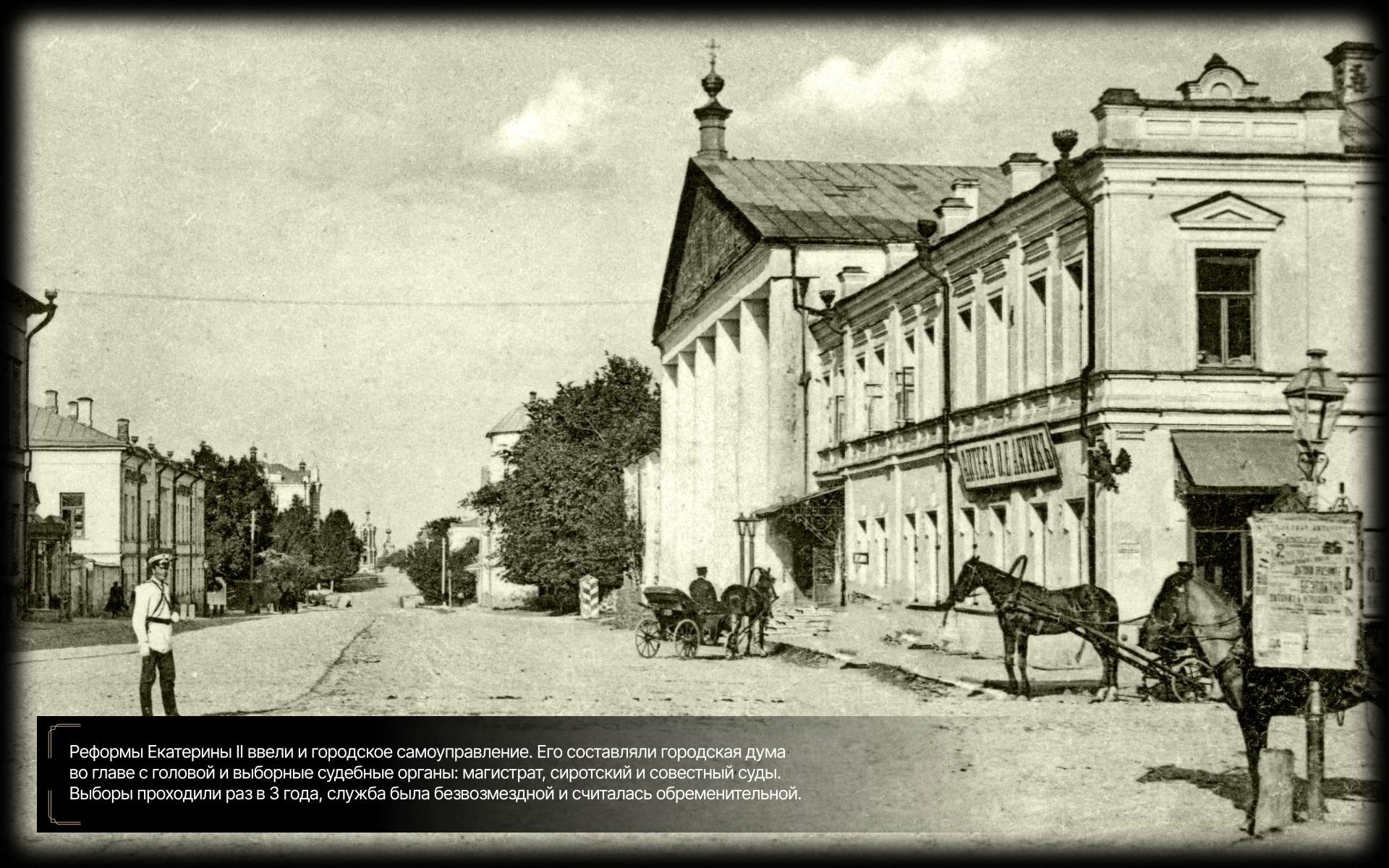
The “Provincial Ryazan” card index is a projection onto a filing cabinet with seven topics chosen by buttons: governorate and city administration, banks, public amenities, charity, post and telephone, clubs and societies, transport. Photo studio — a projection of backdrops for a photo; the visitor switches the backdrop. An information touch screen. An audio handset with a projection of a spinning record: a knob selects the recording — Chaliapin, Sobinov, Nezhdanova, military bands. A projection for the 800th anniversary of Ryazan — views of the city in the 1880s–1900s.
“The flat”
A touch screen with Ryazan newspapers that can be leafed through, and an audio handset with a projection and voice-over narration.
Content management system
Through it, museum staff change and publish the exhibition materials themselves. We also carried out the testing and commissioning on site.
How it is built
The interactives are tied to physical objects: lidars at the entrance-area screens, a page sensor in the coronation book, sensors in the objects on the table at the projection on the reforms of Peter I, buttons and rotary knobs, a potter's wheel as a controller, the knob of the audio handset.
Potter's wheel: the video starts when the wheel turns in either direction, pauses when it stops and resumes from the same point; after 30 seconds without movement it goes into standby.
The military uniform game has a photo feature powered by a neural network, and the “Boudoir” offers outfit try-ons with real-time body tracking.
The videos are built on archive photographs, engravings and documents, which we brought to life with parallax and animation.
Result
The exhibition opened to visitors on 13 March 2026; the official opening was on 11 March.