Exhibitions · 2024
Ministry of Industry and Trade “Made by Us” pavilion
Exhibitions / Ministry of Industry and Trade “Made by Us” pavilion
About the project
Eleven interactives for the Ministry of Industry and Trade pavilion at the “Russia” Expo: an industry map, games about farm machinery and drones, VR periscopes and the “Laboratory of the Future”.
The “Russia” International Exhibition and Forum ran at VDNKh from 4 November 2023 to 8 July 2024. The Ministry of Industry and Trade presented Pavilion E, “Made by Us”, there — ten halls on the past, present and future of Russian industry.
We made eleven interactives for the pavilion: touch-screen applications in the “History Corridor” and the “Engineering Centre”, a projection book, a farm machinery game, a drone simulator, VR periscopes with three vessels, the “Laboratory of the Future” with four scientists, and a screen on light industry.
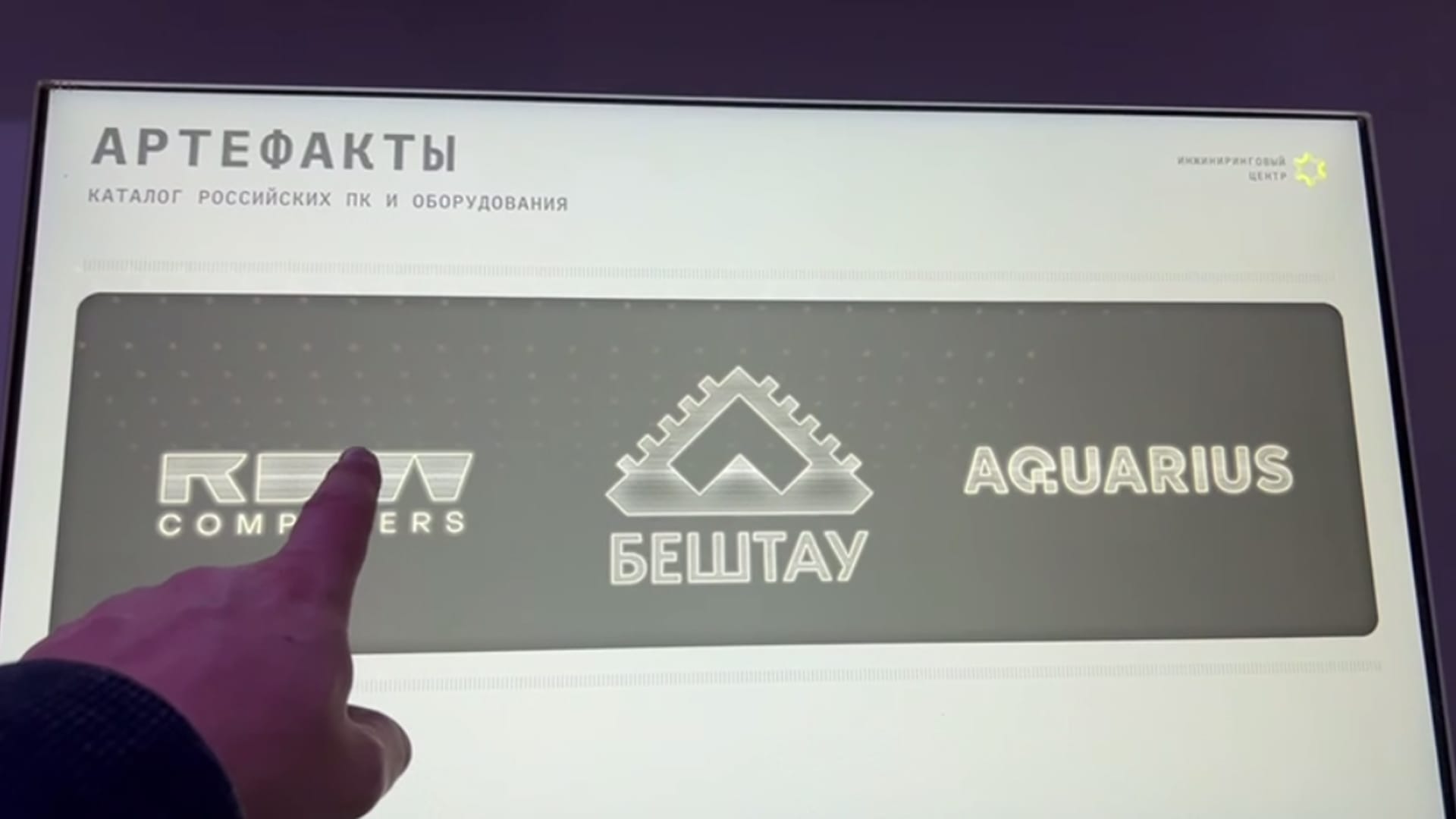
Earlier, for the pavilion’s opening on 4 November 2023, we made eight interactive installations for the “Engineering Centre” hall: the central “Computing Core” installation with punched cards and seven stations — 3D modelling, crash test, digital twin, 3D printing materials, metrology and standardisation, reverse engineering, and the “Artefacts” catalogue of Russian computers.
Year
2023–2024
Industry
Exhibitions
Scope of work
2023 — 8 interactive installations for the “Engineering Centre” hall; 2024 — 11 interactives: touch applications, games, VR periscopes, the “Laboratory of the Future”
Venue
“Made by Us” pavilion, “Russia” Expo, VDNKh, Moscow
- 8
- interactive installations in 2023
- 11
- interactives in 2024
- 2 million+
- visitors to the pavilion by July 2024
The task
The pavilion told the story of industrial achievements from 2000 to 2023 and of how modern products are made. Several halls needed exhibits that visitors could work out for themselves: choosing a region on a map, matching machinery to a task, steering a vessel or a drone, following production from raw material to finished item. All in the pavilion’s common style.
What we did
History Corridor
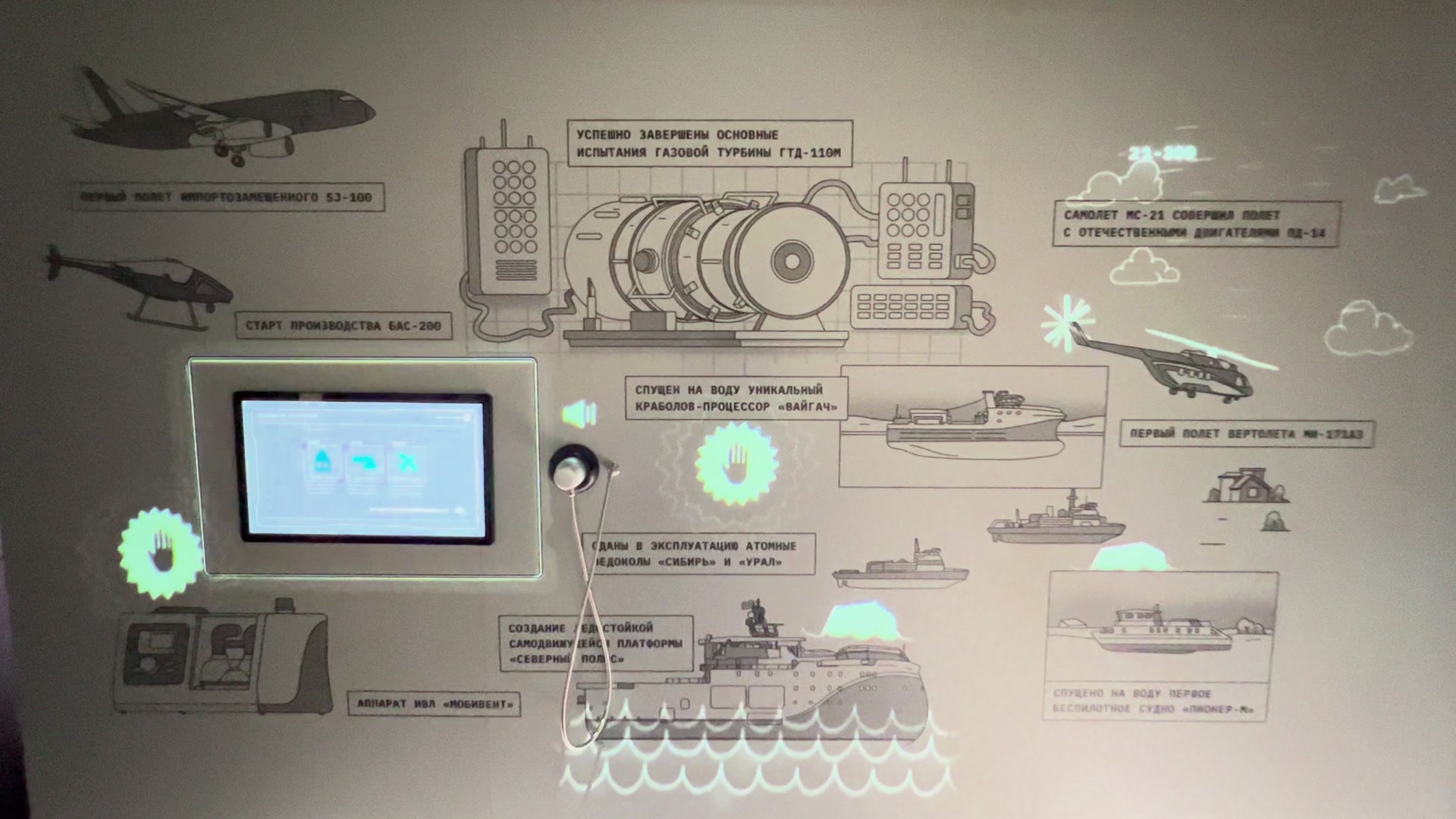
“Timeline of Achievements” — touch screens built into a wall with a timeline of 2000–2023. The visitor chooses an event — KOMPAS-3D, the Mi-38 helicopter, the Vector combine harvester, Aurus, the RITM-200 reactor, the Sputnik V vaccine, the MC-21 with the PD-14 engine, the SJ-100 with the PD-8, the BAS-200 — and watches a video story, listening to the sound through an earpiece by the screen.
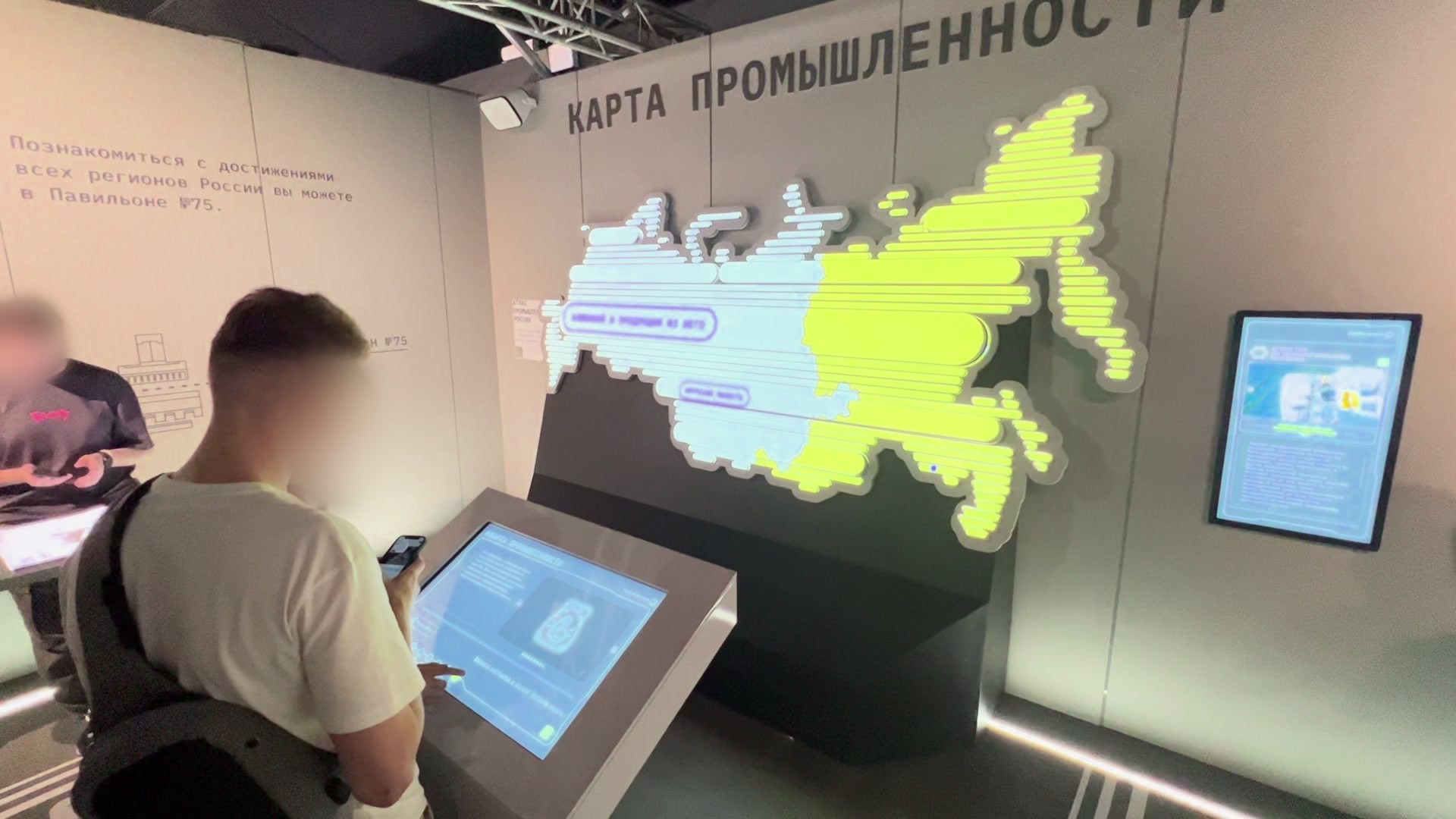
“Industry Map” — a touch terminal and a wall map of Russia. The visitor chooses one of the eight federal districts, and a region lights up on the map with its products — 64 cards in all, from heating equipment made in Adygea to radiators from Bashkortostan. While no one is using the terminal, the map shows an attract loop by industry: automotive, power engineering, oil and gas engineering, light industry.
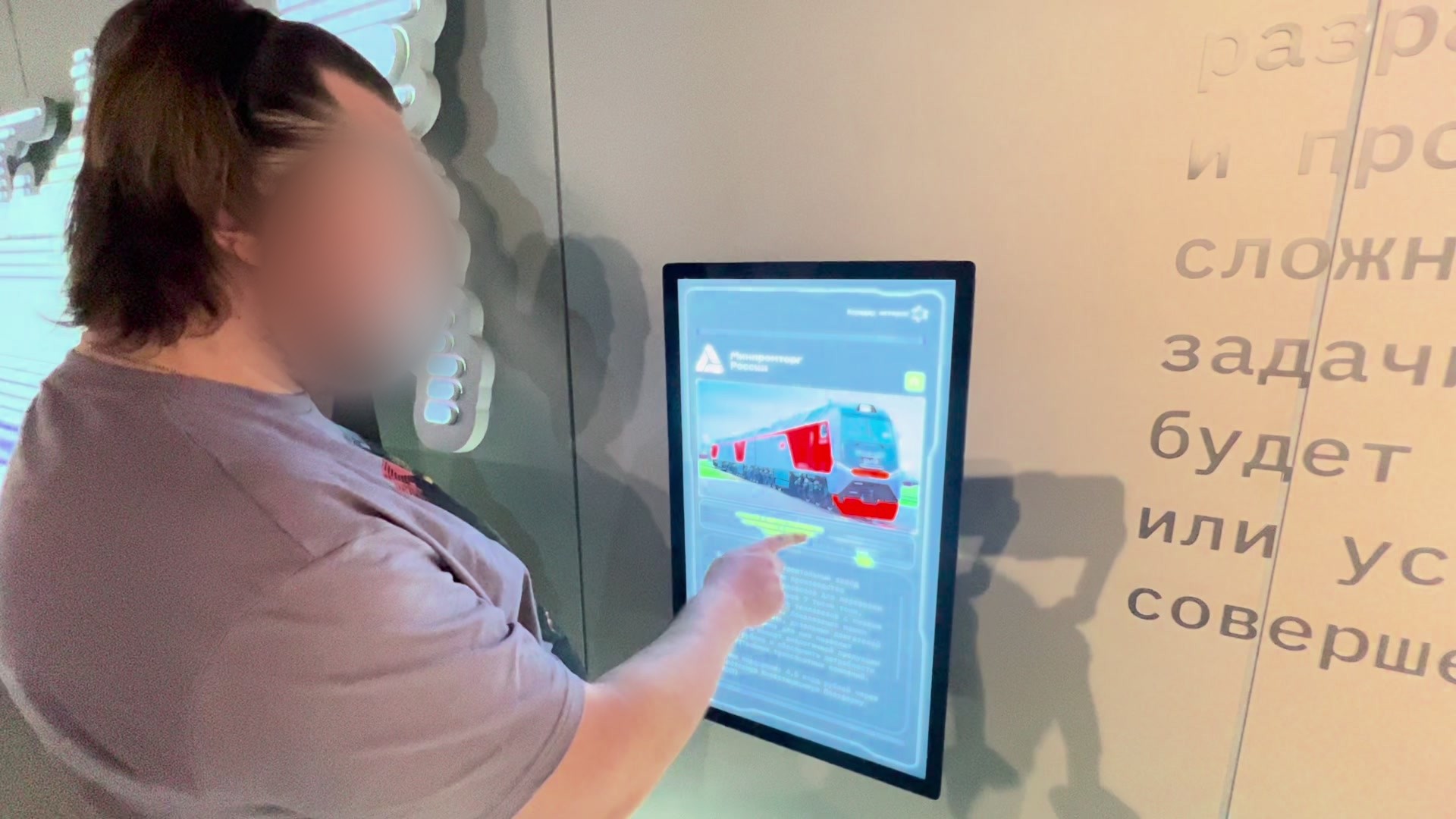
“Support Measures” — a vertical touch screen next to the map: 23 examples of enterprises that received support from the Industrial Development Fund (7), the Ministry of Industry and Trade (12) and the Technological Development Agency (4), and a QR code with a list of all the measures.
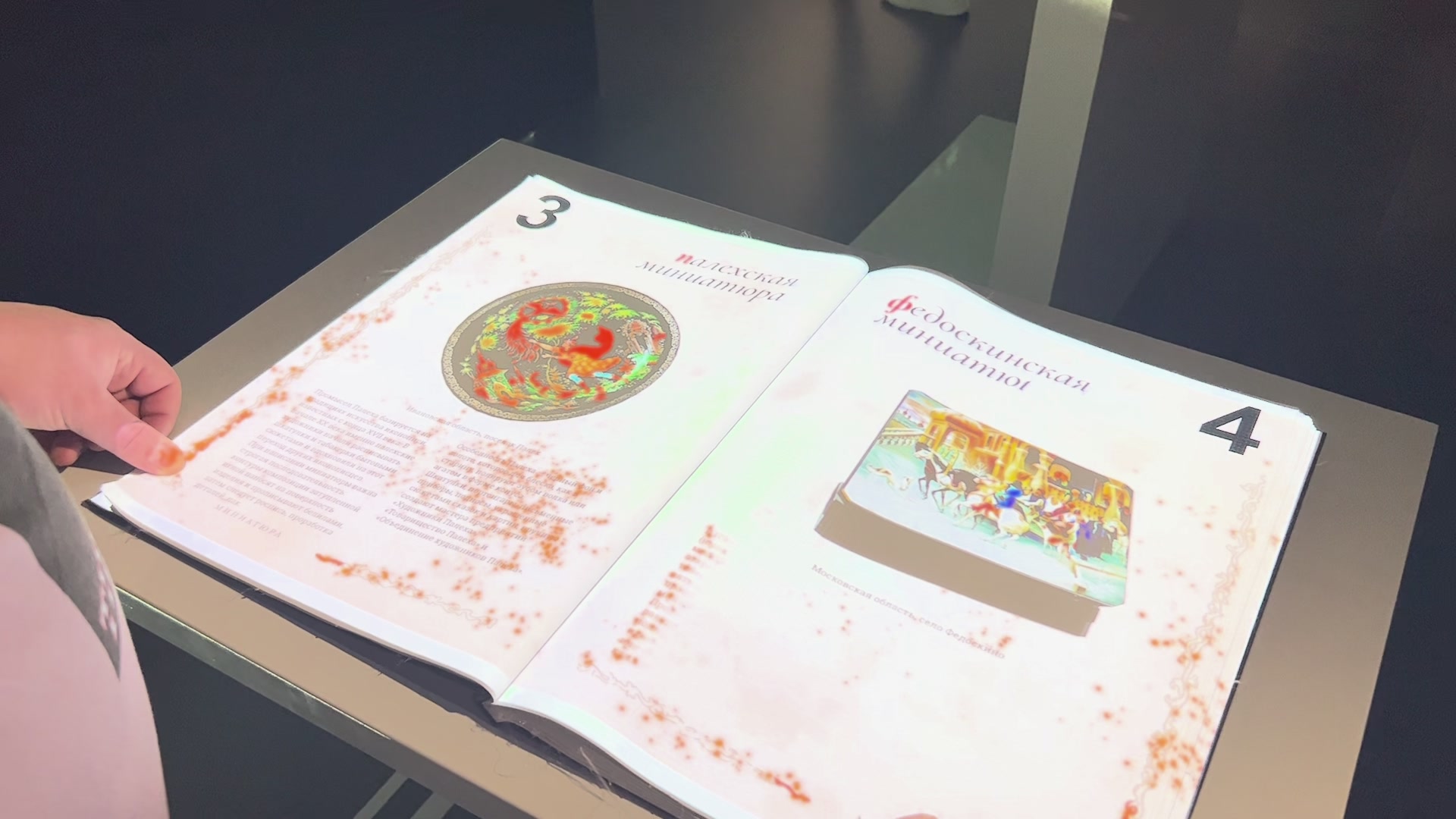
The projection book by the map: spreads are projected onto the white pages of a book — for example, on Palekh and Fedoskino miniature painting.
Engineering Centre
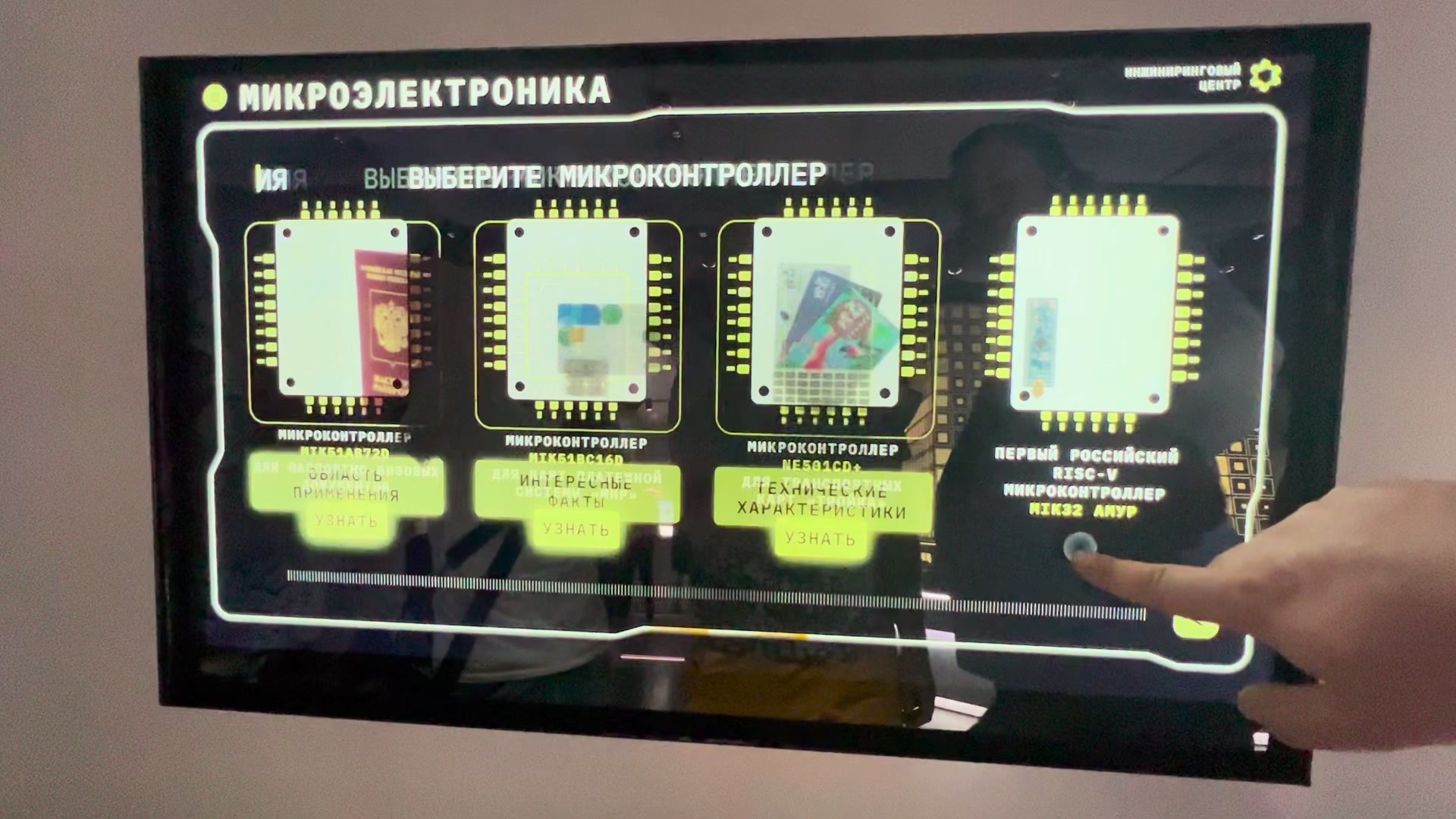
“Microelectronics” — a touch screen about four Mikron microcontrollers: the MIK51AB72D for passport and visa documents, the MIK51BC16D for Mir cards, the NE501CD+ for Troika transport cards and the MIK32 Amur on the RISC-V architecture. Each comes with its field of application, interesting facts and technical specifications.
A section on the Katyusha company in the “Artefacts” catalogue of Russian PCs and equipment: the company itself and two of its motherboards for multifunction printers — the MB24001 and MB450001.
Assembly shop: farm machinery
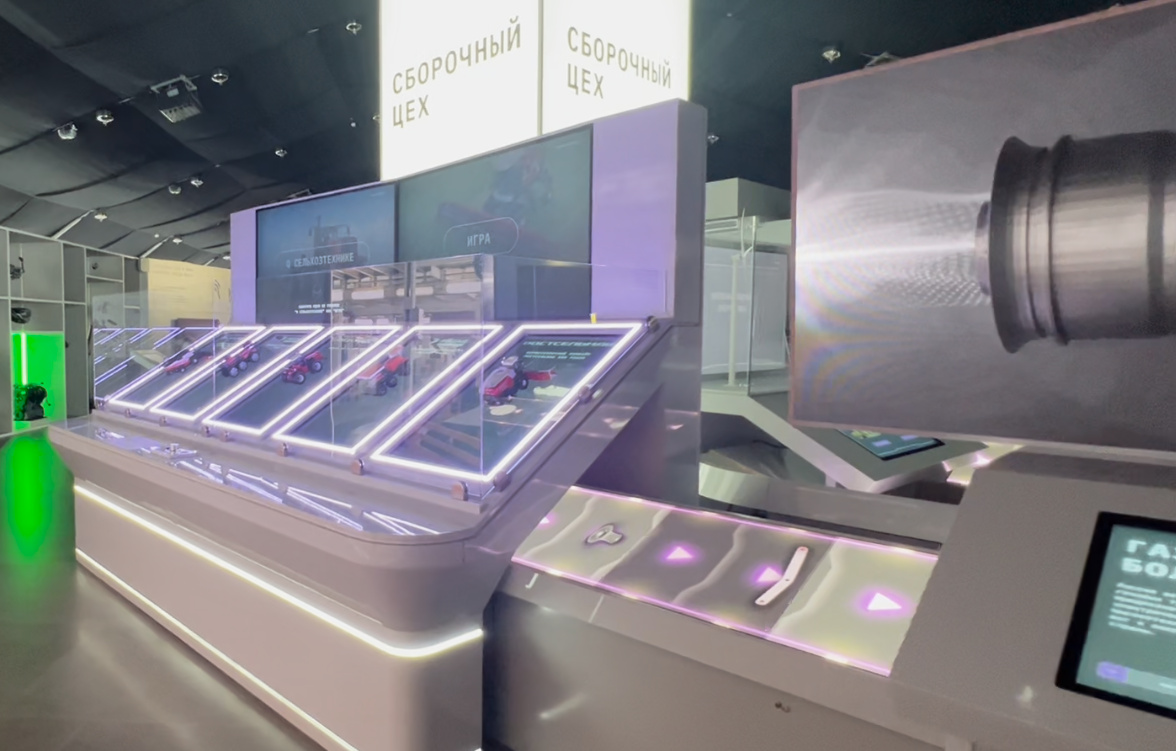
A table with five machine models above screens, two large screens and a spinner — a rotary knob that controls everything. Machines by Rostselmash and Pegas Agro: the RSM 161 grain combine harvester, the RSM F2650 forage harvester, the Rostselmash 2400 tractor, and the self-propelled Tuman-3 sprayer and fertiliser spreader. Under each model, the screen shows a field with that machine at work.
Two modes. “About farm machinery” — a 3D model of the machine and six sections about it: specifications, production facts, design. “Game” — a task appears on the screen: “Harvest the grain”, “Plough the field”, “Spray with liquid concentrated fertiliser”, “Clear the straw from the field”. The visitor picks the right machine and scores points: up to 20 — “novice”, up to 40 — “professional”, up to 50 — “master farmer”.
Aviation hangar: drones
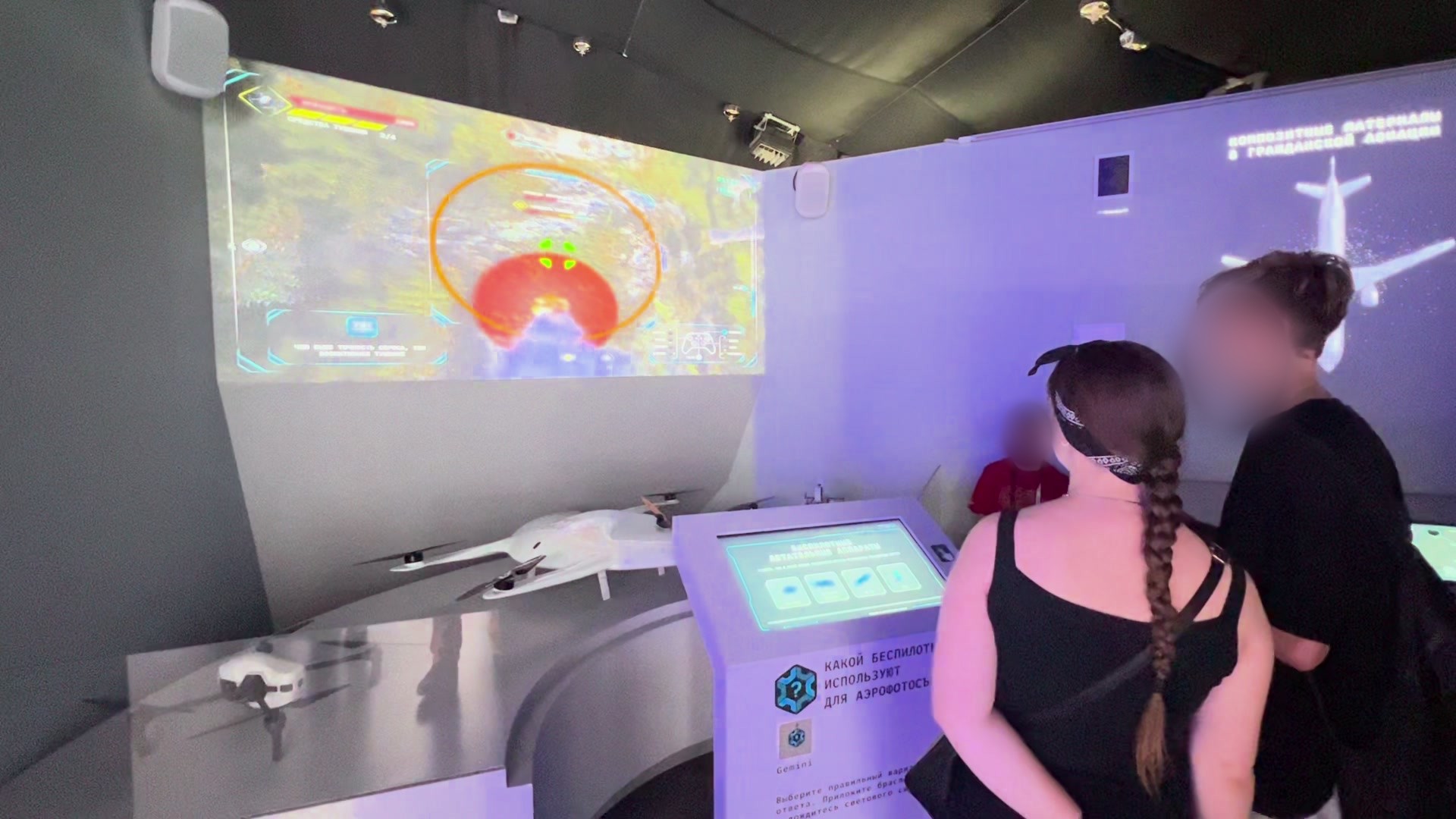
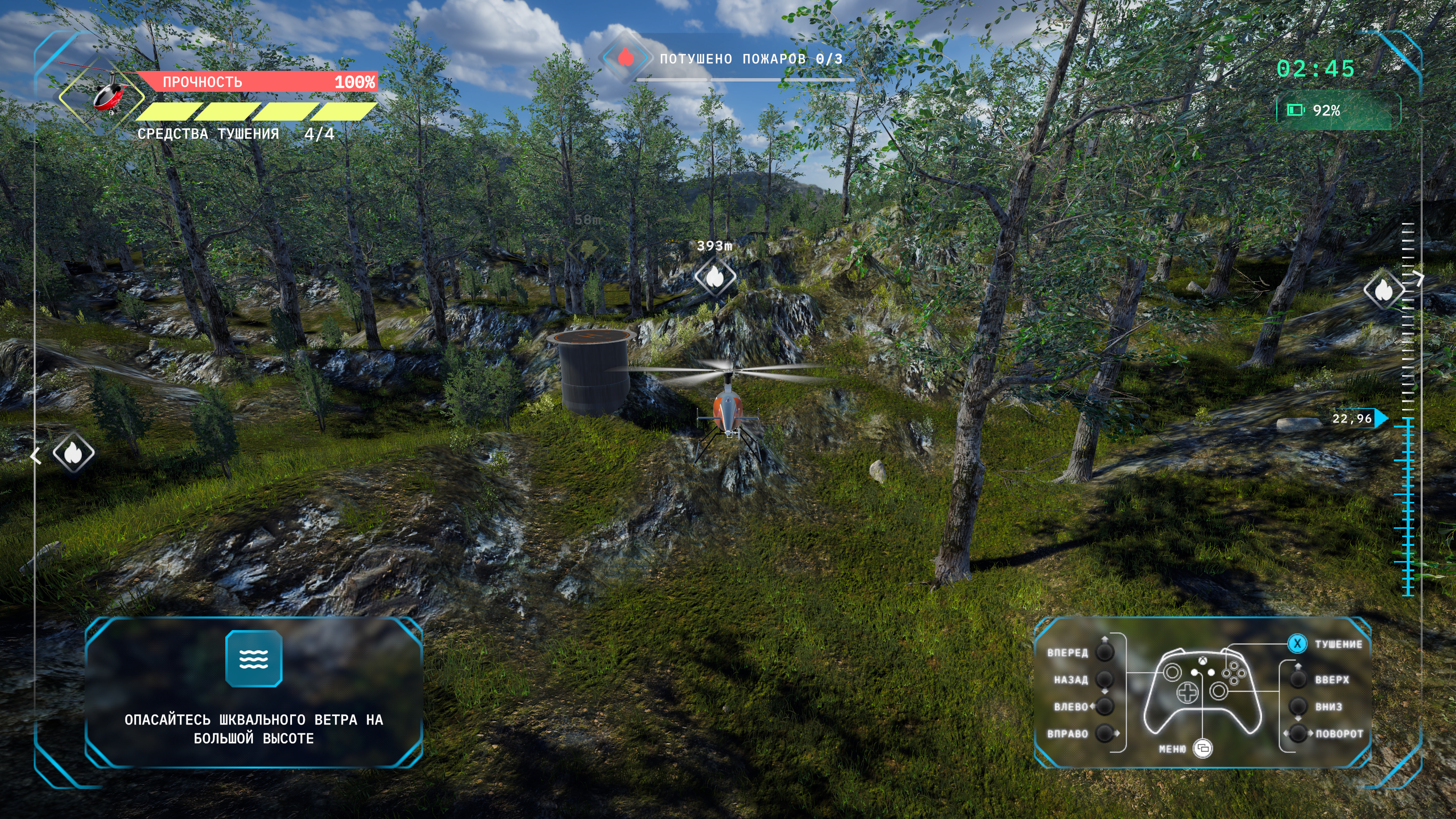
A game on a large projection. In the hangar the visitor chooses a drone and flies a mission: putting out a forest fire — three fires and four drops — or flying round an industrial site and photographing ten points. At the end come points, a rank (“trainee pilot”) and a leaderboard.
Shipbuilding: VR periscopes
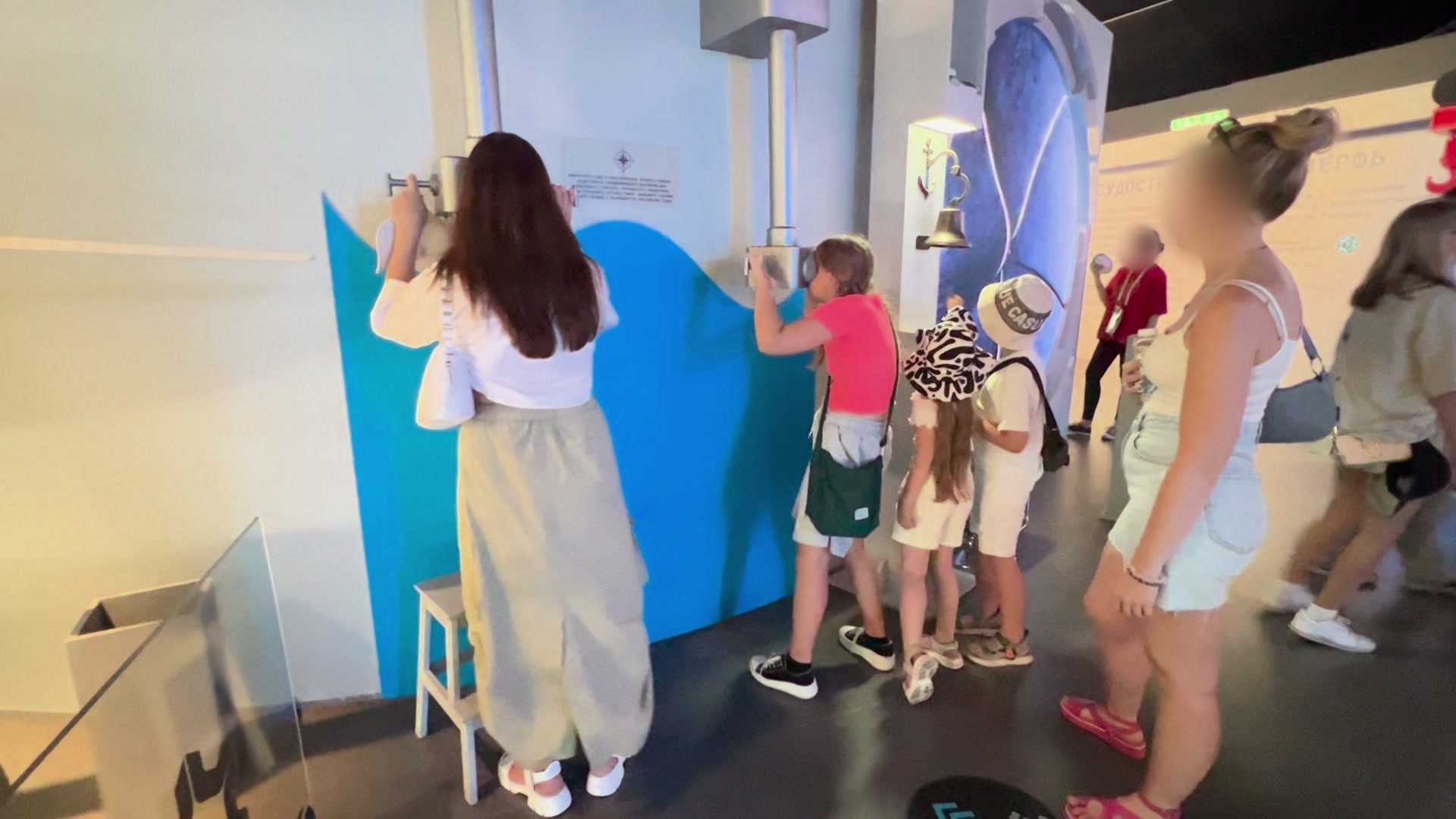
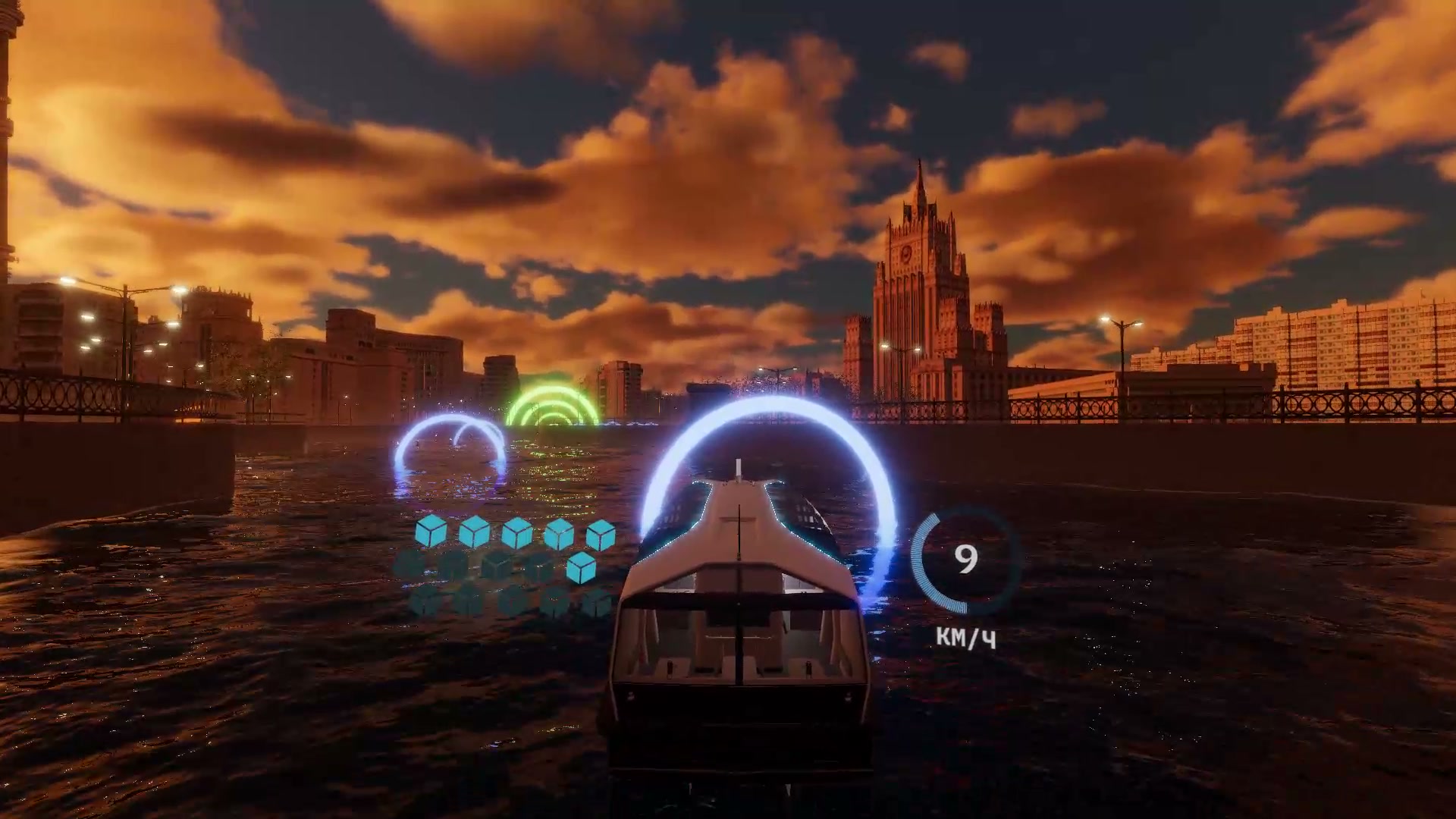
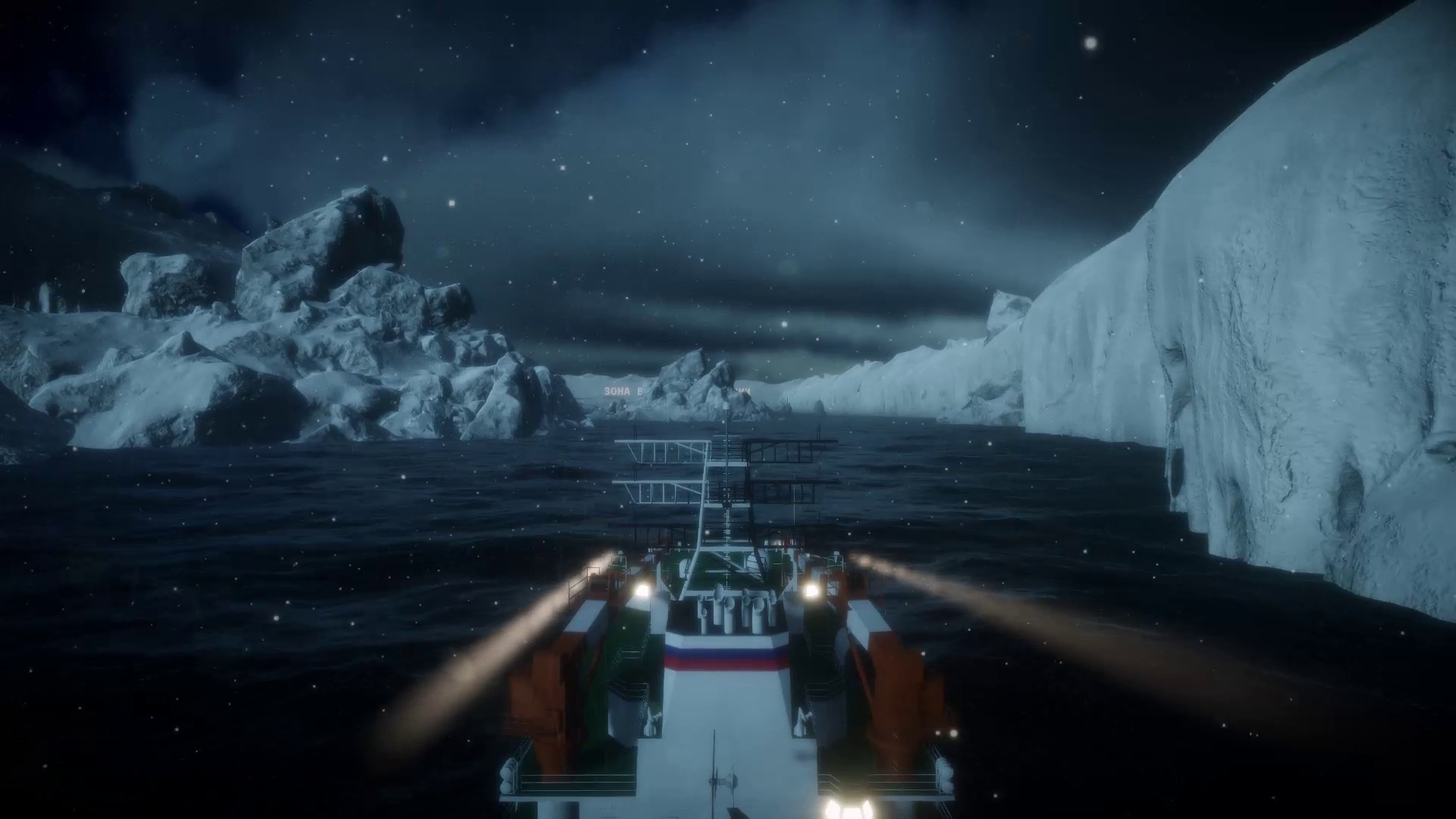
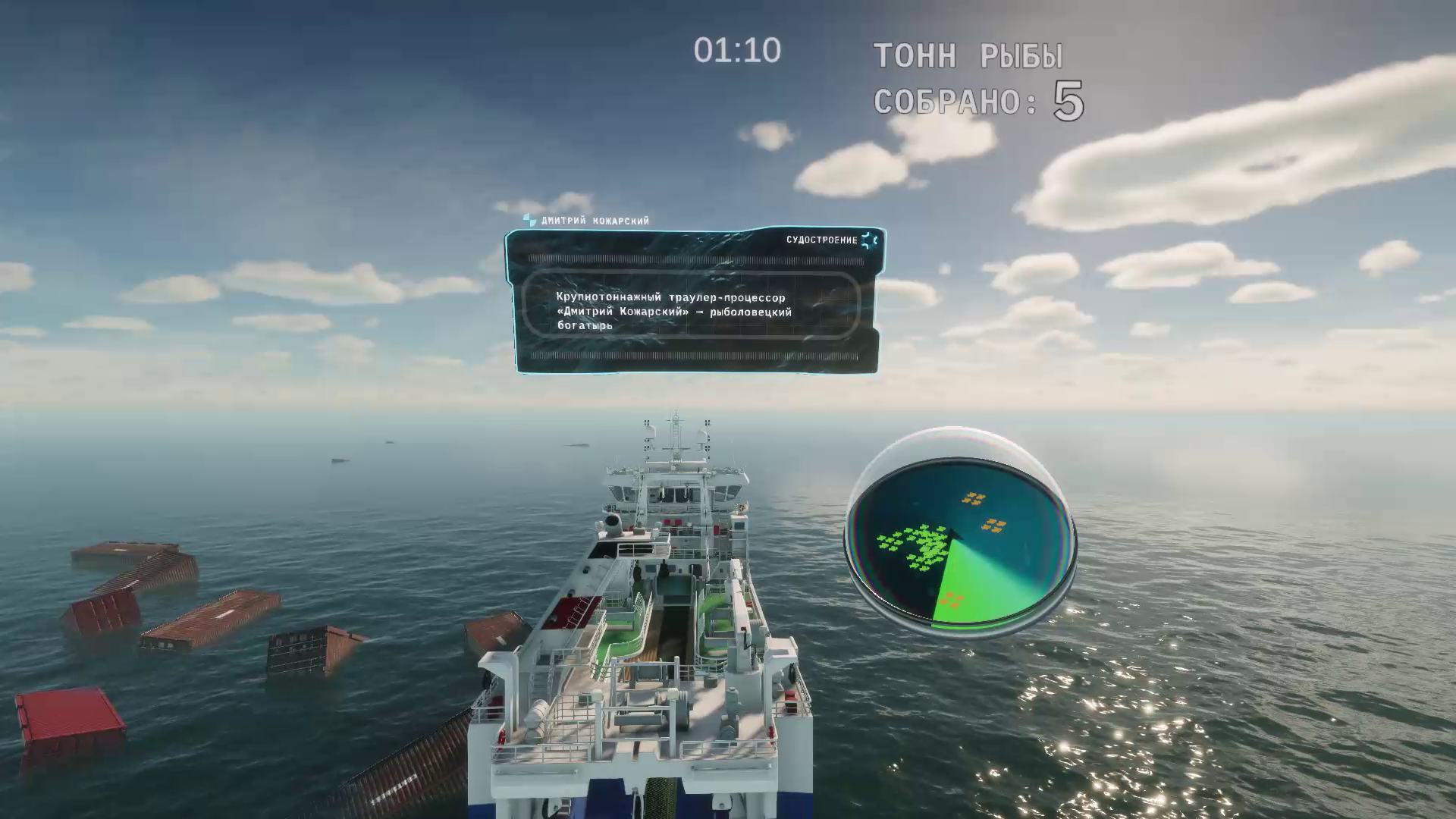
“Try yourself as the captain of a Russian ship”: the visitor looks into a VR periscope and turns it to steer the vessel. Three scenarios: the ice-class electric river bus “Sinichka” passes through 15 gates on a city river, trying not to touch the buoys; the factory trawler “Dmitry Kozharsky” catches as many fish as possible in two minutes; the ice-resistant platform “North Pole” makes its way through the ice to an expedition landing zone.
Laboratory of the Future
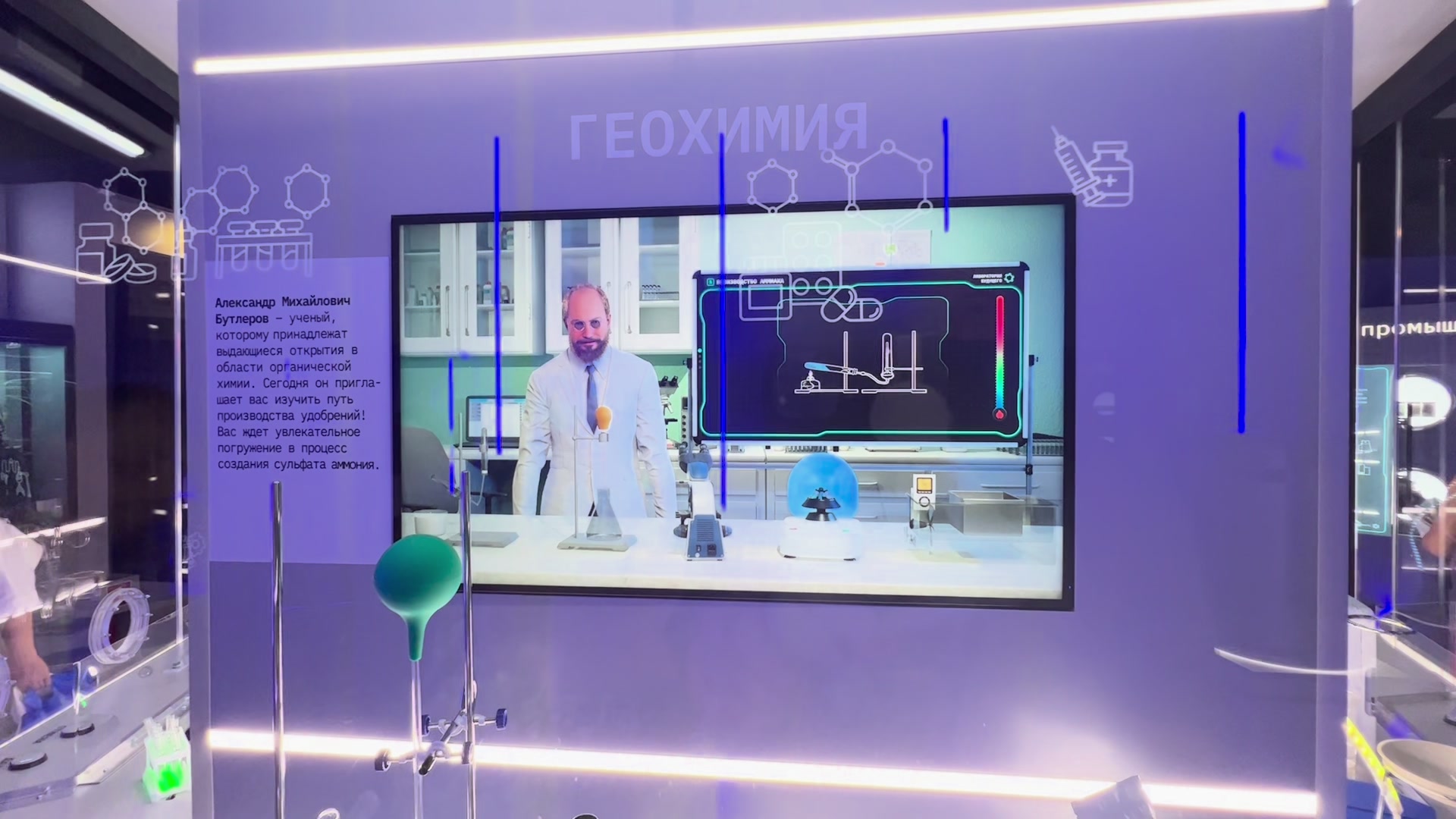
Four glass cubes — “Geochemistry”, “Biotechnology”, “Hygiene and Health”, “Cosmetics and Perfumery”. Each contains a screen with a scientist and a laboratory unit with a “Start” button, a slider and a spinner. Butlerov guides the visitor through the production of fertilisers, Kablukov through biotech products, Lebedev through toothpaste and Mendeleev through lipstick. At each production stage the visitor controls the process with the slider and the spinner, and at the end sees “Congratulations, you have created…” and a QR code with a story about the scientist.
Light industry
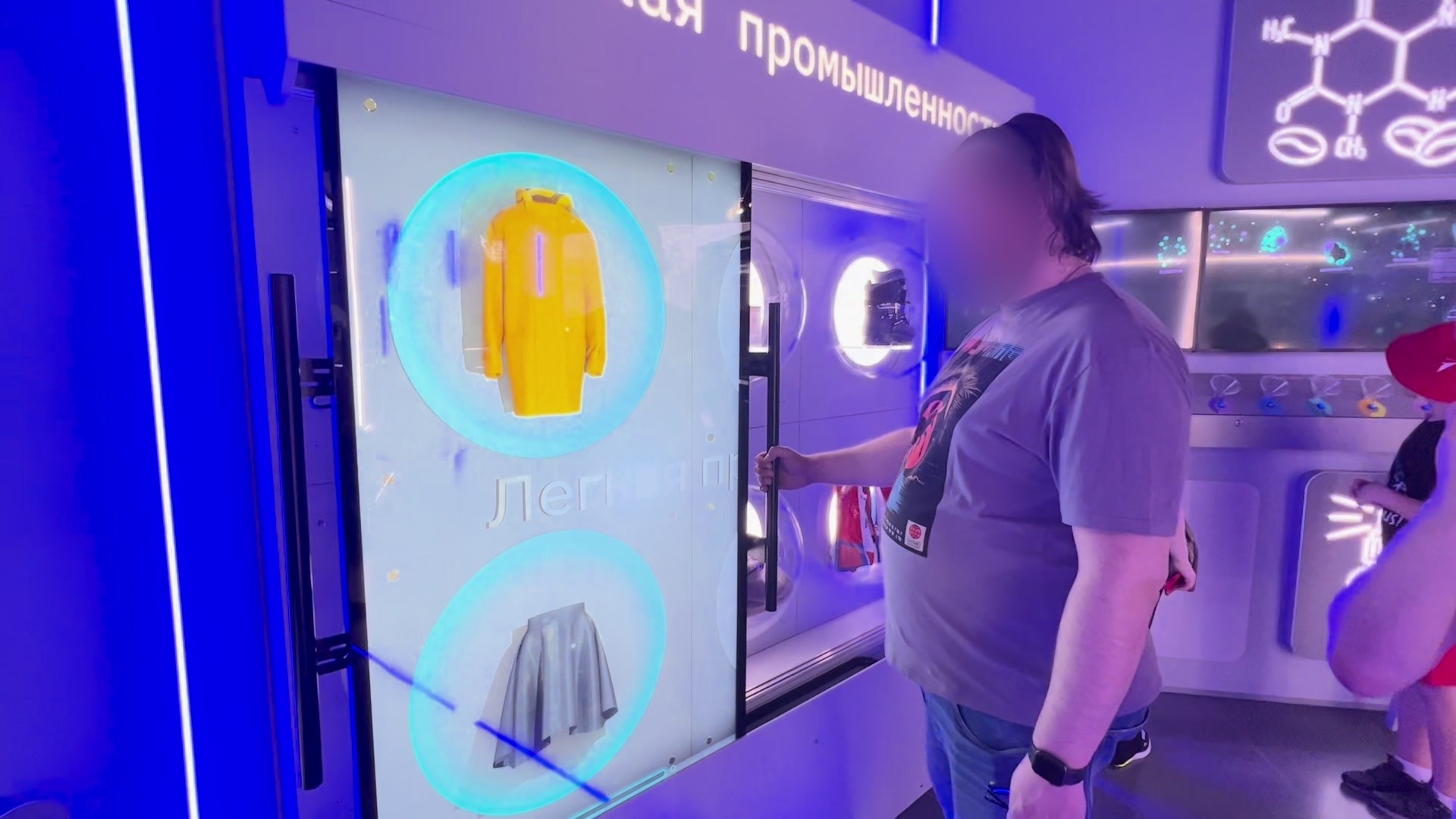
A transparent vertical touch screen in a display case between “portholes” holding products. Six items — a raincoat, a skirt, a down jacket, trekking boots, thermal underwear and bed linen — and their manufacturers: Cosmotex, Elis, BASK, Trek, V-Motion, Shuyskiye Sitsy and others. For each item there is a story about the material and a step-by-step production process, from raw material to finished product: the visitor drags flax to the machine, fibre to the loom, a sketch to pattern making, and the cut pieces to the sewing equipment.
2023: the “Computing Core”
The “Engineering Centre” hall opened together with the pavilion on 4 November 2023. It shows how industrial products are designed and tested in Russia, how they are standardised, and what digital solutions are created for this.
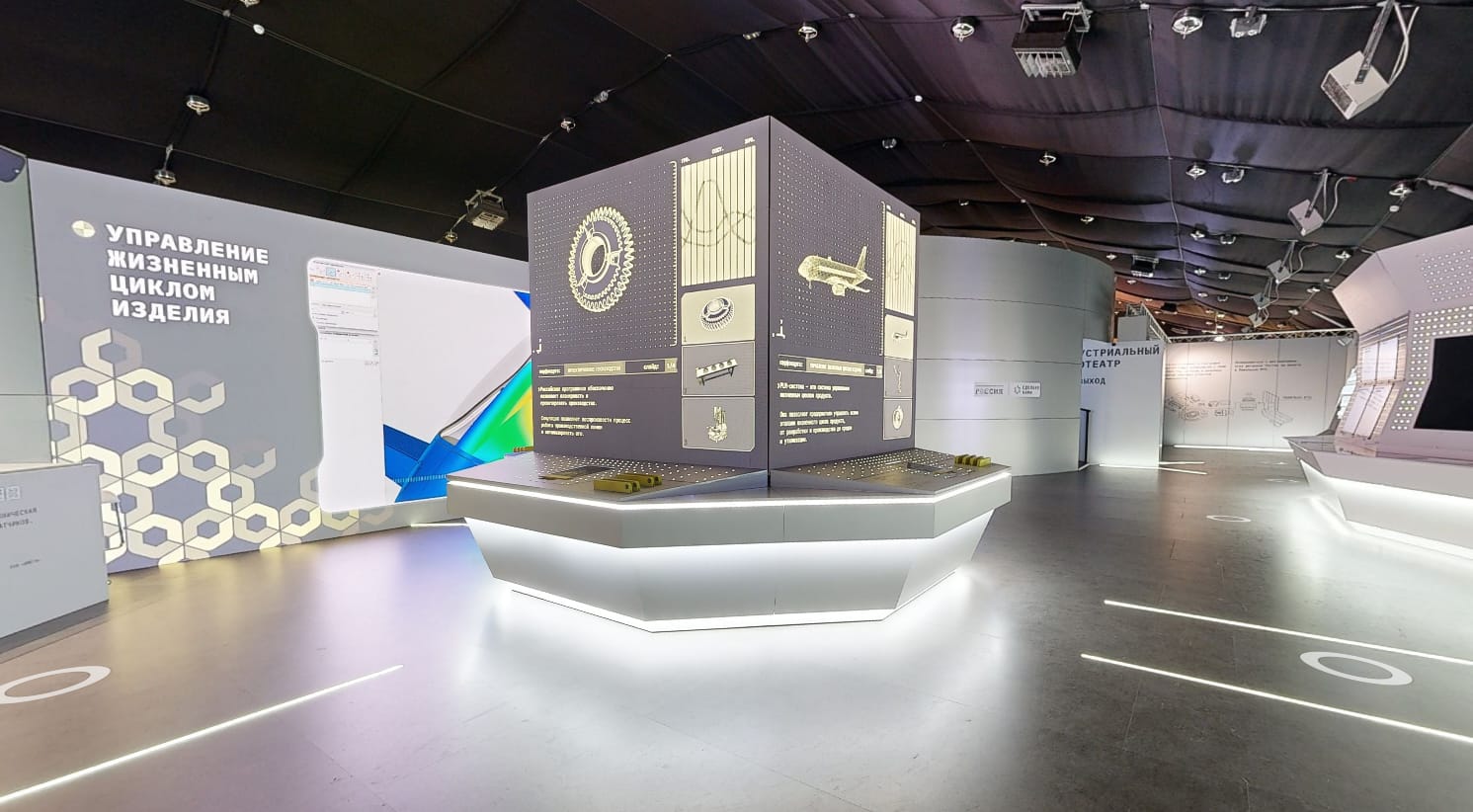
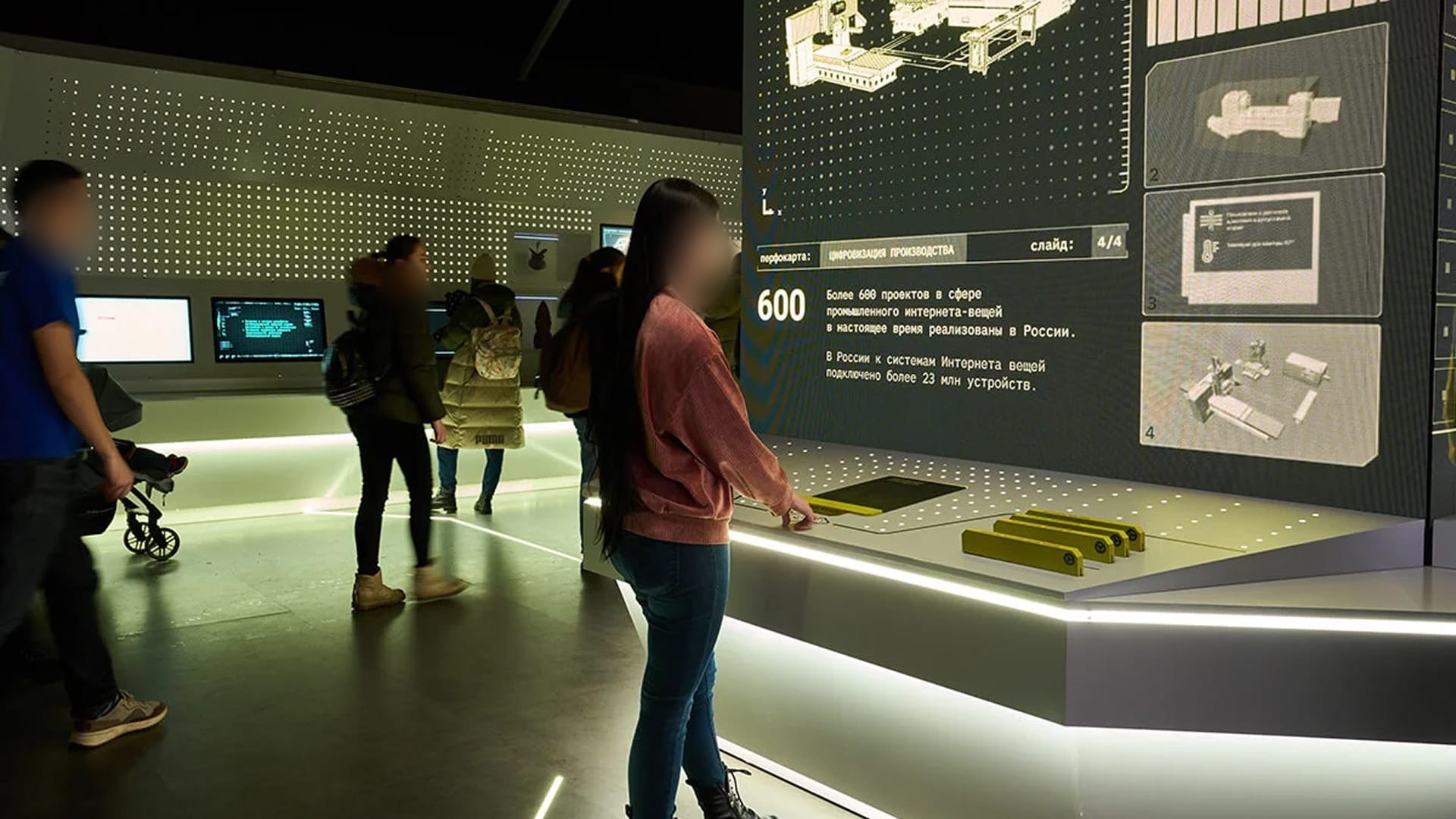
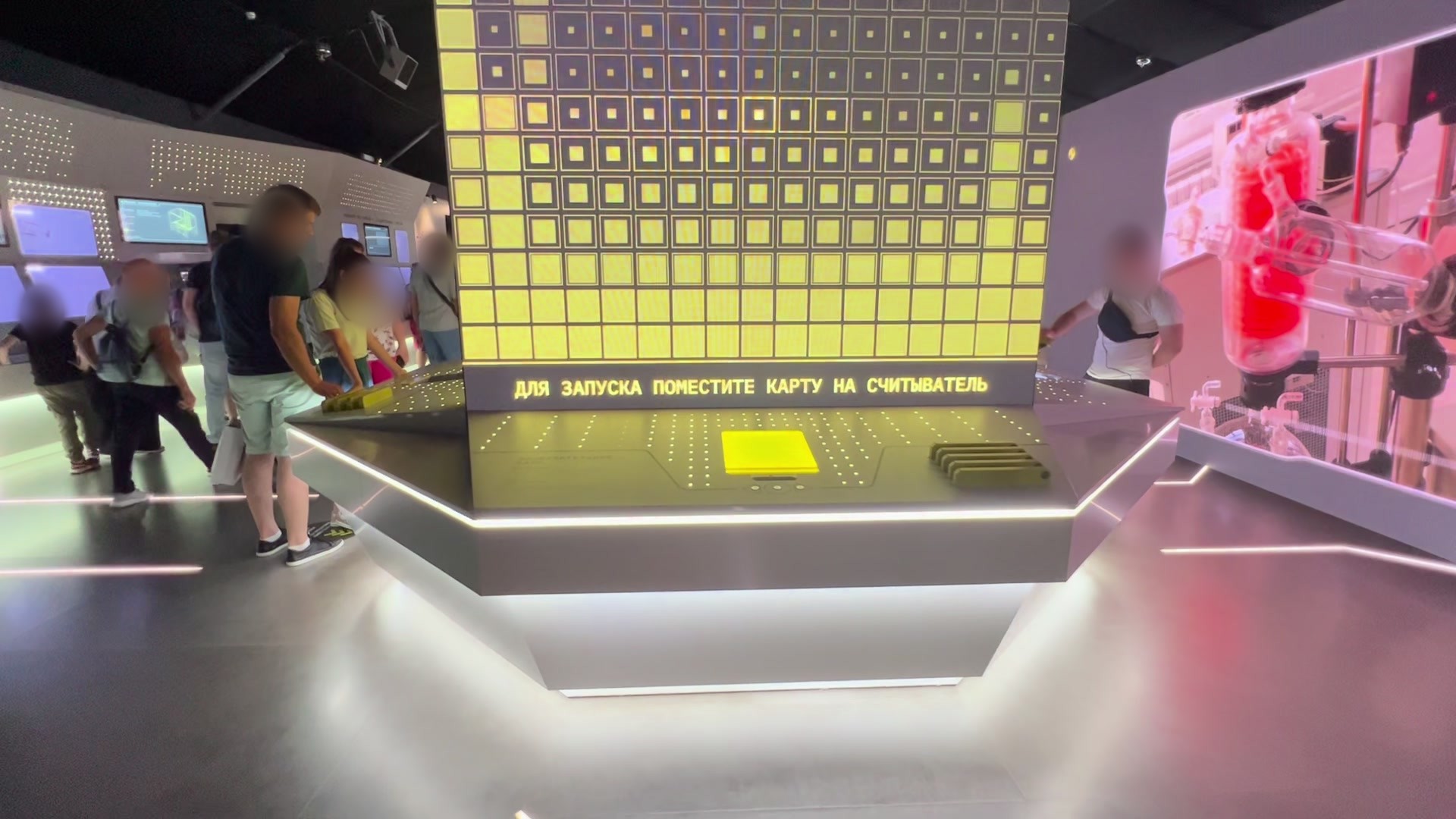
The “Computing Core” is the hall’s central installation: a cube of LED screens on a table podium. Punched cards with topics lie on the table. The visitor places a card on the reader, and a topic of four slides opens on the faces of the cube: “Product lifecycle management”, “Production design”, “Digitalisation of production” and others. The slides show 3D models and figures; with buttons on the table, the visitor switches slides and rotates the models.
2023: the “Engineering Centre” stations
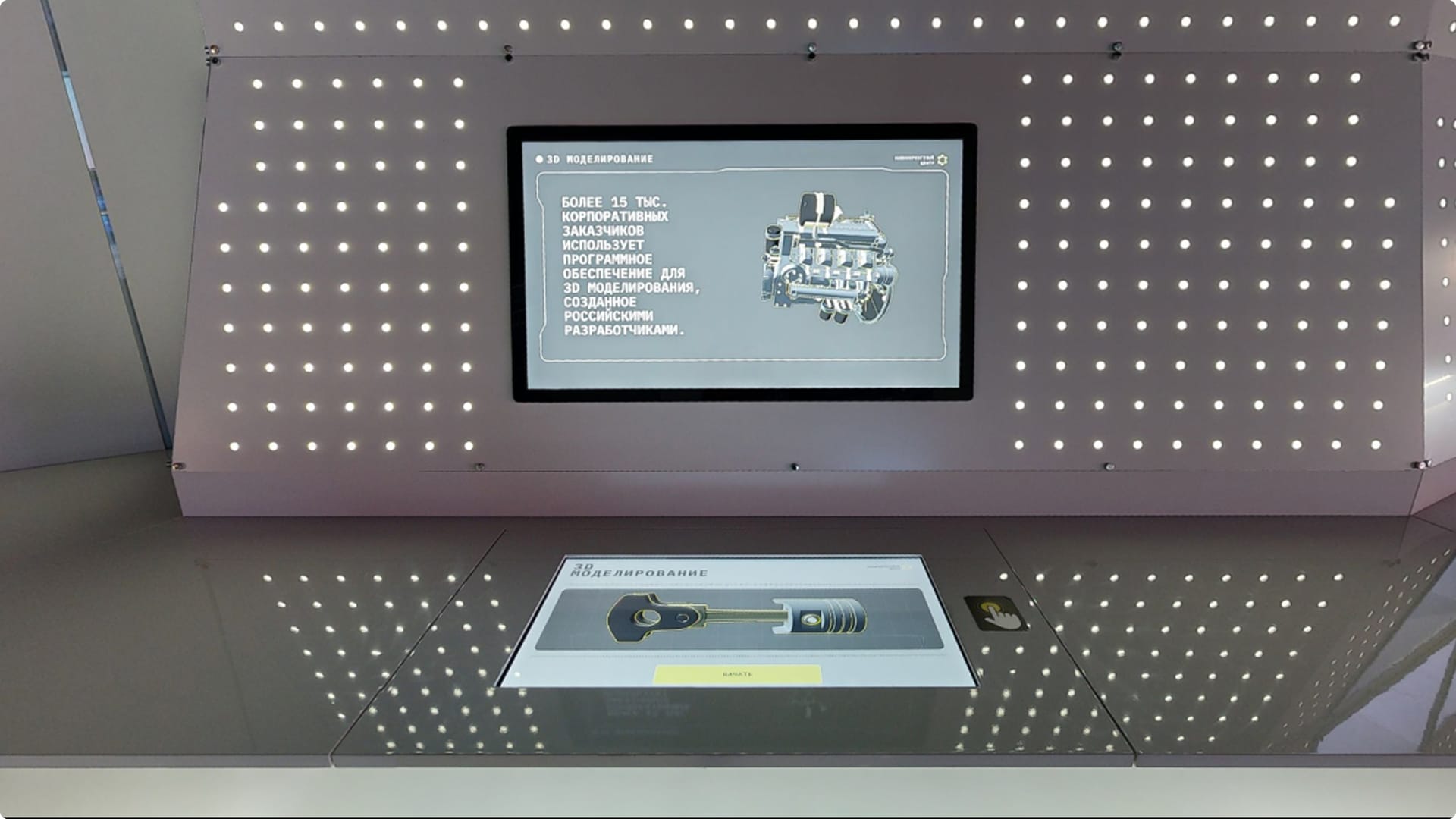
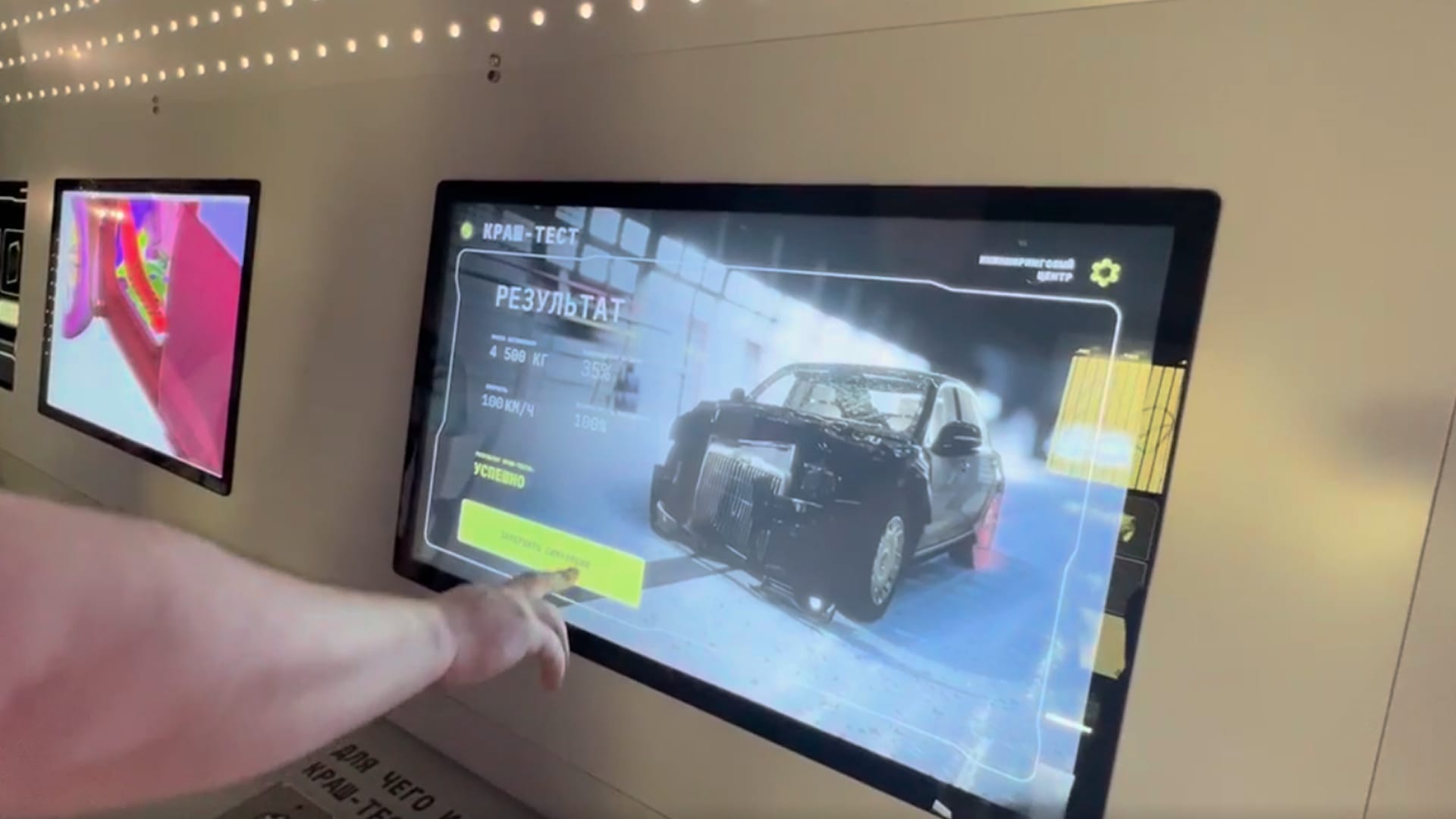
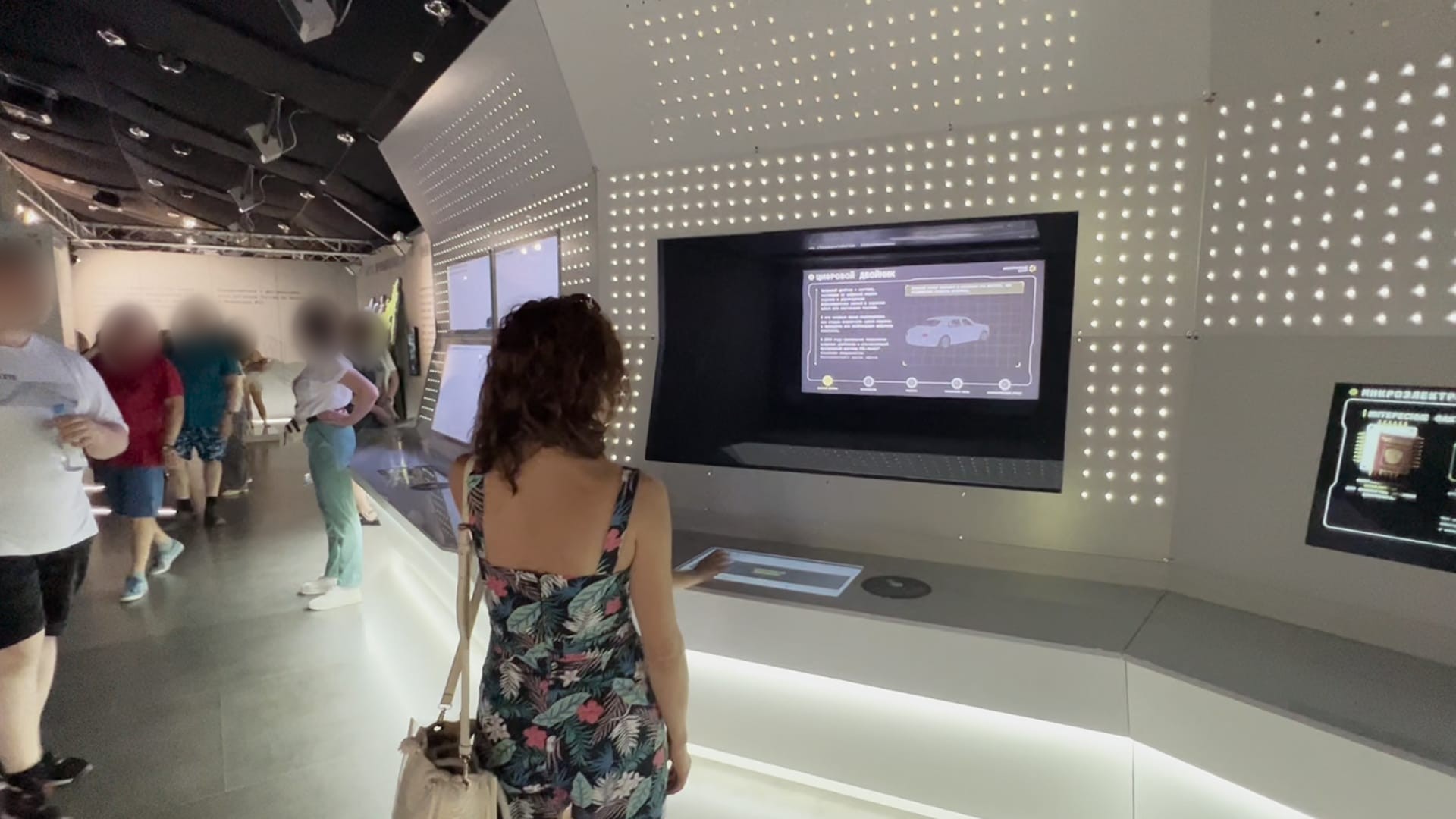
“3D Modelling”: the visitor chooses a part — a piston with a connecting rod, for example — and assembles its 3D model without specialist software. “Crash Test”: they set the parameters, run a virtual car crash test and get the result — mass, speed and the outcome “Success”. “Digital Twin” — the story of a car’s digital twin in five steps.
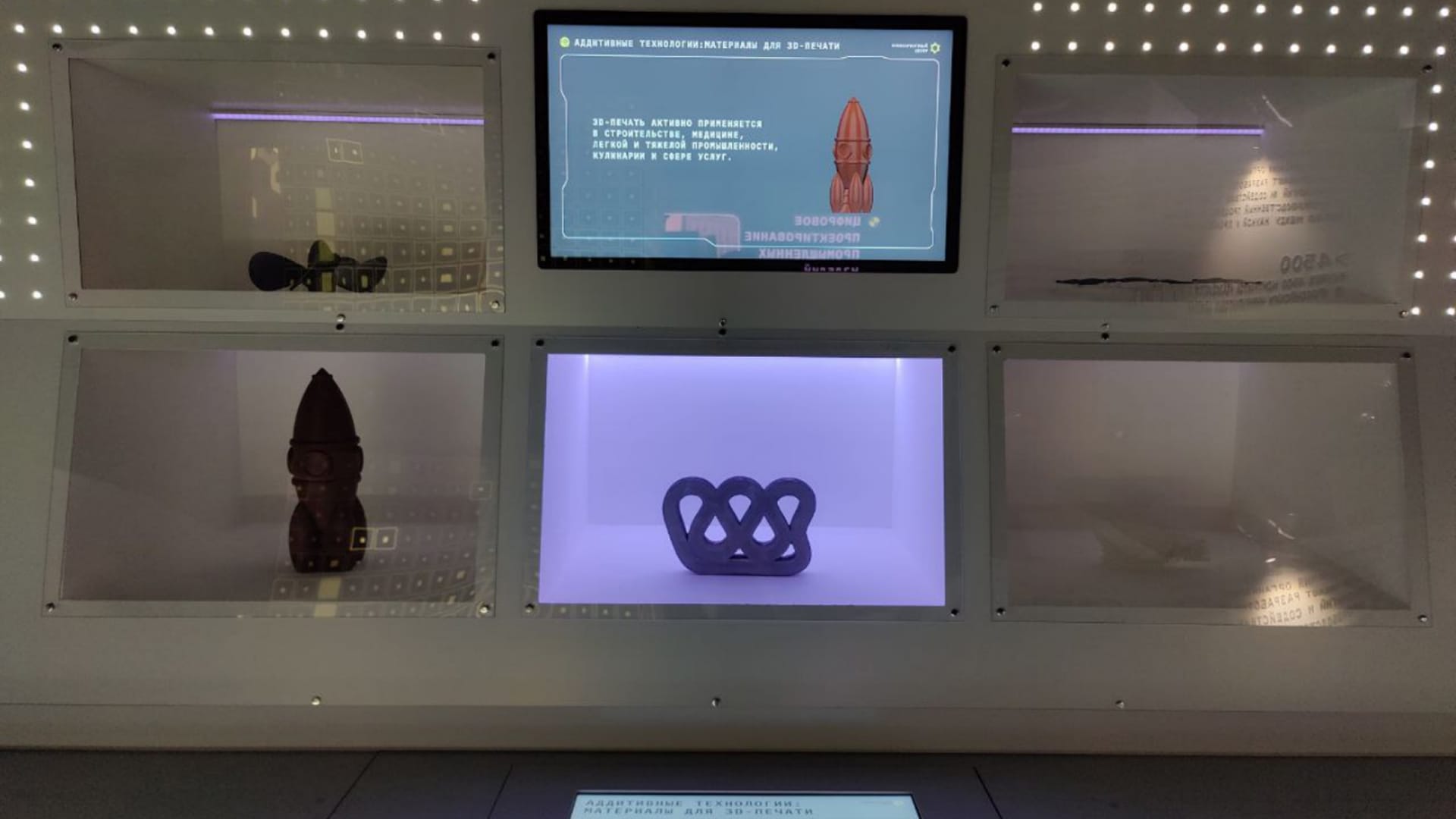
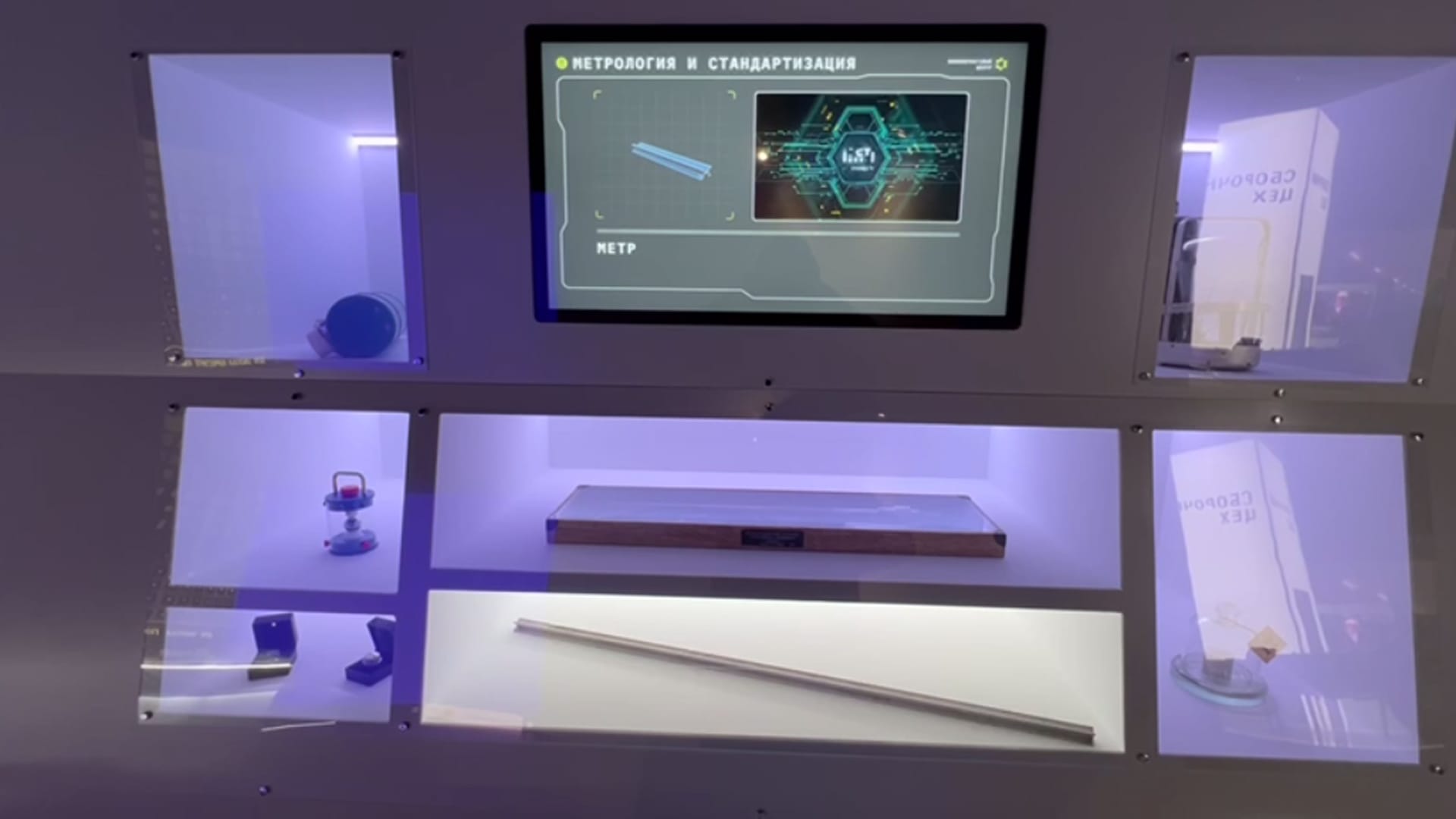
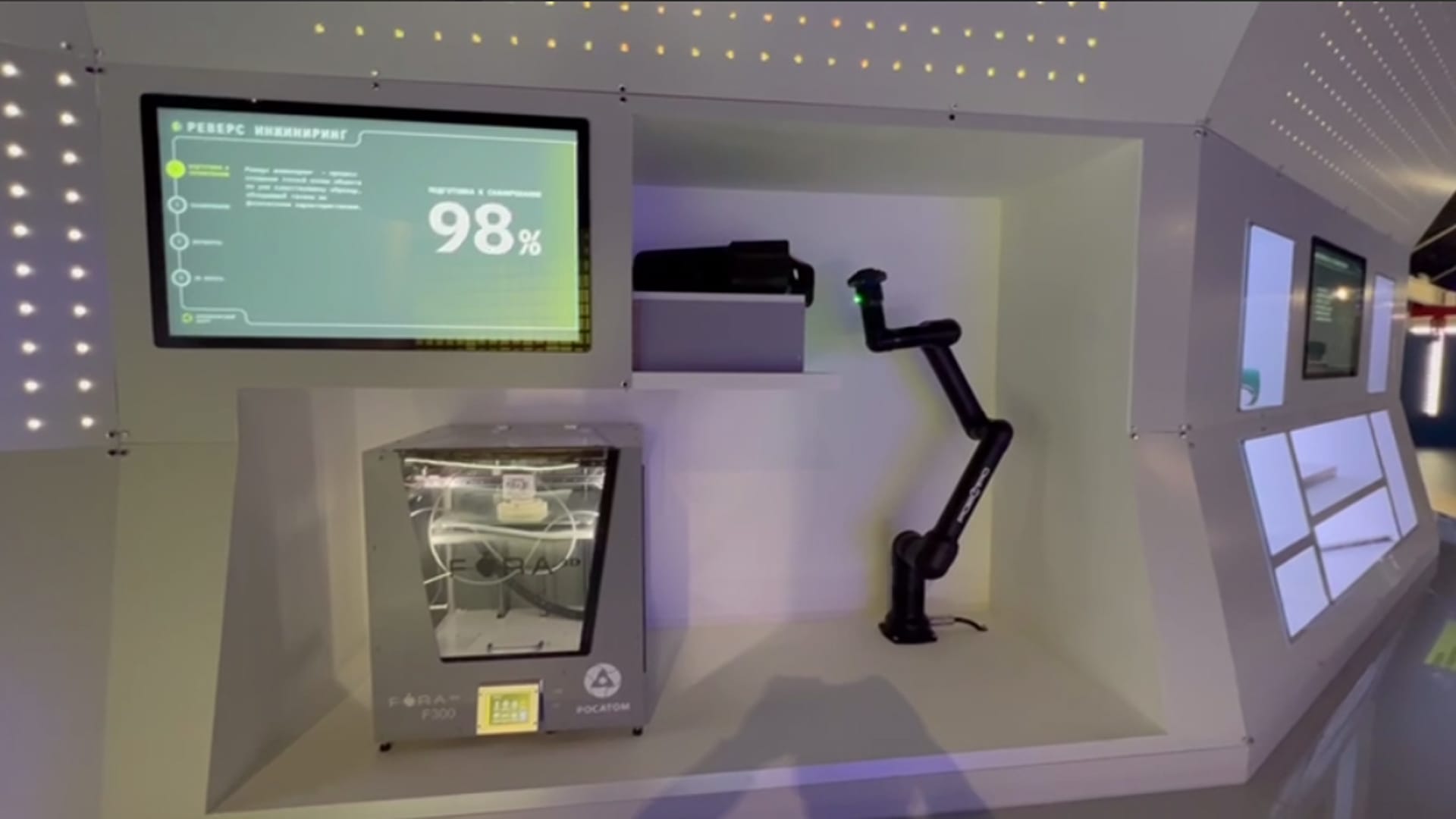
“3D Printing Materials” — a touch table with five printed items and a screen above display cases with real samples. “Metrology and Standardisation”: the visitor chooses a unit — metre, mole, ampere — and sees a 3D model of the standard and a video. “Reverse Engineering” — the process step by step, with a robotic arm and a 3D printer alongside. “Artefacts” — a touch catalogue of Russian PCs and equipment: Beshtau, Aquarius and other manufacturers.
How it is built
Touch screens — horizontal 1920×1080 and vertical 1080×1920 (“Support Measures”, “Light Industry”).
The games use physical controls: a spinner for the farm machinery; a button, a slider and a spinner in the “Laboratory of the Future”; a rotating VR periscope for the vessels.
The drone game is designed for 3840×2160 resolution.
The “Industry Map” has two outputs: the interface on the terminal and the image for the wall map.
The 2023 “Engineering Centre” stations are built into light walls with points of light: a screen above, a touch panel or table below, and display cases with exhibits alongside. All of them share the hall’s unified interface: grey screens, yellow-green accents and a monospaced font.
Result
On 2 July 2024, six days before the exhibition closed, we filmed the exhibits being used by visitors; on the same day we also filmed the 2023 installations in operation — the “Computing Core”, the crash test, the digital twin and metrology. According to Argumenty i Fakty, more than 2 million people had visited the “Made by Us” pavilion by 4 July 2024; according to Lenta.ru, an average of 11 thousand a day.