Exhibitions · 2026
Multimedia for the Ministry of Agriculture of Russia’s “Source of Life” exhibition at the International Youth Festival 2026
Exhibitions / Multimedia for the Ministry of Agriculture of Russia’s “Source of Life” exhibition at the International Youth Festival 2026
About the project
Fourteen multimedia installations and videos for the Ministry of Agriculture of Russia’s “Source of Life” exhibition at the International Youth Festival in Yekaterinburg, September 2026.
The International Youth Festival took place in Yekaterinburg on 11–17 September 2026. The Ministry of Agriculture of Russia presented its “Source of Life” exhibition there, at Ekaterinburg-Expo: more than 1500 m² and seven themed zones on agriculture and ecology — water and ecology, Baikal, crop farming (“We Grow”), livestock farming (“We Care”), food (“We Feed”), international cooperation and agricultural education.
We created the multimedia for the exhibition: scripts, interface design, graphics and animation, software for the screens and touch panels, and on site, commissioning and support throughout the festival. Fourteen installations and videos in all; the texts and interfaces are in Russian and English.
Year
2026
Industry
Exhibitions
Scope of work
14 multimedia installations and videos
Venue
Ekaterinburg-Expo, Yekaterinburg — International Youth Festival 2026
- 14
- multimedia installations and videos
- 2
- languages of texts and interfaces: Russian and English
- 11.09.2026
- festival opening
The task
The exhibition shows young people from Russia and other countries what agriculture has become: high-tech, with robots, sensors and digital systems. Each zone needed its own way of showing this — in some the guest chooses a topic on a screen, in others they turn a spinner or pick up a handset, in others they watch a video. Working versions of the software had to be delivered by 5 September, and everything had to be set up on site by 10 September, the day before the opening.
What we did
“Drop”
An installation of curved screens in the shape of a drop at the start of the exhibition. On a touch panel the guest chooses one of six themes — “Baikal”, “Forest”, “Sunflower”, “Wheat”, “Livestock and milk”, “Sunflower oil” — and the drop fills up: with a shoal of omul among bubbles, a growing forest, a field of sunflowers, golden wheat, a meadow with a cow and milk, seeds and oil. After a minute without a touch the drop returns to its attract loop of shimmering water.
The “Baikal” digital eco-trail
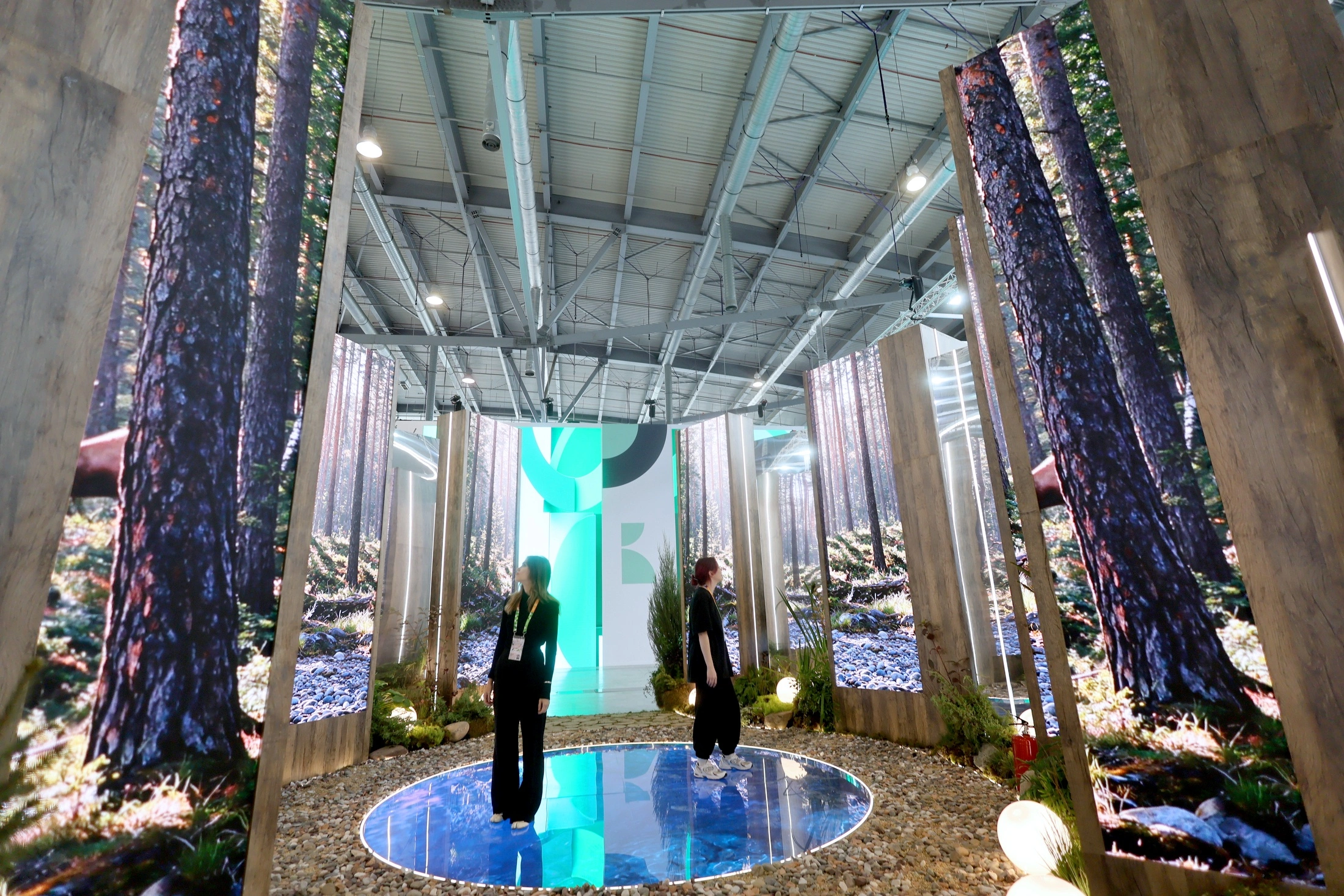
Siberian forest on vertical screens among living fir trees, and a floor screen with the clear water of Baikal, in which a Baikal seal swims.
“Red Book”
A digital book, “The Red Data Book of the Russian Federation. Animals”: its spreads feature the Amur tiger, argali, Mongolian gazelle, European bison, Siberian crane, saker falcon, great bustard, Russian desman and other species, each with its range, population and the measures taken to protect it.
“Our Land”
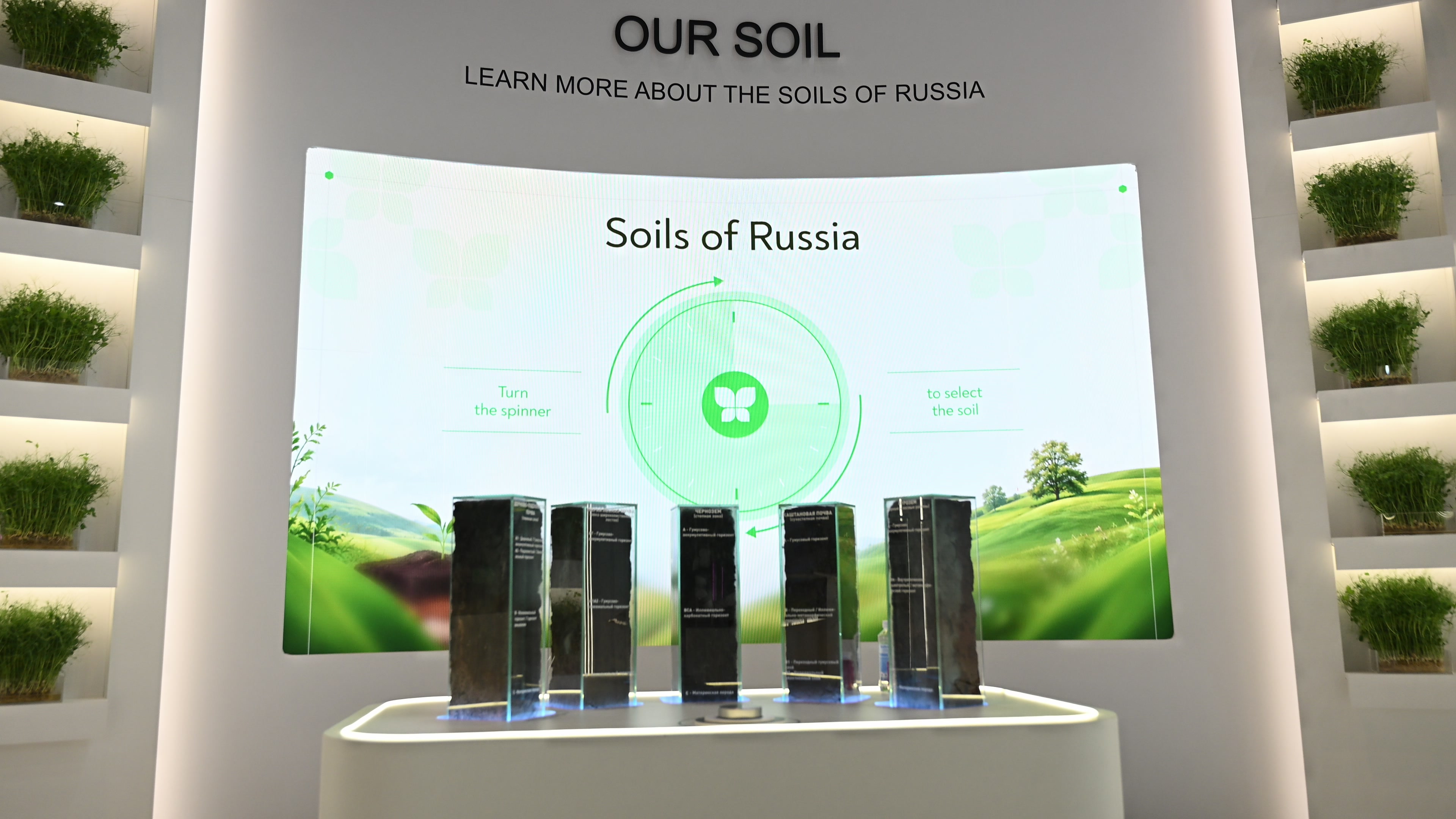
A large screen, with a physical spinner and five transparent columns of soil samples in front of it. The guest turns the spinner and chooses a soil — sod-podzolic, grey forest, chernozem, chestnut or burozem — and the screen raises its profile with a depth scale and a story about where this soil is found, what crops grow on it and what makes working with it interesting for a specialist.
“Scientists Who Changed Agriculture”
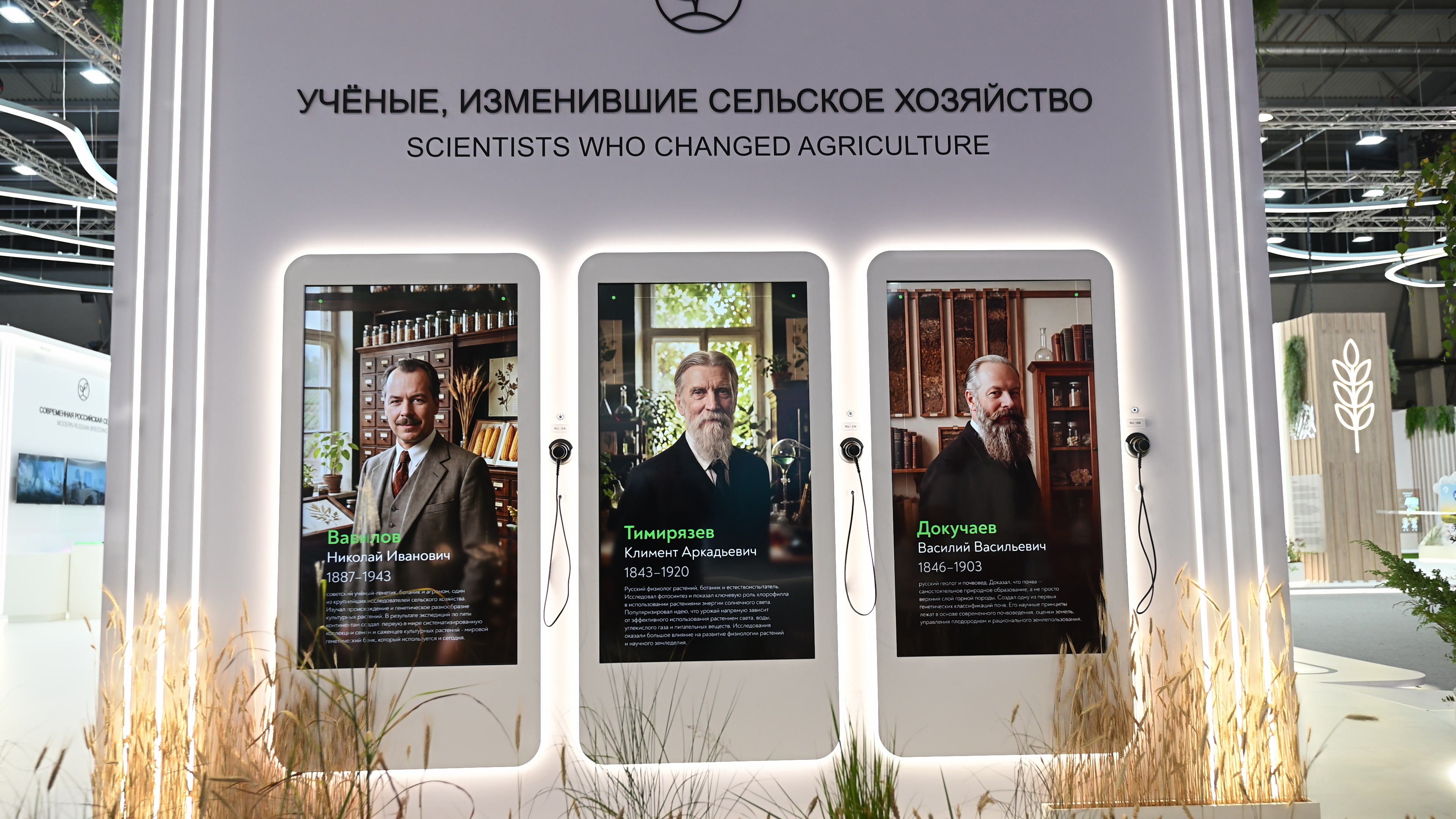
Three vertical screens with portraits of Nikolai Vavilov, Kliment Timiryazev and Vasily Dokuchaev. When a guest picks up the handset by a portrait, the scientist “comes to life” and talks for up to two and a half minutes about himself and about what agriculture has become. A button by the handset switches the language.
“Modern Russian Poultry Farming”
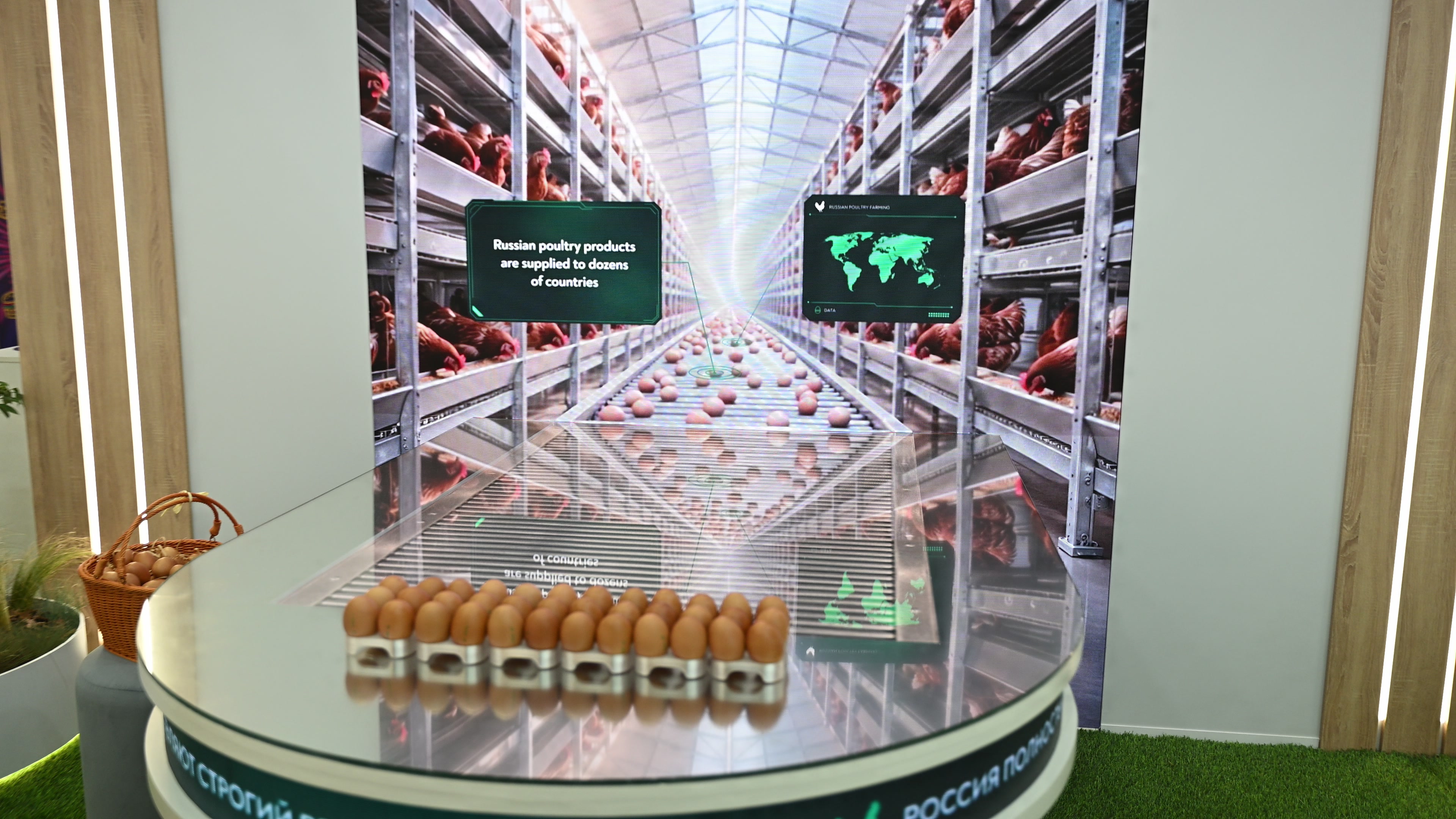
An LED screen above a conveyor table with egg boxes: on the screen a stream of eggs travels along a digital conveyor towards the guest, overlaid with infographics on egg production, automation and exports, while a ticker about poultry farming runs along the end of the table. Subtitles appear first in Russian, then in English.
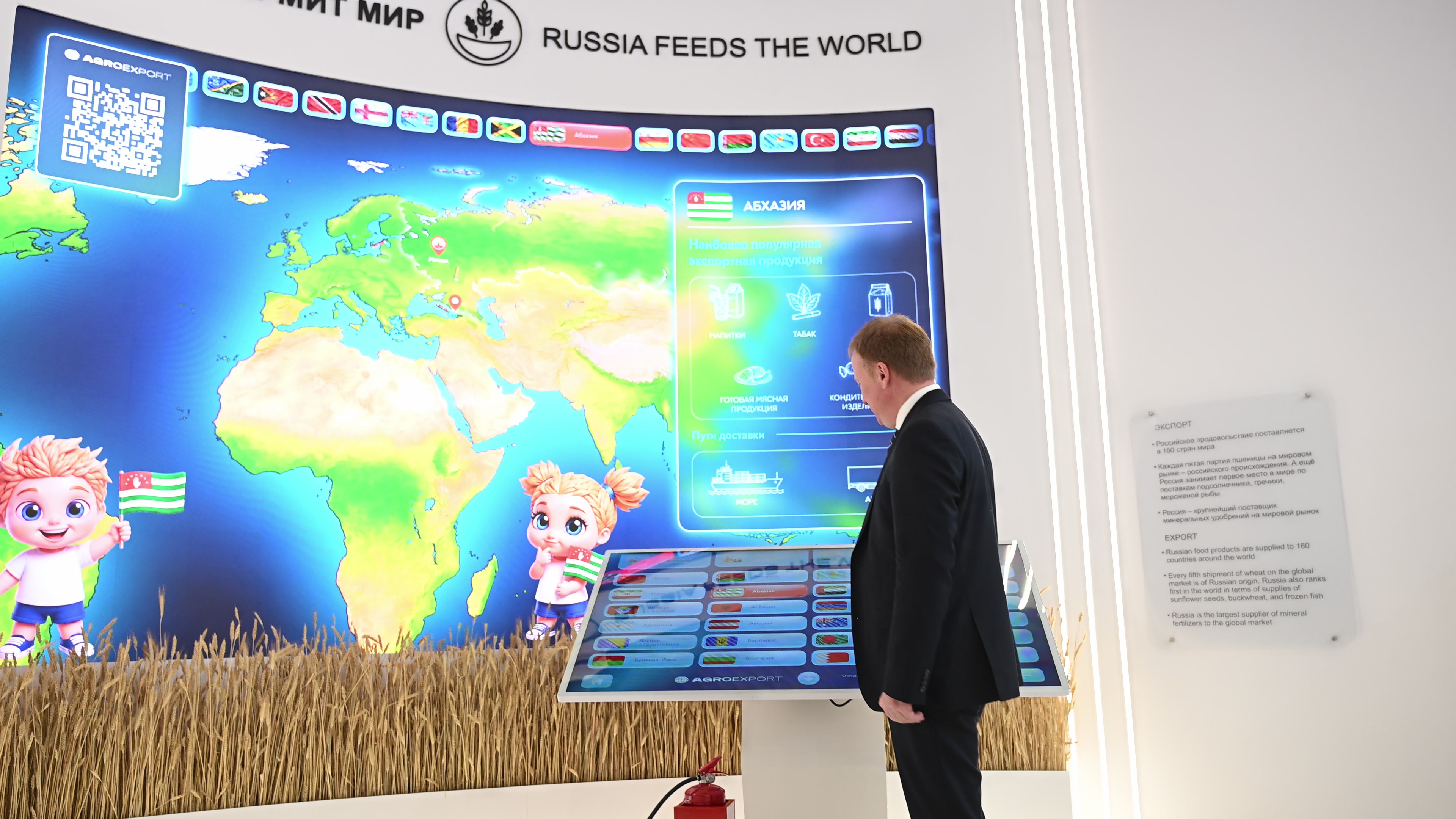
“Russia Feeds the World”
An interactive map: a large screen with a world map and a separate touch table with a list of countries. Three modes — “Food”, “Agritech” and “Imports”. When the guest chooses a country, a card opens on the map with the main Russian exports to it and the delivery routes (sea, rail, road, air), and Kolosok and Pshenichka raise that country’s flag.
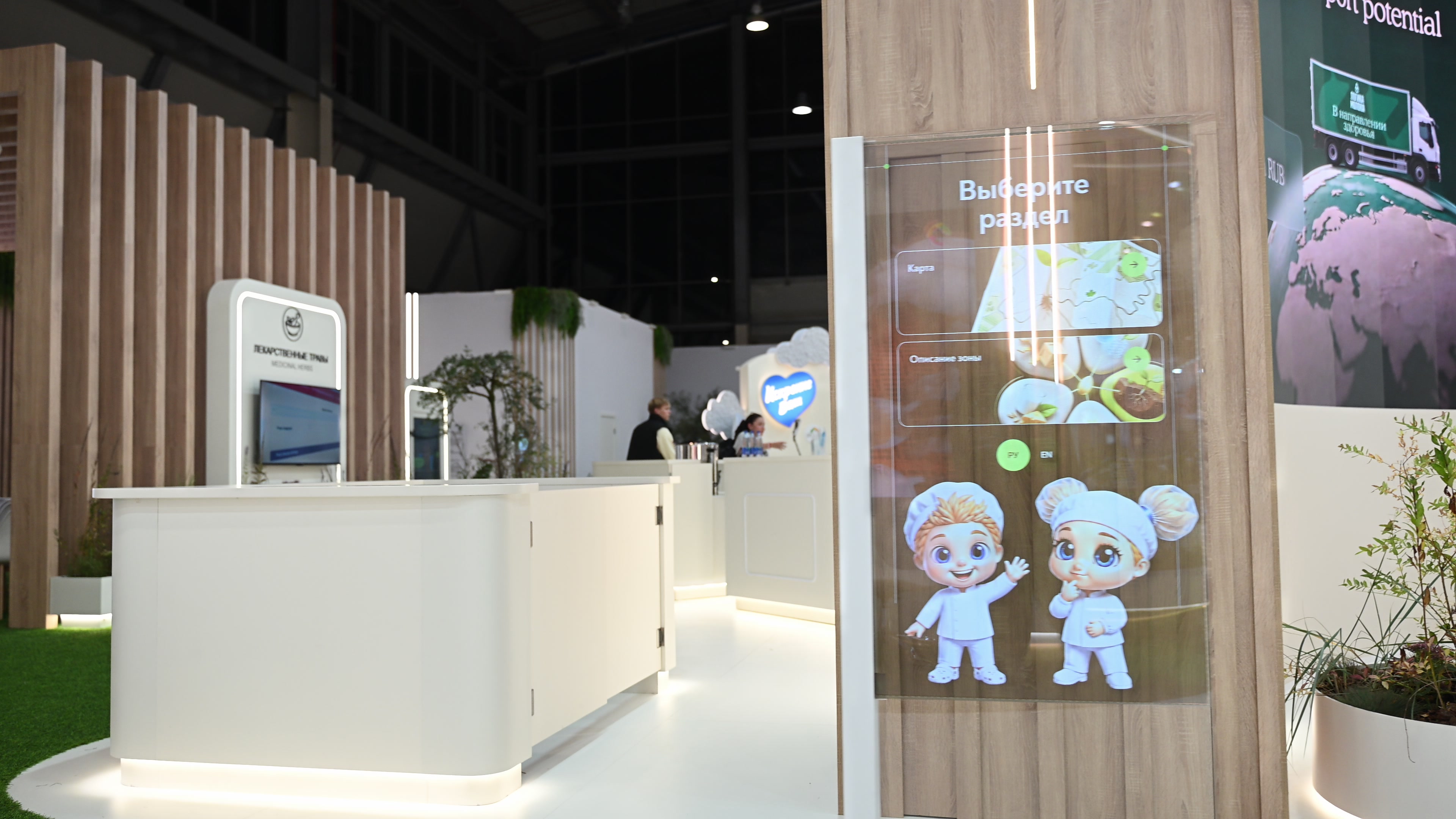
Kolosok and Pshenichka
Transparent touch panels in the zones, with guide characters dressed to suit each zone: a map of the exhibition with a “you are here” marker and a story about the zone. We generated and animated twelve versions of the characters in the costumes of the different zones.
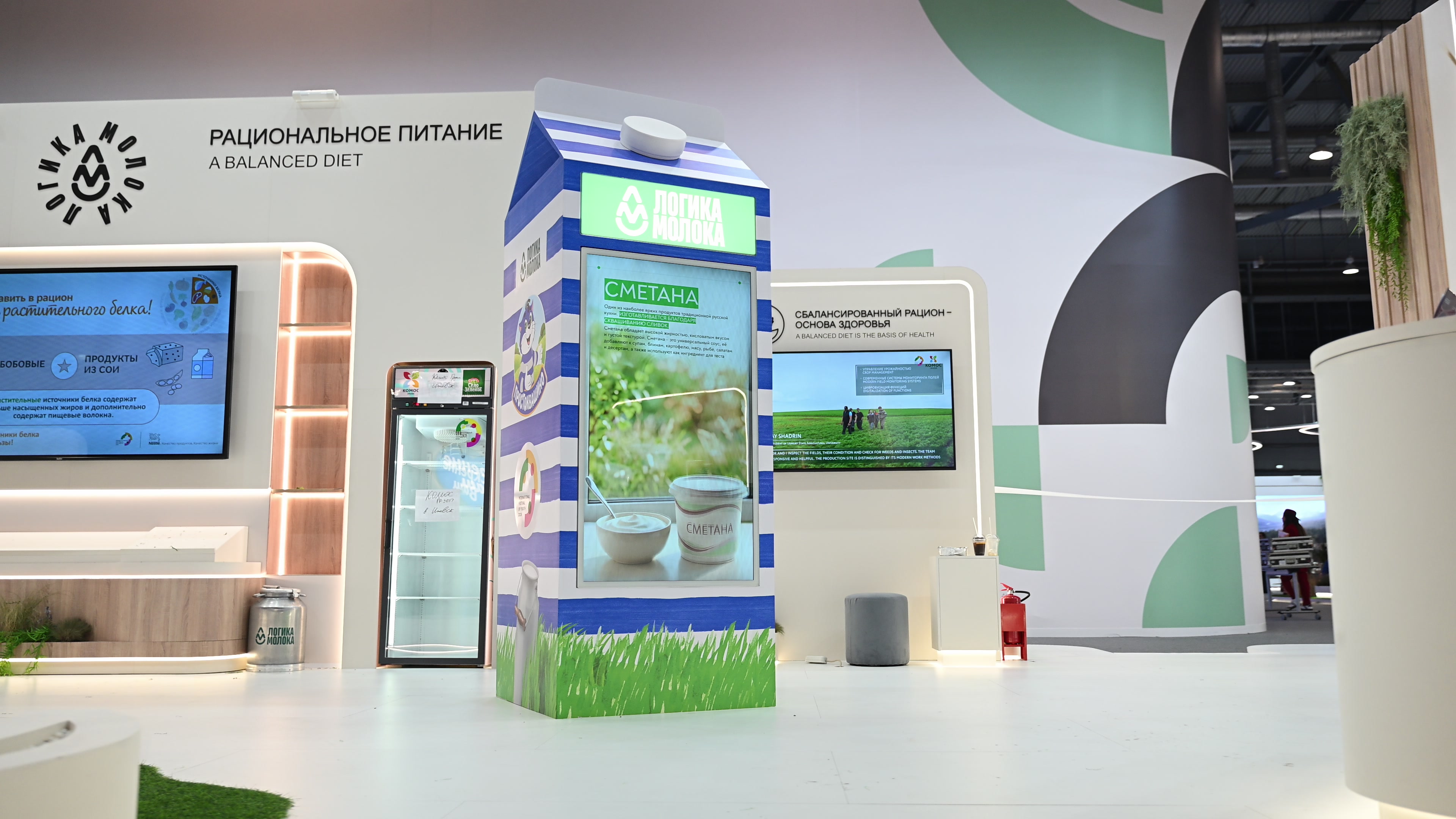
“Milk Carton” and “Cheese”
Vertical touch screens inside objects shaped like a milk carton and a piece of cheese: slides on dairy products and cheesemaking, and at the press of a button a quiz — in the milk one, ten questions with four answer options, the correct answer with an explanation, and a score at the end.
The “Tastes of Russia” fridge
A screen shaped like a fridge door, with magnets from ten regions of the world. When a guest touches a magnet, the door opens to reveal products from that region; touching a product shows which Russian raw materials it can be made from.
“Balanced Nutrition” video
A 48-second animated video on five rules of balanced nutrition — with a plate, food and infographics, and captions in two languages.
AI photo booth “You in the World of Agribusiness”
A booth with a camera and a screen: the guest chooses a zone — “Source of Life”, “We Grow”, “We Care”, “We Feed” or “Export” — a neural network places their face into a story scene, and the finished photo is collected via a QR code. A separate “Try on a mask” mode offers a squirrel, hare, bear or lynx.
Idents
Splash screens for the displays — for example, the “Source of Life” start screen.
How it is built
The interface language is switched on the screen or with a button.
The “Our Land” spinner and the soil sample lighting are linked to the software via the OSC protocol; the lighting is driven by controllers that convert Art-Net to DMX.
The scientists’ portraits are triggered by telephone handsets: pick up the handset and the story begins; hang it up and the screen returns to the portrait.
The spinner, the three handsets, the lighting controllers and six Logitech BRIO 4K cameras for the photo booth are our own equipment, which we provided for the duration of the festival.
The graphics, characters and backgrounds were created with generative neural networks and then animated.
Result
The exhibition was open throughout the festival, 11–17 September 2026; it was visited by the Minister of Agriculture, Oksana Lut. The floor screen with the seal, the “digital images” of Vavilov, Timiryazev and Dokuchaev, Kolosok and Pshenichka, and the digital Red Book are mentioned in publications about the exhibition.
Similar projects
-
 Animated presentation on climate and agriculture for Roshydromet
/2026 — Exhibitions
Animated presentation on climate and agriculture for Roshydromet
/2026 — Exhibitions
-
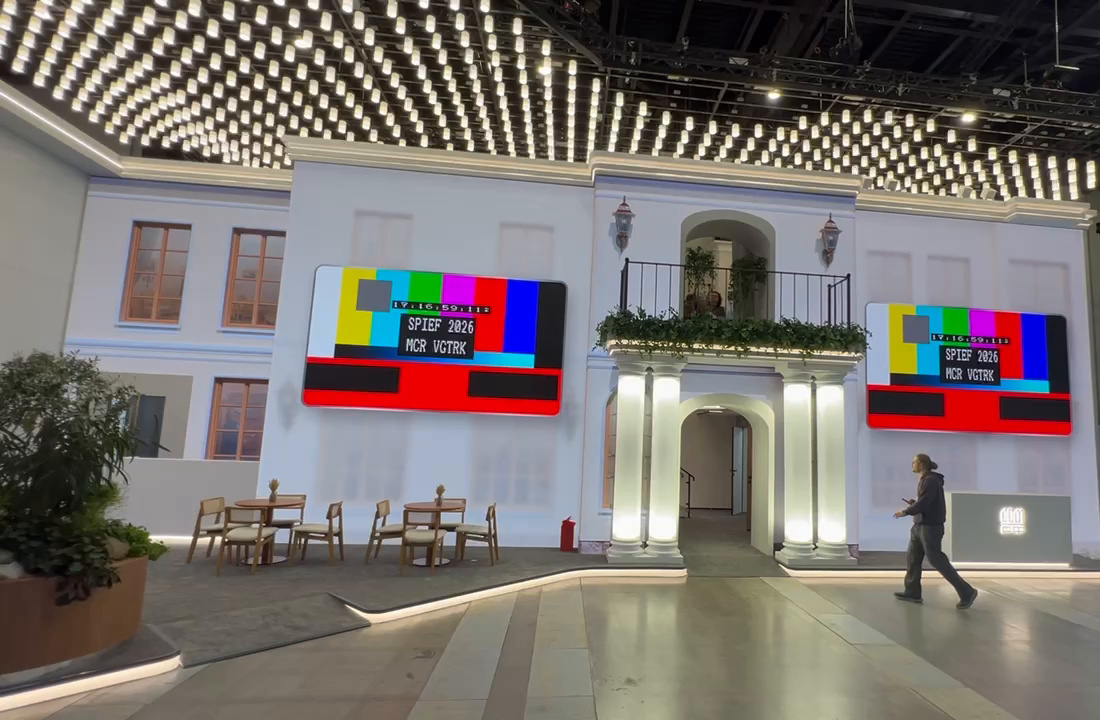 Software for the DOM.RF stand screens at SPIEF 2026
/2026 — Exhibitions
Software for the DOM.RF stand screens at SPIEF 2026
/2026 — Exhibitions
-
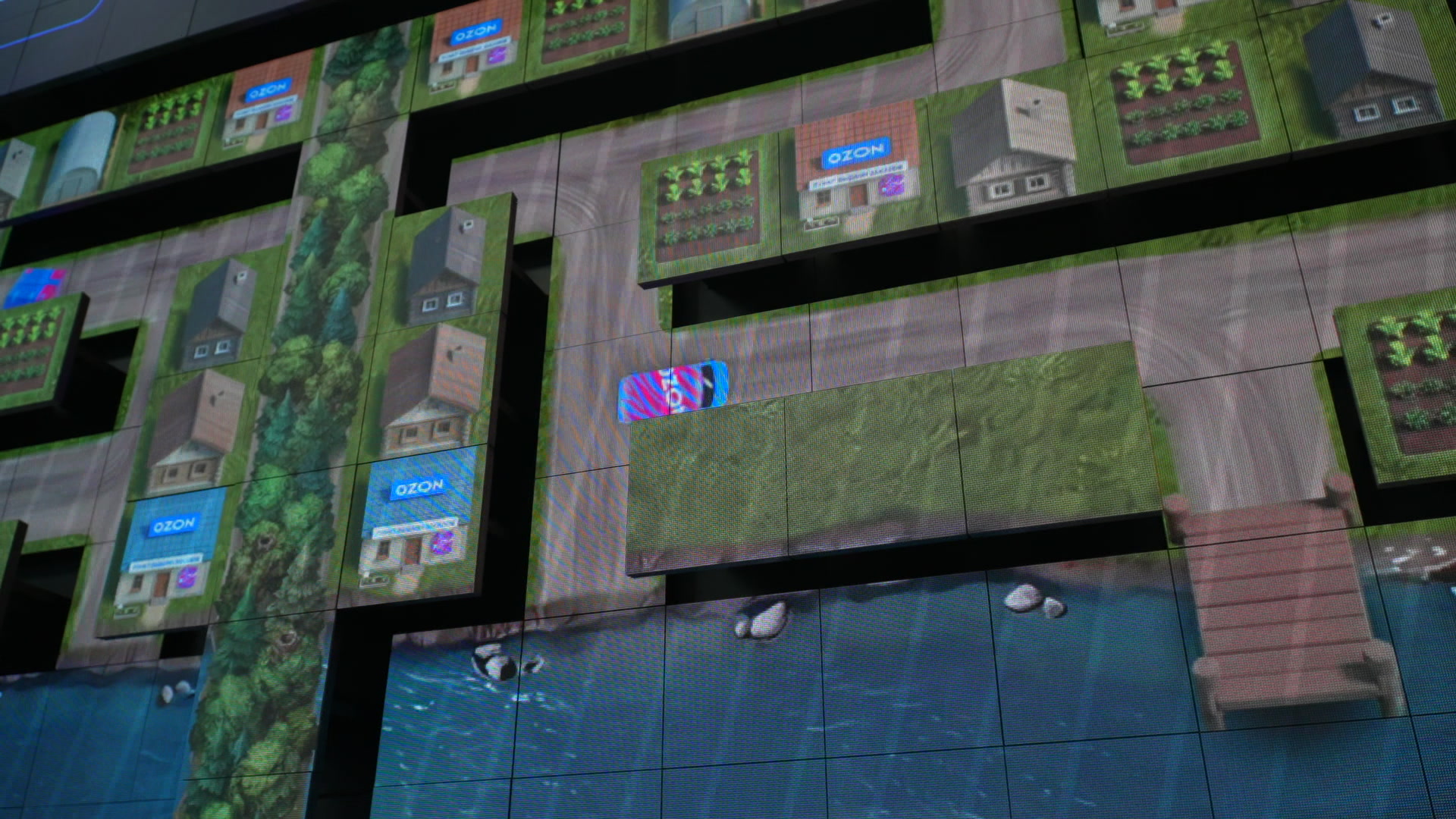 Kinetic screen game for the Ozon stand at SPIEF 2026
/2026 — Exhibitions
Kinetic screen game for the Ozon stand at SPIEF 2026
/2026 — Exhibitions
-
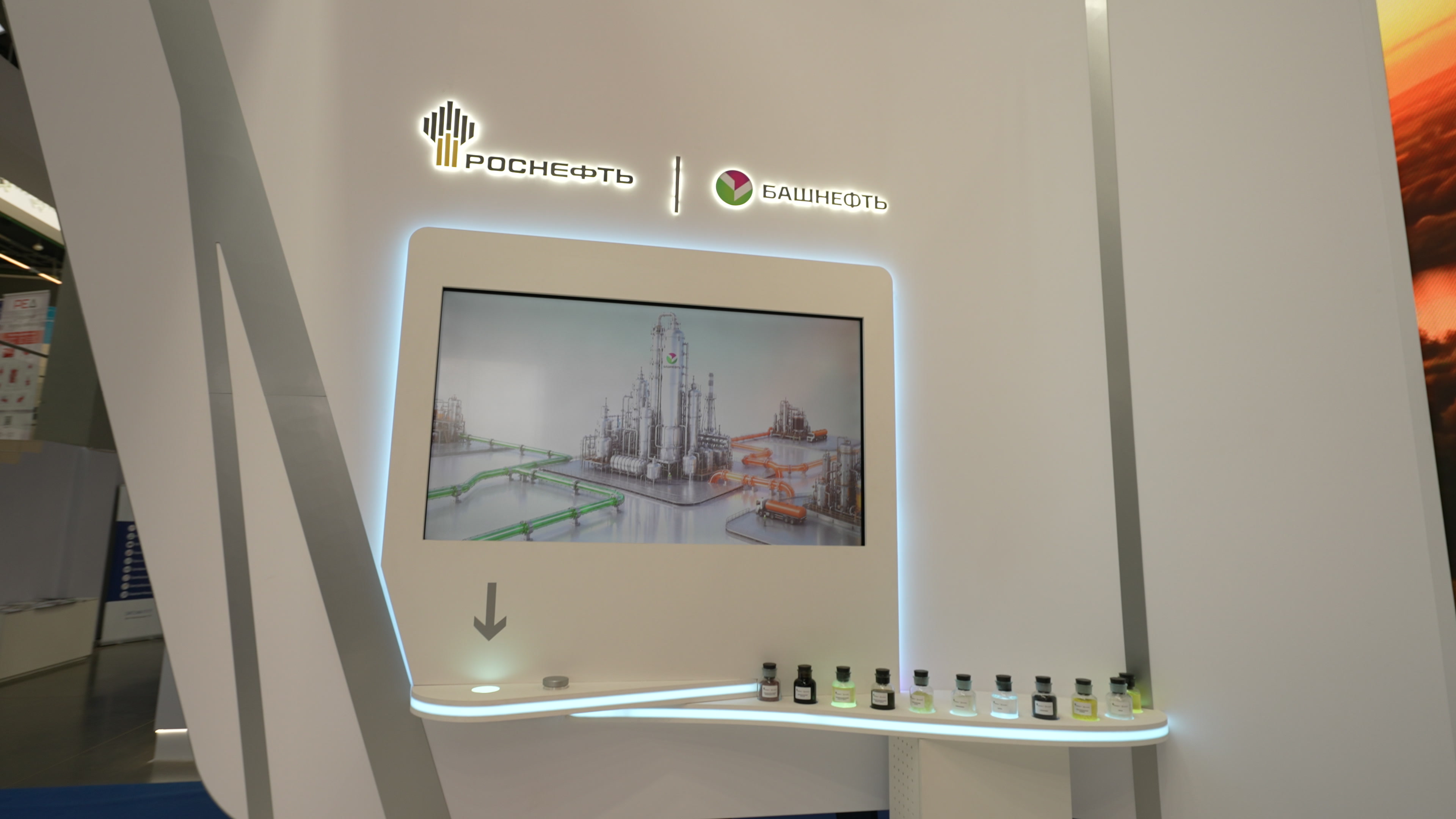 Interactive zone of the Bashneft stand at “Gas. Oil. Technologies — 2026”
/2026 — Exhibitions
Interactive zone of the Bashneft stand at “Gas. Oil. Technologies — 2026”
/2026 — Exhibitions