Museums · 2022
The Horse Museum
Museums / Horse Museum
About the project
Software for 17 interactive installations at the “Horse Museum” at VDNKh: touch screens, projections, sensors in objects and a shared content management system.
On 28 December 2022, the “Horse Museum” opened in Pavilion No. 42 at VDNKh. It is part of the Centre for National Equestrian Traditions, which VDNKh is creating together with the Kremlin Riding School. The exhibition runs from the evolution of the horse to breeds, biology, equestrian professions, cavalry, art, sport and the world’s riding schools.
We made the software side of the museum: touch-screen applications, projection control, the links between screens, objects and sensors, and a system in which museum staff change texts, photos and videos themselves. In total, 17 installations in ten zones.
Year
2022
Industry
Museums
Scope of work
17 interactive installations and a content management system
Venue
Centre for National Equestrian Traditions, Pavilion No. 42, VDNKh, Moscow
- 17
- interactive installations
- 10
- zones with our installations
- 28.12.2022
- museum opens at VDNKh
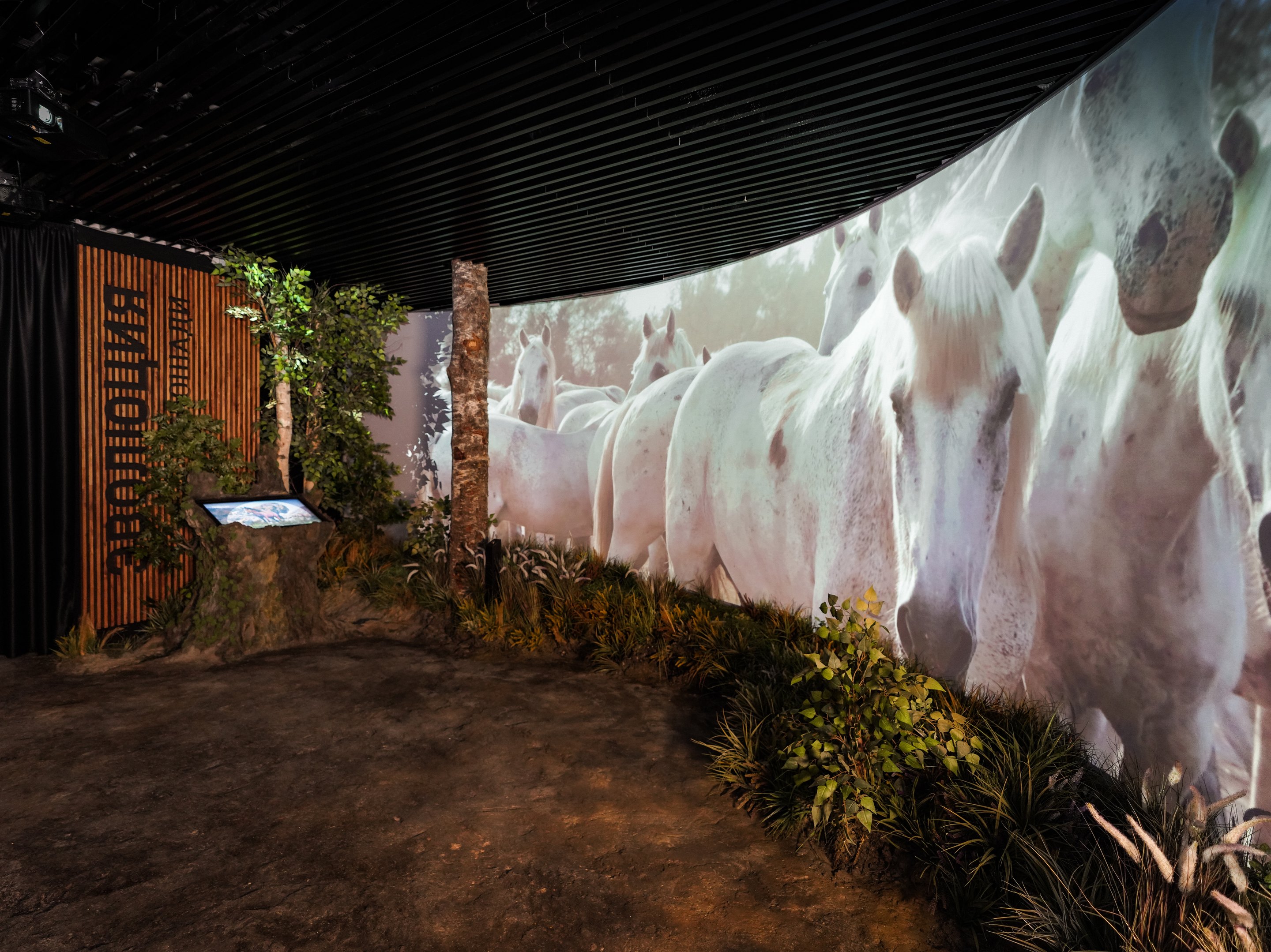
“Evolution of the horse”: a panoramic projection with a herd of horses and a touch screen in a “stone”
The task
Under the concept, the museum is meant for a broad public — VDNKh visitors, school and tourist groups, equestrian professionals — and interactivity was to be at its core. Each zone needed its own way of interacting: here a screen, there a projection, elsewhere an object you pick up. The museum also had to grow without developers: staff add new facts, photos and videos themselves.
What we did
Evolution of the horse
A panoramic projection with a video on the evolution of the horse — an intro and the main narrative with a narrator; a button on a stand starts it and selects the language. Next to it, a touch screen built into a “stone” shows the evolutionary tree: the visitor chooses one of the ancestors — Eohippus, Mesohippus, Merychippus, Pliohippus — or the modern horse and compares them.
In “Gaits”, the wall shows the walk, trot, pace and gallop with the average speed of each. In the centre is a screen with a quiz: the visitor listens to a gait through headphones and identifies it from an animation.
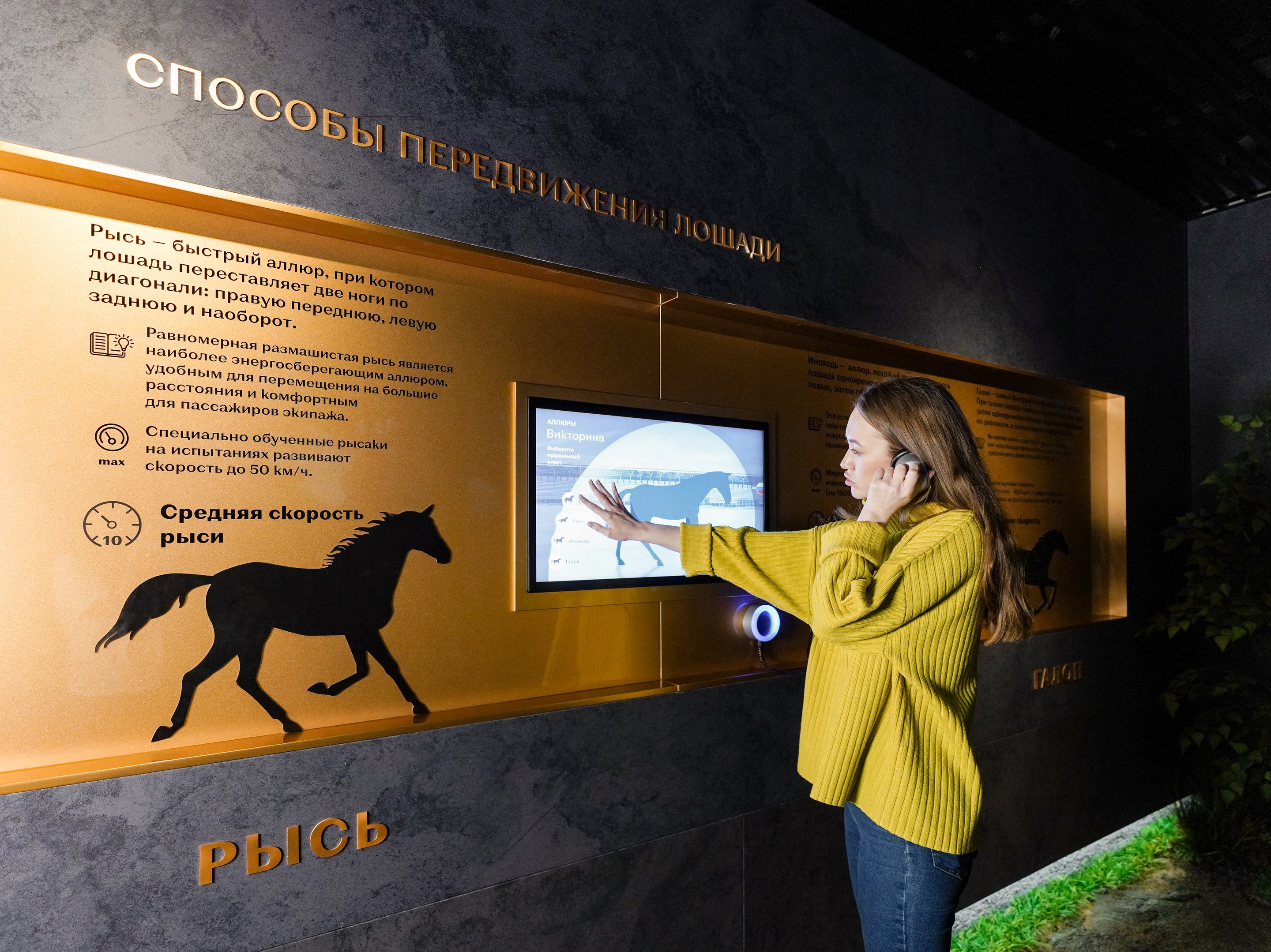
“Gaits”: a visitor taking the quiz with headphones
Breed groups
A wall with a printed world map: markers are projected onto it, and a touch launches an animation about a breed; several people can touch the wall at once. A touch screen with a two-level classification of breeds — a section, then a breed with photos, video, text and infographics. “Three breeds” is a transparent touch screen in front of a niche with sculptures of an Akhal-Teke, an Arabian and an English Thoroughbred: the sculptures are visible through the screen, with facts about the breeds displayed over them.
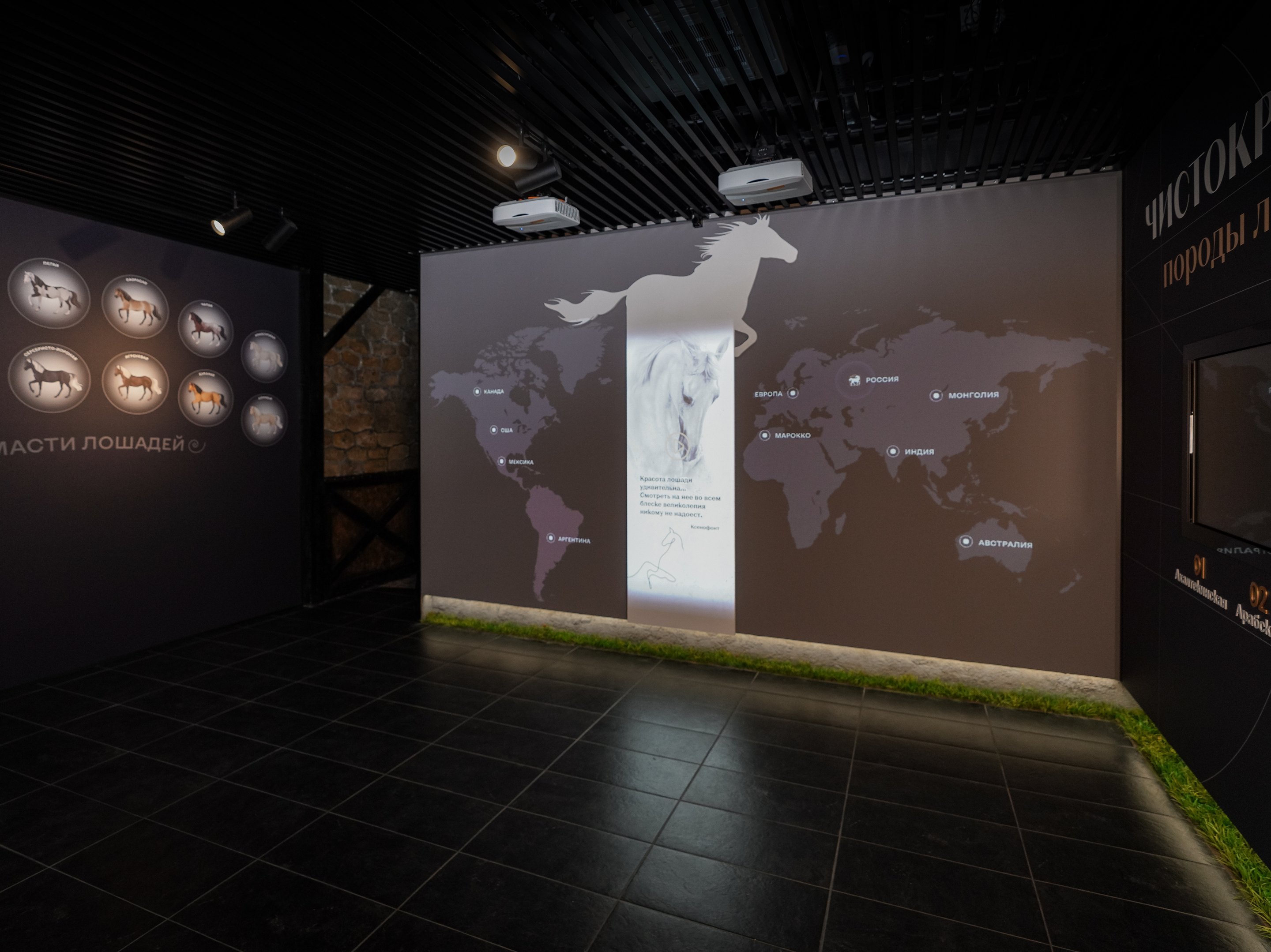
“Breed groups”: the wall with the breed map and projection
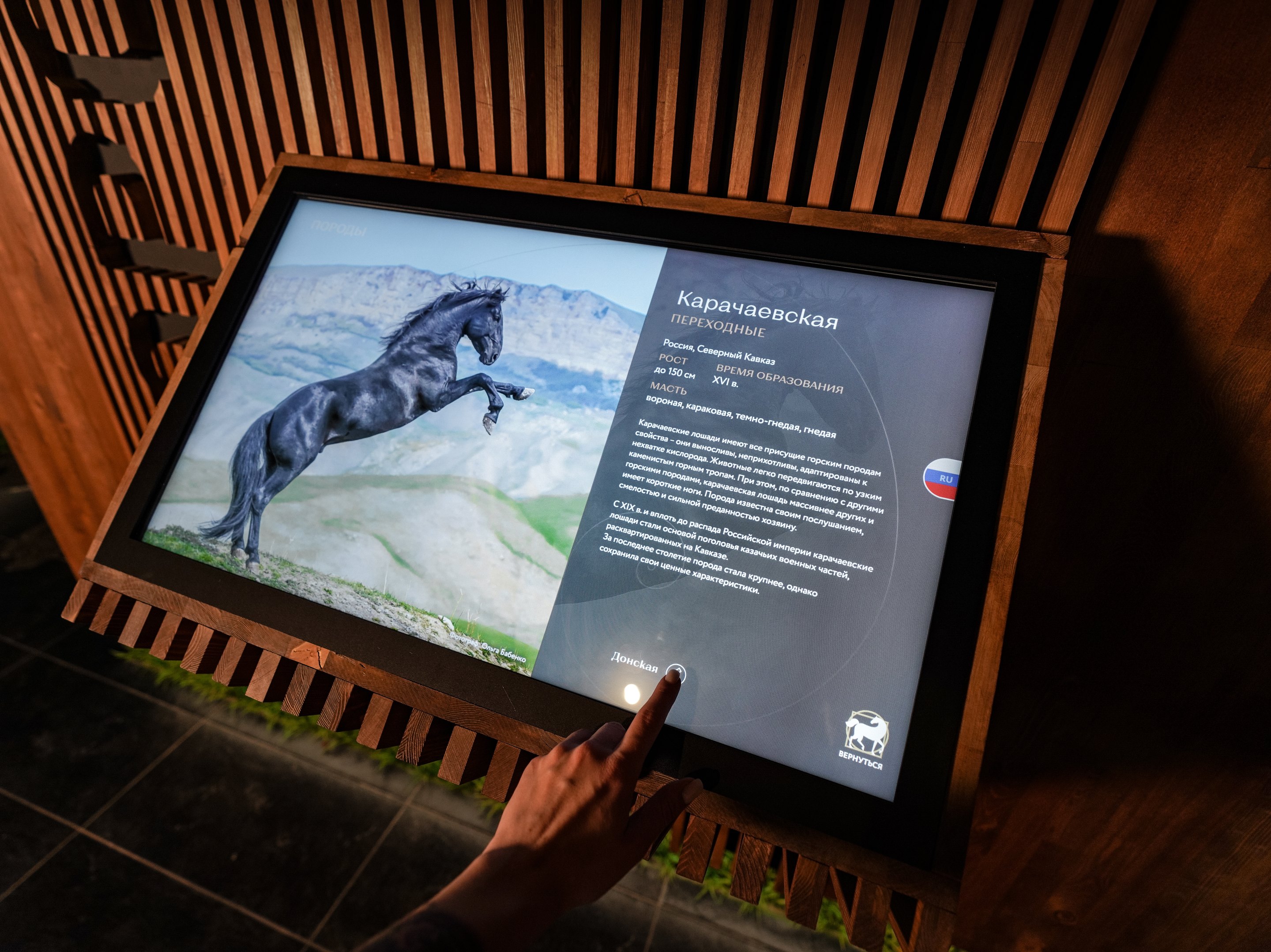
“Breed groups”: touch screen, the Karachay breed card
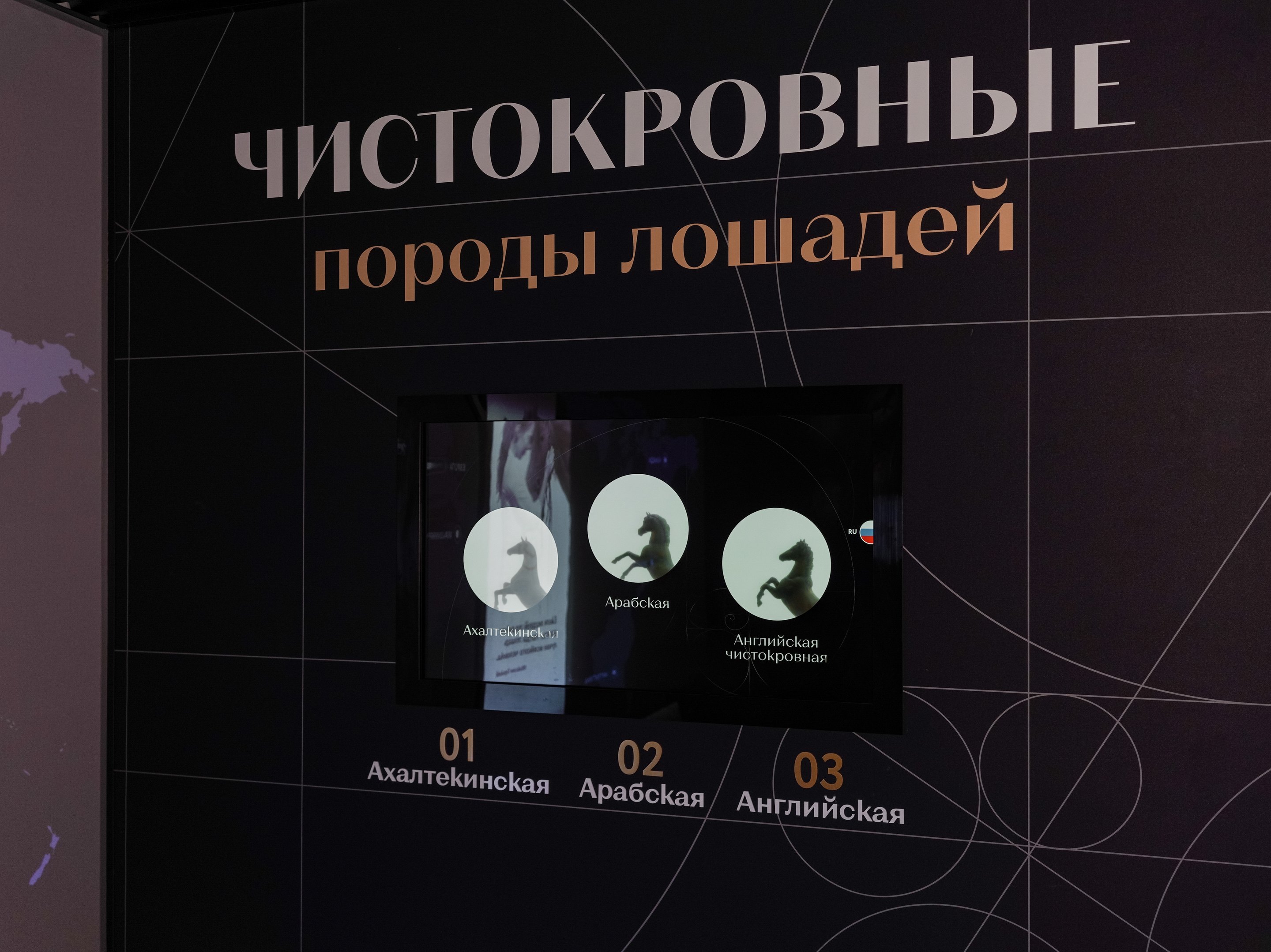
“Three breeds”: the transparent touch screen “Purebred horse breeds”
Biology of the horse
A touch console in front of a projection: the visitor chooses a topic on an image of a horse — the sense organs, breathing, circulation, movement and others — and an animation with sound starts on the wall.
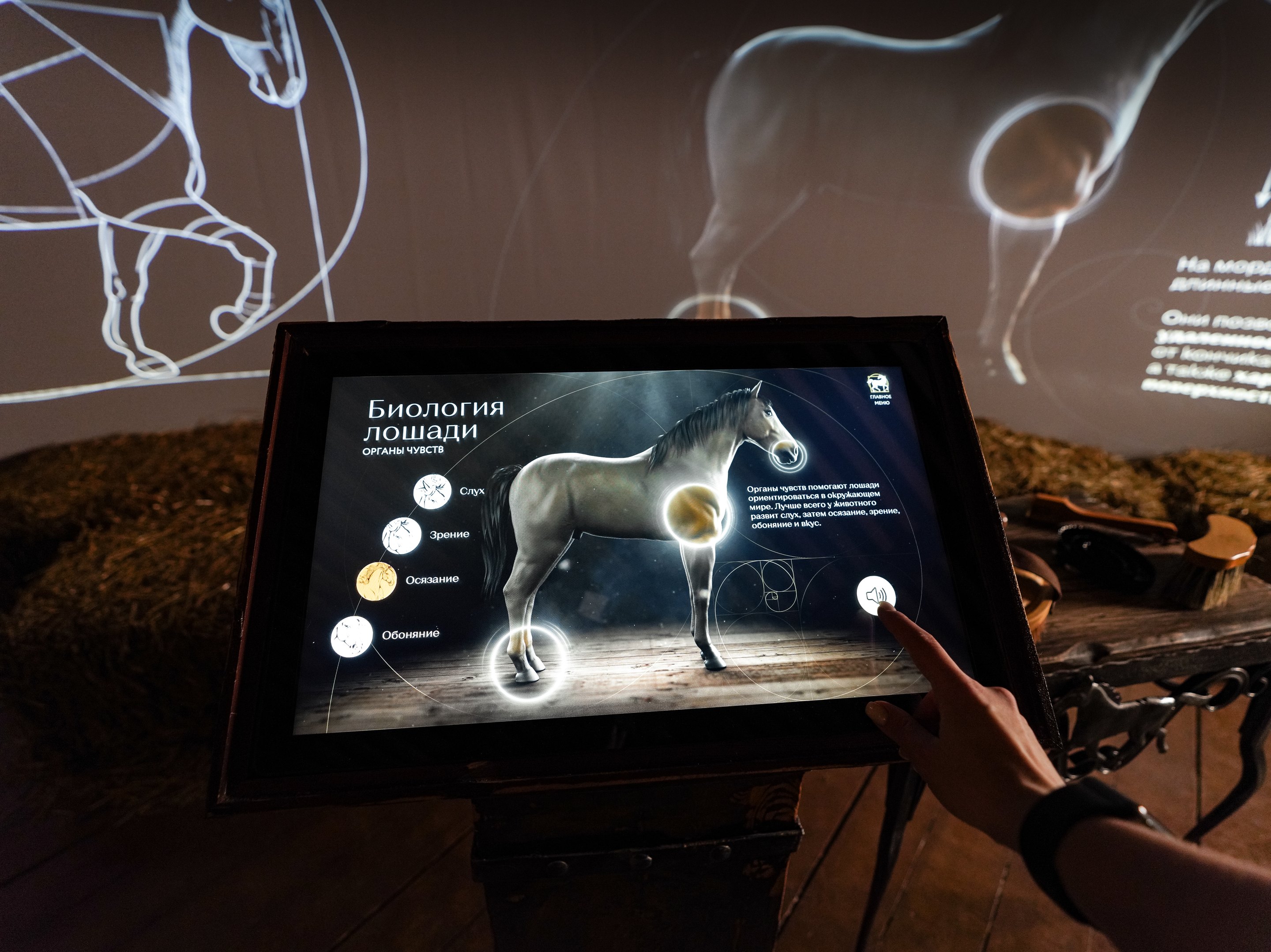
“Biology of the horse”: touch console, the “Sense organs” section
The workshop
The “Horse tack” projection surrounds a real bridle, saddle and stirrup on the wall. In “Professions in the world of horses”, the tools of a vet, a blacksmith, a farrier and a saddler lie on a workbench with marker hints: the visitor touches a tool, and a video about the work of that craftsman starts on the screen.
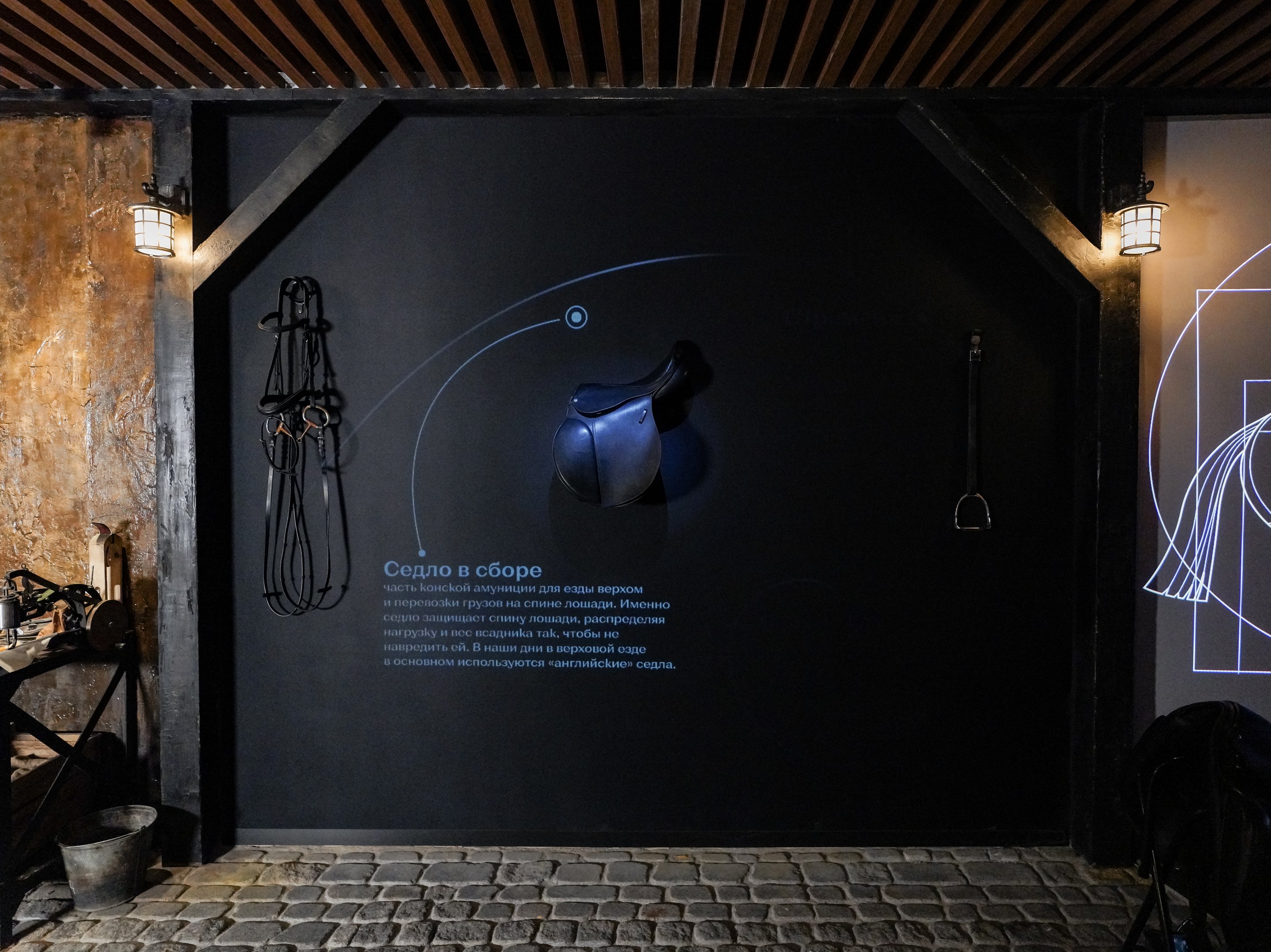
“Horse tack”: the “Complete saddle” projection around the bridle, saddle and stirrup
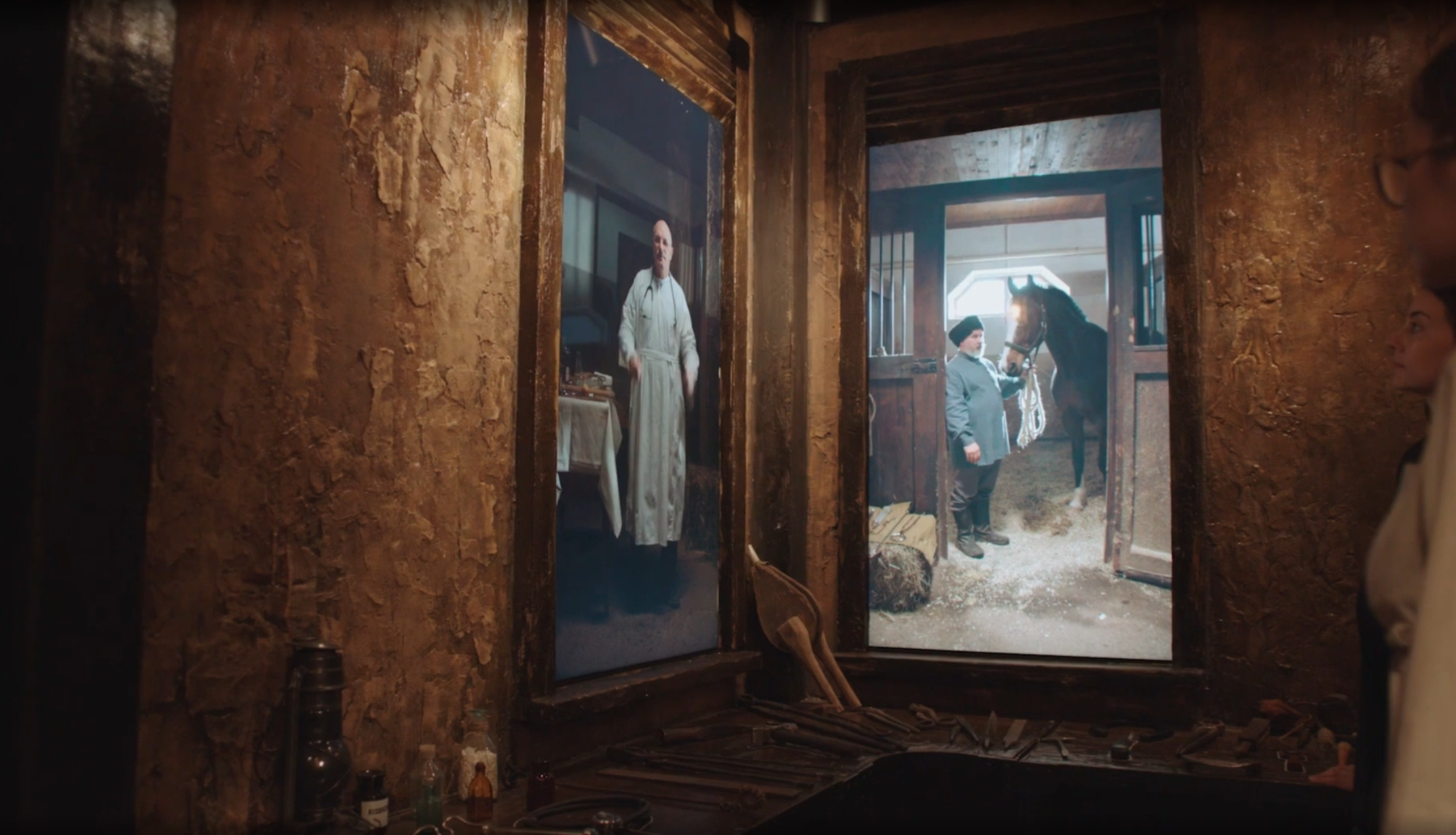
“Professions in the world of horses”: screens with craftsmen above a workbench with tools
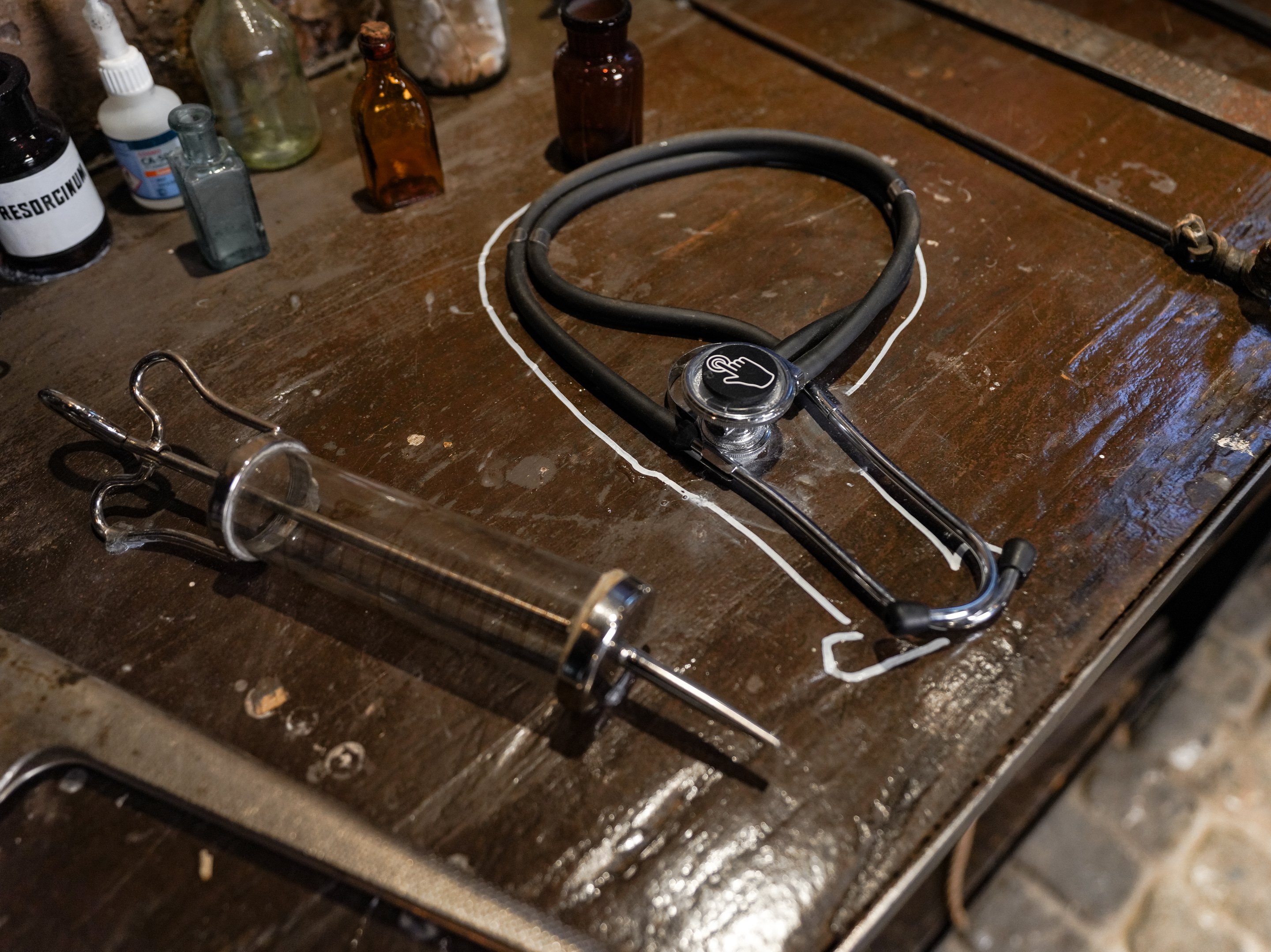
“Professions in the world of horses”: the vet’s tools, a touch marker on the stethoscope
Photo gallery
In the passage between the halls, the sound of a herd that every now and then thunders past the visitors.
Cavalry through the ages
A projection about the horse as a companion of man in battle: an intro and the main film, started in the chosen language with a button on a stand.
The horse in art
A projection onto frames on the wall: paintings with horses arranged by era along a timeline, with the title, artist and year. The paintings are shown in two sessions that alternate in a loop.
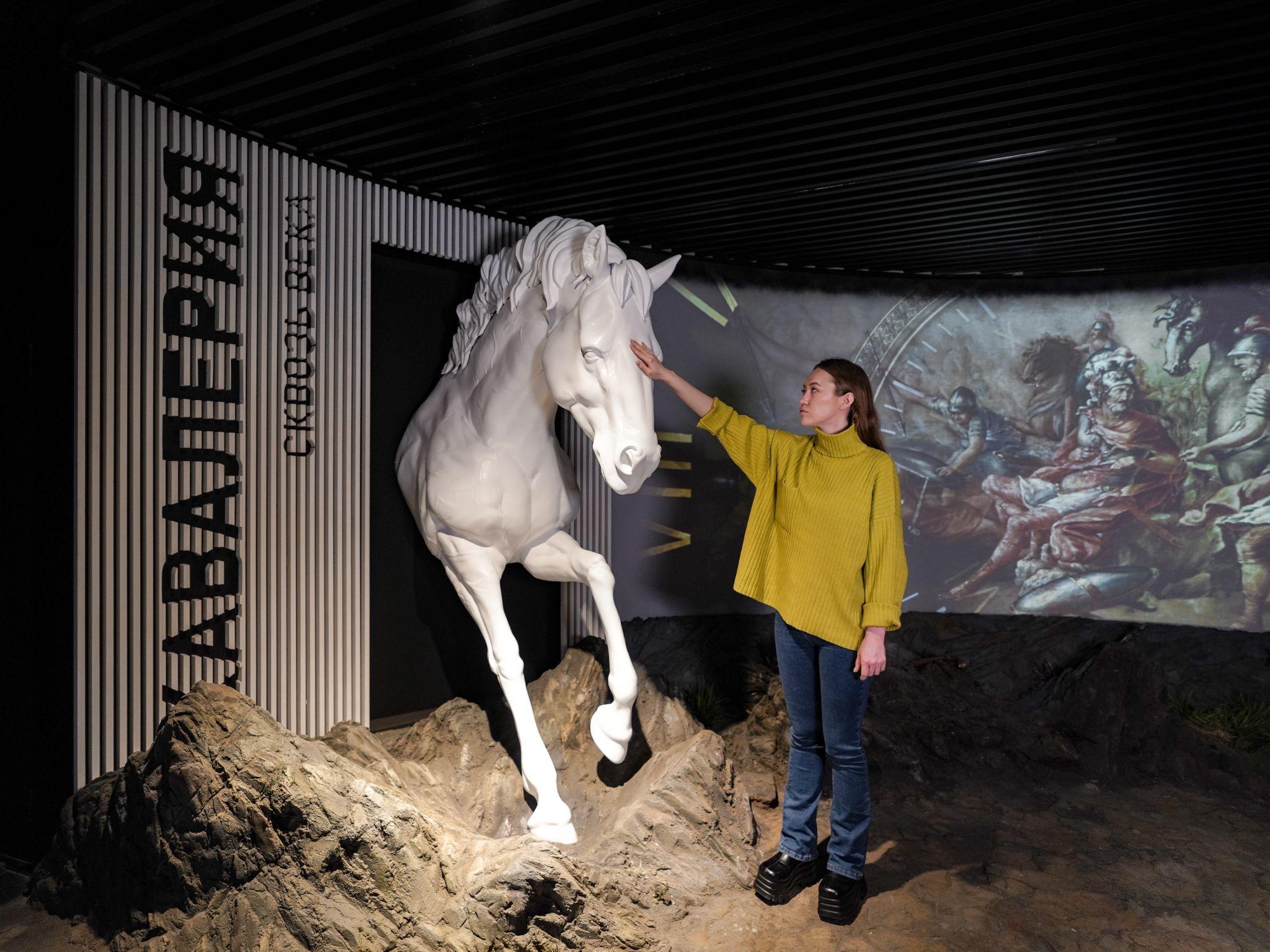
“Cavalry through the ages”: the projection and a white sculpture of a horse
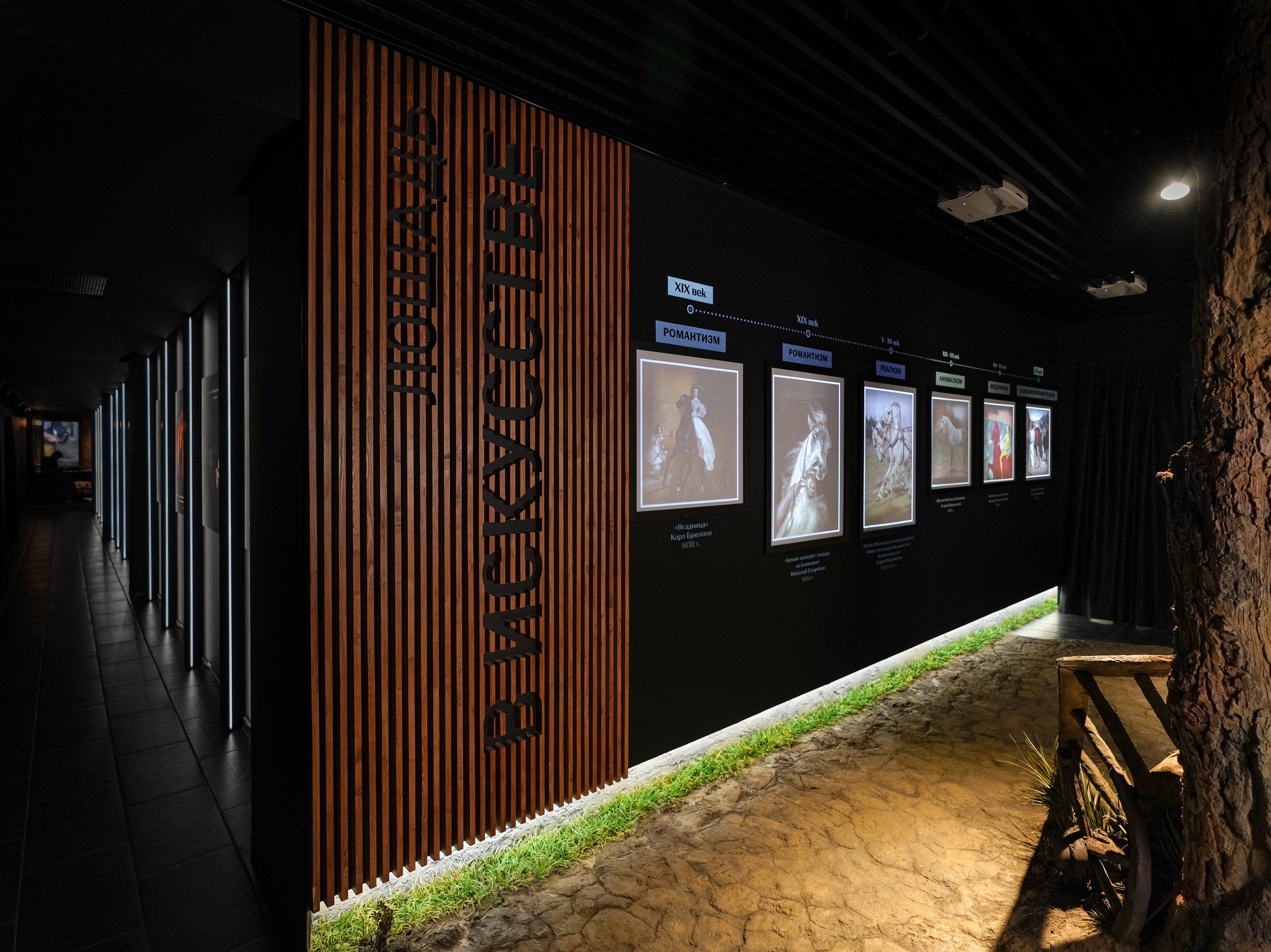
“The horse in art”: paintings projected onto frames along a timeline
National traditions and equestrian sport
A mirror: the visitor places a palm on the handprint next to it, and a story about equestrian traditions begins on the mirror. Two screens with cups: a cup is placed in a socket on the stand, and the screen tells the story of the sport for which that cup was awarded. A touch screen on equestrian sports, horse trials and Soviet records.
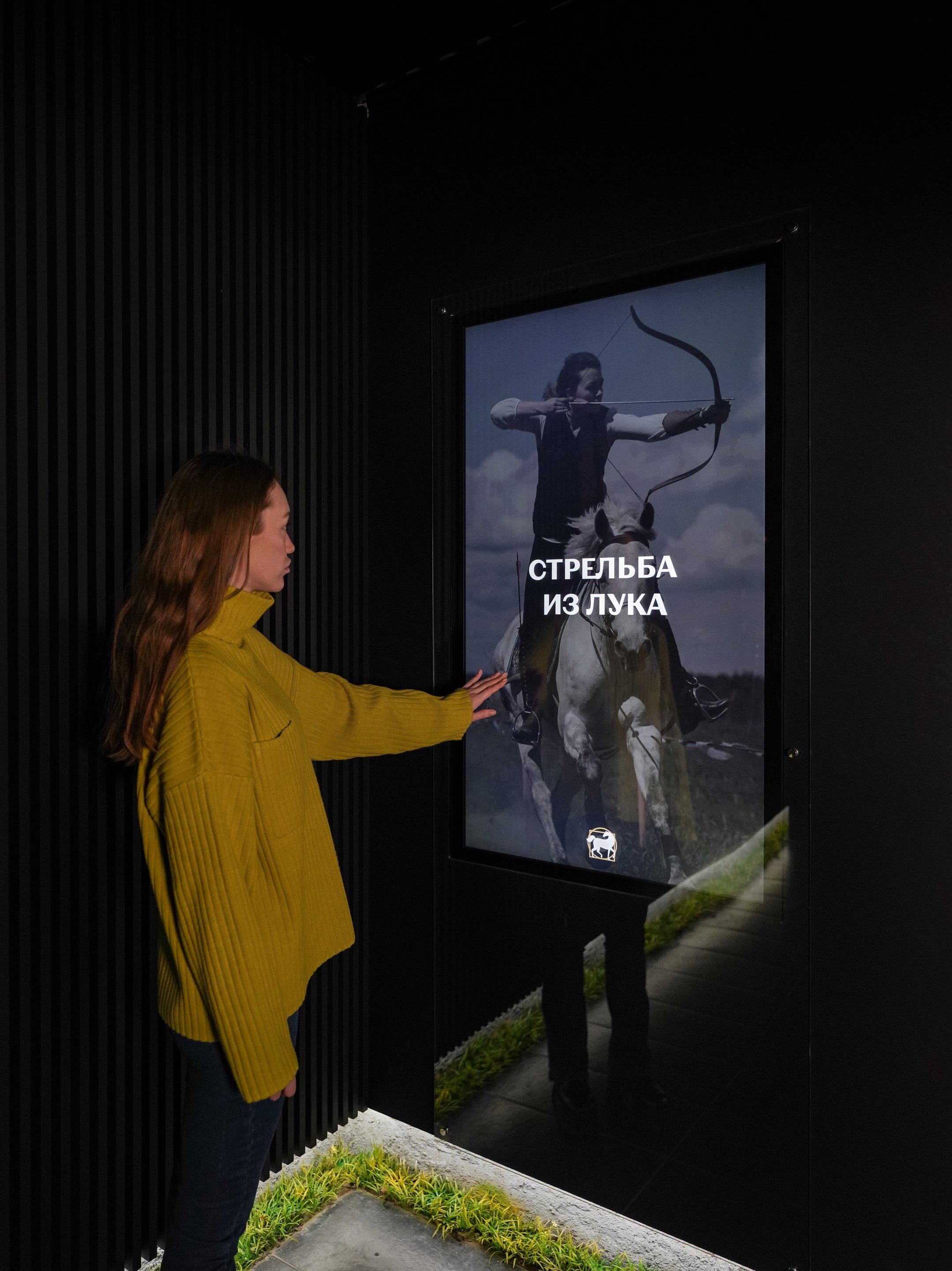
“National traditions”: the mirror, showing “Archery”
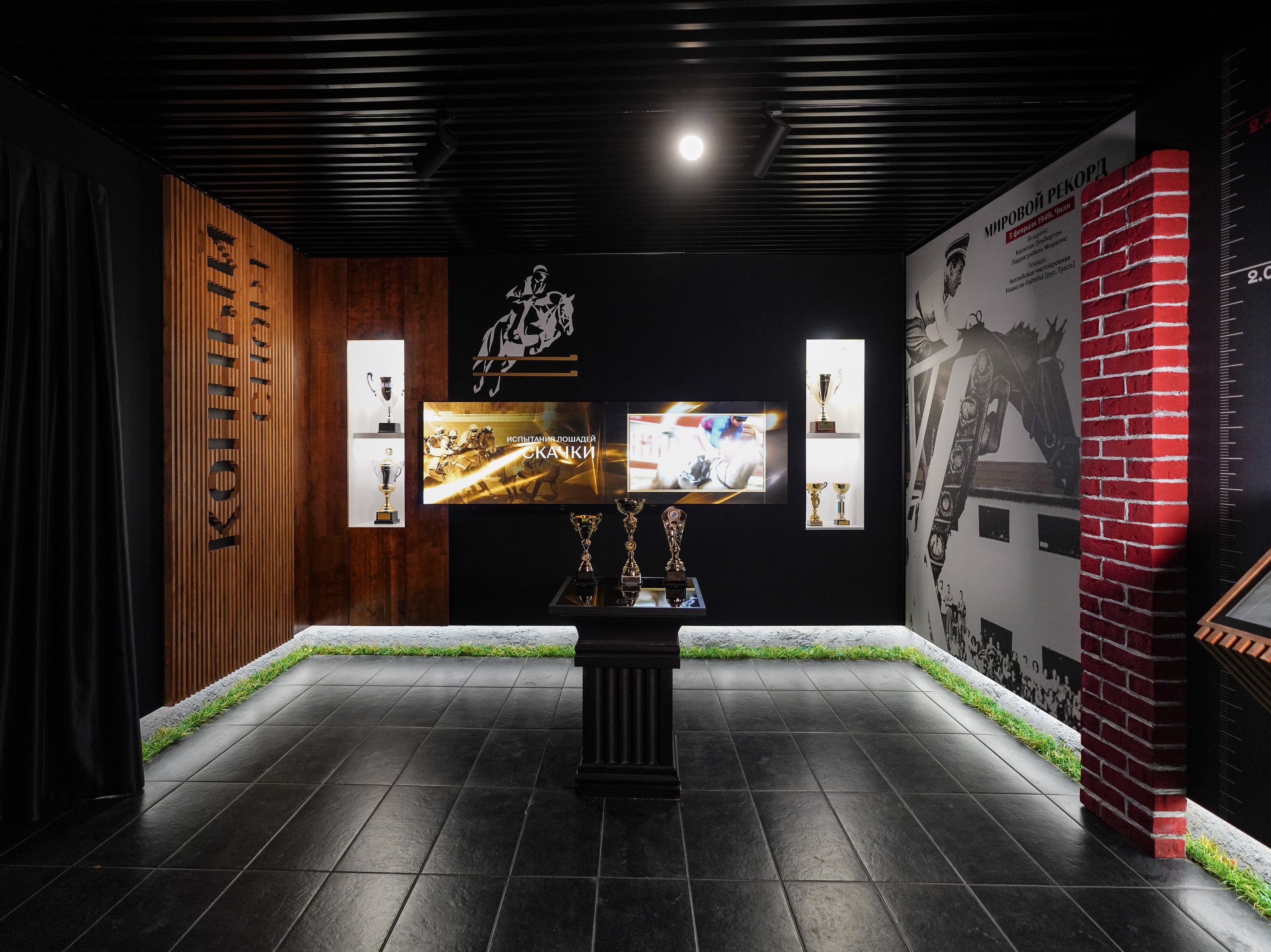
“Equestrian sport”: two screens and the cups on the stand
World riding schools
A projection room about five schools: the Cadre Noir in Saumur, the Spanish Riding School in Vienna, the Royal Andalusian School of Equestrian Art in Jerez de la Frontera, the Portuguese School of Equestrian Art in Lisbon and the Kremlin Riding School. A school is chosen by turning a model built into the table.
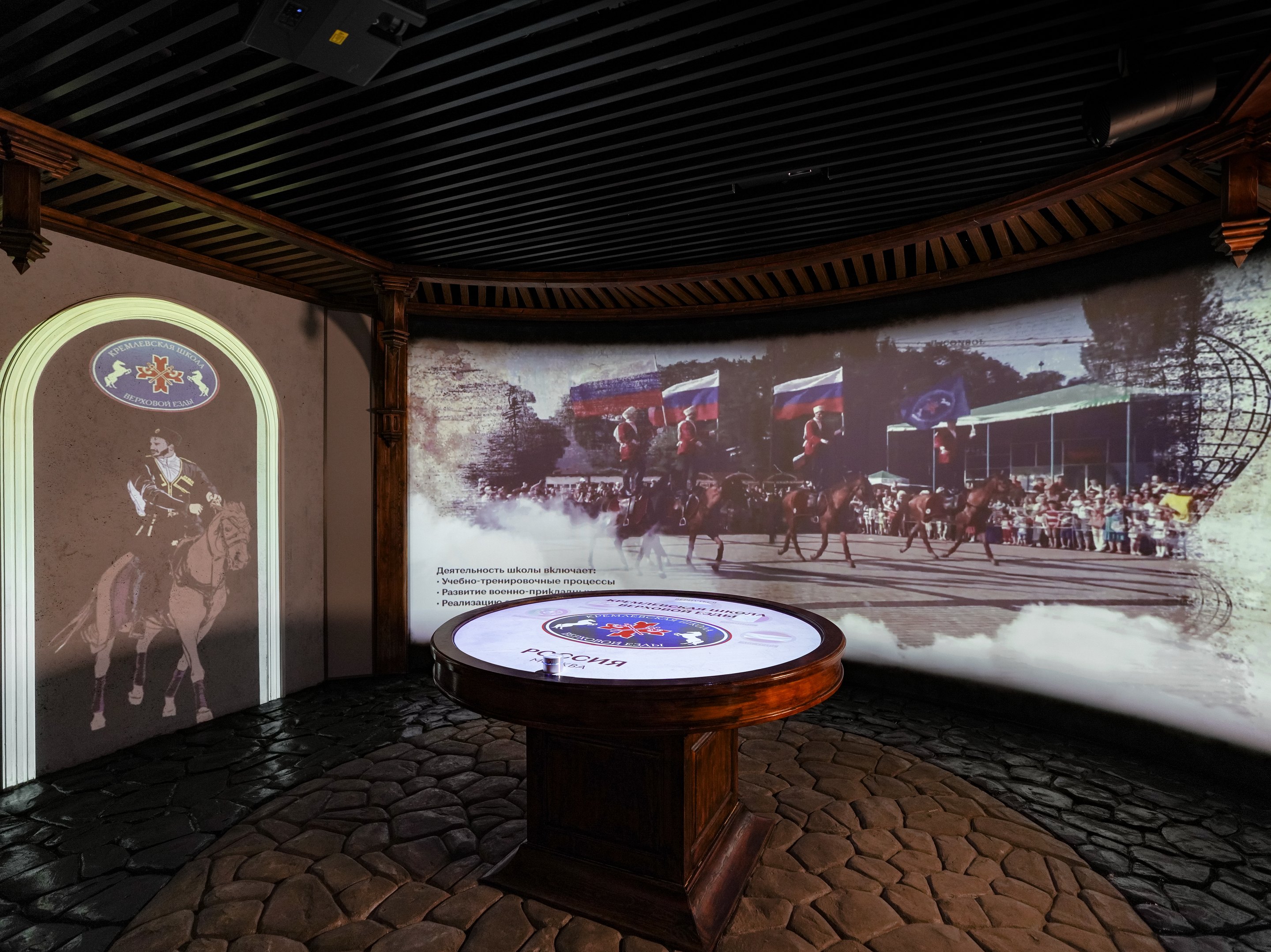
“World riding schools”: the projection about the Kremlin Riding School and the table with the model
Photo zone
The visitor starts the shoot on a console, sees themselves projected into a field next to a horse, the camera takes pictures, and a QR code appears on the screen for downloading the photo to a phone.
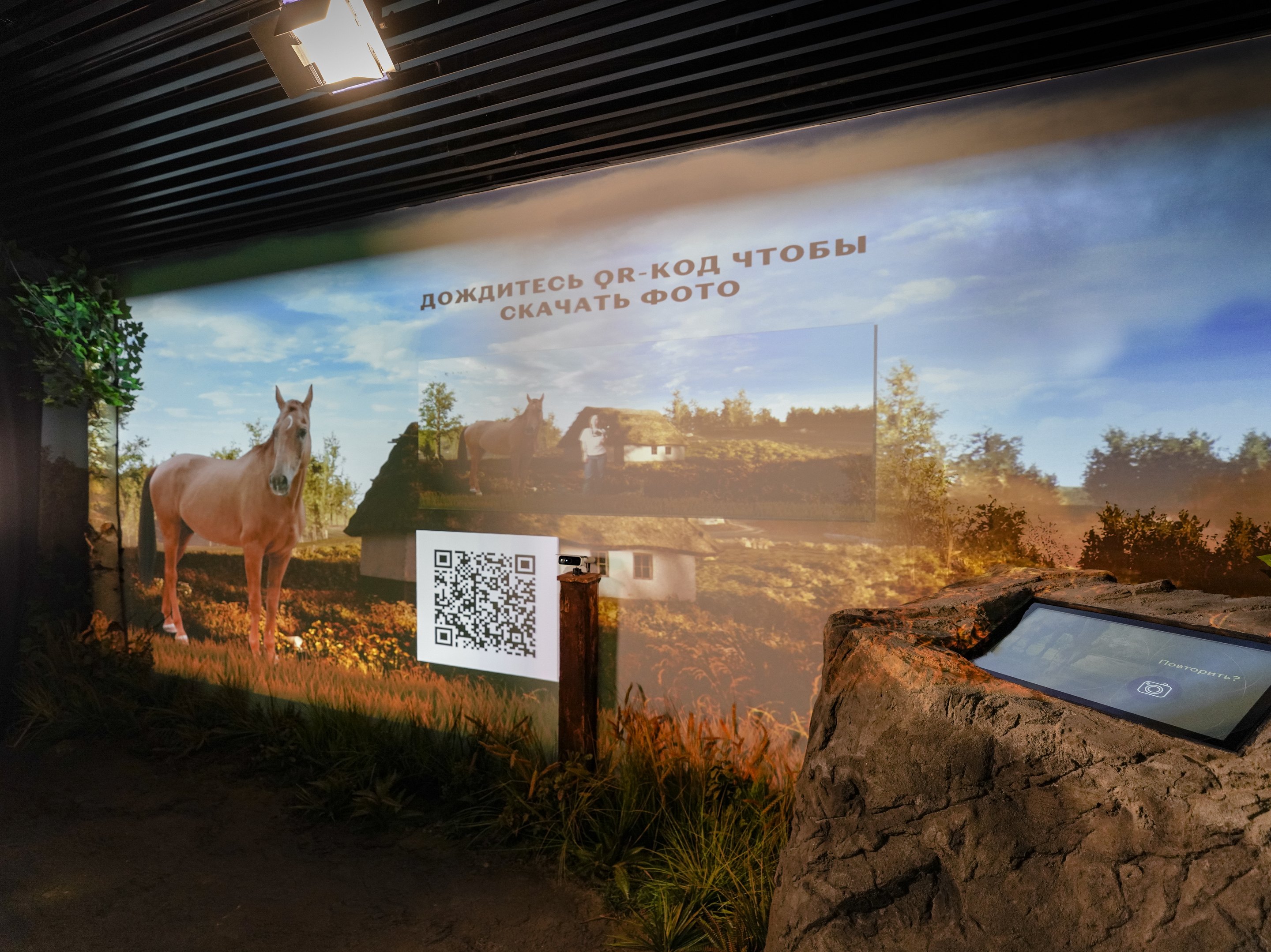
“Photo zone”: a projection of a field with a horse and a QR code for the photo
Reception
A screen with a map and a description of the museum’s zones. For the self-service ticket kiosk we did only the design.
How it is built
All applications get their materials through a shared API from the content management system and keep a local copy. We packaged the system — the database, the API and the staff interface — into a container and deployed it on a server.
The interactive features are tied to objects: RFID tags in the cups, a palm reader at the mirror, touch sensors in the workshop tools, a rotating model in the table, a camera in the photo zone.
The transparent touch screen in “Three breeds”: white on it is transparent, so the sculpture in the niche can be seen through the interface.
The language — Russian or English — is chosen with physical buttons on the stands and walls or in the touch-screen interface.
Result
The museum opened on 28 December 2022. In the first three weeks, up to 18 January 2023, 20 guided tours were given around the exhibition, and Pavilion No. 42 together with the Equestrian Theatre received more than 800 visitors (VDNKh, 20.01.2023).